I can’t say enough good about the work of Dan Stevers. I’ve used Dan’s videos in several of my presentations because we are on the same page—especially in the following video, God of the Broken.
God is truly God of the Broken. My novels and short stories revolve around this, too. Some of the characters don’t realize it at first. They refuse to see themselves as they really are. Others are shattered, or left behind, by someone they’ve loved. But then, as in life, something changes for them, or more specifically in them. Some of my characters, but not all of them, recognize an offer of healing. The recognition comes when GRACE is offered.
God’s grace is infinitely available. We only have to want it, to take advantage of it. We only have to trust in Him. We only have to turn around and see Him behind us, possibly in the face and actions of a caring human being that He’s called to help us.
Our lives will change then; maybe in ways we never imagined, or maybe in the way we’ve prayed for. Whatever–we will be transformed.
Can you think of a time in your life when you were so down, so miserable, that you couldn’t put one foot in front of the other? Grace is very present in these circumstances. Often, the time we encounter God’s grace is when our life hangs in the balance. Especially in our sins, God encounters us, offering us grace and mercy and redemption.
It is a ‘waiting’ grace, waiting for us to take it. Maybe we have to admit our weaknesses. Maybe we have to give up what is dragging us down. Maybe we need to dig deeper for courage, or patience with others, or let go of our anger, or forgive another. Or unfortunately, maybe we just ignore its presence.
But we should never imagine that God is not present. Instead, we should imagine ourselves reaching out to Him, to realize that being broken at a given moment does not mean being broken forever.
And it is, after all, up to us.
Because we are all broken people yearning to be whole, and that wholeness is within our reach.
When a child is born to us, we may look at him or her and say, “Oh, she’s just like her mother,” or “He’s the spitting image of his father.” But as our child grows we see likenesses in more than just appearance, because a child will imitate the parents in actions, too–the reason parents play such an important role in their child’s life.
What are we handing down to our children?
Are we handing down honesty? Do we show them that we value ourselves and others? Do we give them an example of working for something we want, or only that we deserve to be given something we want? Have we taught them that God created them, that He exists and loves them?
Our children are watching and listening.
But they are not only listening to us. The world is smaller, now, with social media. They can listen to anybody, anywhere, with no moral sense. Are we paying attention to that? Or do we even care whether our children have morals?
Twenty years ago, David Elkind, a professor emeritus of Child Development at Tufts University, and formerly professor of Psychology, Psychiatry and Education at the University of Rochester, warned about this:
Up until mid-century, most young people died from polio, tuberculosis—from disease. Fortunately, medical science conquered these illnesses, but today we lose as many young people through stress-related causes as we once lost through disease. We lose 10,000 youngsters a year in substance abuse-related automobile accidents. We lose 5,000 kids a year in suicide. We have two million alcoholic teenagers. All of these are stress-related problems arising from the fact that in our society the needs of children and youth are simply weighted less heavily than the needs of adults. A few decades ago, women consumed millions of pounds of tranquilizers because their needs were not being met. Today children and adolescents are reacting to stress in equally self-destructive ways.
If we really want to attack this problem, we can’t just talk about drug and sex education. They are important, but we have to talk about how we can better meet the needs of children and youth. Their needs for love and care and adult supervision and guidance. Their need for more space for activities. More age-appropriate curricula. More sense that they are important in their parents lives and in the life of society.
I was watching a documentary program last night. The reporters were asking a group of kids about stealing and lying. These kids had no strong moral sense about doing these things. They didn’t worry about whether the person would be hurt or damaged by taking something from them. It’s not true for all of our children, but I think that to the extent we don’t really care about kids, kids are not going to care about other people.
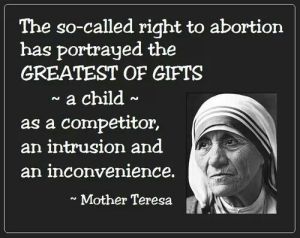
Now, twenty years later, many young people don’t care about other people, but only about themselves as evidenced by bullying, stealing from, and even violently harming others. Have we handed down this selfish attitude? It is surely a fact that in our society today, the needs of children and youth are weighted less heavily than the needs of adults. Think abortion, and the horrific selling of baby parts by Planned Parenthood.
I’m all for certain rights for women, but I shudder to think of what the next twenty years will bring if we don’t come to the conclusion that our children–created by God–are immeasurably valuable, and worth more than just a little of our precious time.
God so loved the world that he gave his only-begotten Son,
so that everyone who believes in him might not perish
but might have eternal life.
For God did not send his Son into the world to condemn the world,
but that the world might be saved through him.
Whoever believes in him will not be condemned,
but whoever does not believe has already been condemned,
because he has not believed in the name of the only-begotten Son of God.
And this is the verdict,
that the light came into the world,
but people preferred darkness to light,
because their works were evil.
For everyone who does wicked things hates the light
and does not come toward the light,
so that his works might not be exposed.
But whoever lives the truth comes to the light,
so that his works may be clearly seen as done in God.
One fourth of the world’s population is between 10 and 24 years of age. The New York Times calls it the Youth Bulge, and goes on to say that. “At no point in recorded history has our world been so demographically lopsided.”
But we’re not only demographically lopsided, we’re becoming lopsided in our considerations of what is actually true and decidedly false.
The fact is 17% of people between 16-29 years of age are neither in school or employed, so one can imagine that they’re not reading, or studying, and probably not happy either.
These young people are our future, and the future of the country Americans fought so hard to have, yet many of them seem stuck to social media, taking delight in putting down the country that–so far–allows them to be free.
Recently, I’ve watched two very instructive, and entertaining, Revolutionary War series. One is John Adams, about the life of the second president of the United States. The other is Turn, about the changing sympathies of certain Americans toward England during the revolution. One cannot watch these without realizing the debt of gratitude each of us owes to the men and women who fought for our freedom.
But today, not only the young people without jobs or ambition, but their parents as well, have come far away from what those Revolutionary Patriots fought for. If any one of those involved in the making of America could come back and take a look a some of our legislation, I believe they would think we have collectively lost our minds.
In this political season, we must vote to make America great again. We must restore our basic good sense and the values that made us great. The flag at the top, The Tree Flag (or Appeal to Heaven Flag) was one of the flags used during the American Revolution. The flag was commissioned under George Washington’s authority as commander in chief of the Continental Army in October 1775.
The American Revolution, the Declaration of Independence, and the Bill of Rights, are not just stories somebody made up. Real people fought, thought, and brought freedom and greatness to us, and now, all that is threatened by politically correct words used to gain votes from some and to throw the rest of us off balance. We need to again to show the true story of our country, beginning with November’s election.
It is a fact that our lives as human beings sometimes become broken.
But how do some people remain unbroken even when awful things happen to them?
What is it that keeps a person going–when he/she’s gone under financially, or been diagnosed with a sickness that saps all strength, or when a child is lost, or when they’ve been betrayed by someone they love, or even when they, themselves, have made egregious, personal errors?
Is it our physical or sensual strength?
Animals have also been given strength, and the ability to see, make sounds, feel, taste, and hear. But animals cannot make a conscious, mental decision by way of free will, memory, or imagination.
Animals have not been given access to immateriality—things that are not achieved only by the senses. Animals cannot solve a mathematical problem, create music or art, run a business, decide to forgive or not to forgive, or make any life-changing, moral decision, because an Animal cannot decide what is good and what is evil.
Nothing in the physical world outside of us will keep a human being from breaking in difficult situations. It’s the spiritual world within us that will give us the strength to endure and overcome. And every human being has access to it. In fact without it, we would not be human.
Remaining unbroken is possible because human beings are made in God’s likeness.
If a child is brought up knowing that he or she is a child of God, possesses His divinity, and actually participates in it, then the child is less likely to succumb to brokenness and suffering in his adult life.
The human person participates in the light and power of the divine Spirit. By his reason, he is capable of understanding the order of things established by the Creator.
By free will, he is capable of directing himself toward his true good. He finds his perfection “in seeking and loving what is true and good.”
By virtue of his soul and his spiritual powers of intellect and will, man is endowed with freedom, an “outstanding” manifestation of the divine image.
By his reason, man recognizes the voice of God which urges him “to do what is good and avoid what is evil. –Catechism of the Catholic Church
We can’t expect other people to take away our brokenness. We can look only to ourselves, to the spirit of God who lives within us.
Certain people are natural fixers—people who can fix anything, a broken drawer, a leaky radiator, a downed computer. Anything. Except themselves.
These are people who have lost a child, or a spouse, or a parent. These are the people who have been fired from a job, or told they have cancer or some other disease. These are the people who go to fight wars and lose legs and arms, and more. These are the people who must care for someone with dementia, or have it themselves.
Sometimes these are people who sense nothing wrong with themselves, until catastrophe shakes their lives and they’re knocked to their knees. They look up and wonder what happened. They look for the screwdriver, or the hammer and nails. But the situation they’re in can’t be fixed with those sorts of tools.
These are people who need tools for their soul.
These are the people with every sort of addiction they can’t get rid of. These are the people who think one lie won’t matter–they’ll never get caught. These are the people who salivate over someone else’s good fortune to the point of jealously that spins out of control.
These are the people who con others out of what is rightfully theirs. These are the people who cheat, murder, sell drugs to children for money to buy a pair of expensive shoes. These are the people with vendettas against those who have hurt them.
These are the people who kill, or abuse their own children, or terrifically wound them with poisonous words and language. These are the people in fat positions who climb up the ladder on the slender backs of others.
These are people who do good, and people who do evil. They are us.
We are, all of us, imperfect people in an imperfect world. Our individual problems and vices abound.
Thankfully, within each of us there are also virtues. The virtues of faith and hope and love. These are the spiritual tools we have been given by our Creator. Use them, and we make our souls shine like new.
The Lordis my shepherd; I shall not want. He makes me to lie down in green pastures; He leads me beside the still waters. He restores my soul… -Psalm 23: 1-3
On Earth, we don’t have the fullness of Heaven, where all is perfect and God’s presence is enjoyed eternally. But when we pray that God’s kingdom will come on earth (as in the Lord’s Prayer) we want our devotion and our service to God to show that He is present, here, in some way. We do this by loving and caring for the people He created; all people, made in His image and likeness.
We can choose not to do this. We can choose to hate, or disrupt, or bring others down. We can choose not to see their connection to the God who made them, and us—-
But—-This does not mean we should be blindly tolerant. This does not mean that we go along with everything.
At times, it means that we are called to rock the boat. At times, we are called to be irate enough to ‘overturn the tables in the temple’ as Jesus did to the moneychangers.
And I think TODAY is one of those times.
I believe our country, our once-respected and great America, is being threatened from within, as well as from without.
If you read this blog, you know I’m a fan of Aesop’s fables. Here is another: The Swallow and the Other Birds
It happened that a Countryman was sowing some hemp seeds in a field where a Swallow and some other birds were hopping about picking up their food. “Beware of that man,” quoth the Swallow. “Why, what is he doing?” said the others. “That is hemp seed he is sowing; be careful to pick up every one of the seeds, or else you will repent it.” The birds paid no heed to the Swallow’s words, and by and by the hemp grew up and was made into cord, and of the cords nets were made, and many a bird that had despised the Swallow’s advice was caught in nets made out of that very hemp.
What did I tell you? said the Swallow. “Destroy the seed of evil, or it will grow up to your ruin. “
Are we headed to a place of ruin? We find it so easy to go along with the crowd—and we find it so hard to stand up against what we know isn’t right. And often we throw up our hands and give up on something, or someone—a child, a friend, a co-worker, even a spouse.
Today, I ask: Have we given up on America? Have we become tired or indifferent to what our country was supposed to be, but is no longer? What can we do about it?
Of course, the first answer is prayer. But we should expect that our prayer will lead God to call for our personal action. When we pray that God’s Kingdom will come on earth—who will bring it if not us? We are, after all, God’s hands, heart, eyes, and feet on Earth.
The call we discover through prayer will be different for each of us. It may be a tiny call by God. It may be a significant one. But small or large, if we don’t act on it, nothing will change for the better.
And so, I ask: Does the re-constructed path we’re presently allowing in America resemble God’s Kingdom on Earth? If not, then in prayer, each one of us should listen carefully to what we ought to do to make our country great again.
None of us like controlling people. None of us like to be under the thumb of another, with their weighty opinions imposed upon us. None of us like to be ridiculed for what we believe, and forced to do what we don’t believe.
And we shouldn’t have to put up with it. We live in a country founded on our personal freedoms. We are not told what to do by some king and his council–are we?
Well. . .hmmmm. Let’s take a look at controlling people
Controlling people are self-centered and immature. They think they are bigger than they are. They don’t like your independence, only theirs, so they’re likely to make sure you don’t rule yourself.
How? They take away your choices, usually through manipulative propaganda, and if that doesn’t work as well as they would like, they enforce laws through some kingly, or executive, power they perceive they have been given.
But . . . . to take away a man’s freedom of choice, even his freedom to make the wrong choice, is to manipulate him as though he were a puppet and not a person.” — Madeleine L’Engle
We are not puppets in our personal relationships. Neither are we puppets to be used by those in control of our government. Yet, we are. And people are angry.
Not only at our president, but political parties. As controllers, they are also self-centered and immature, believing they are bigger than they are. Besides that, they may be too filled with avarice and pride to use typical common sense. Their words are used to tickle ears, to get the vote. But are they sincere? Or are they only using huge segments of the population to get what they want for themselves.
For the time will come when they will not endure sound doctrine; but wanting to have their ears tickled, they will accumulate for themselves teachers in accordance to their own desires.–2 Timothy 4:3
We need people, rich or poor, with guts and gumption enough to stand up for the sound doctrine on which our nation was built. Because the major issues we face today have not been soundly dealt with.
Now, it is our turn to decide. We can restore America. We can get rid of the pompous King Kongs already in our lives, and in our government who say one thing to secure a vote from others, but do something entirely different for themselves.
Nobody crowned them Kings, or Queens, of anything.
Of all the places I’ve been to speak about my writing and my books, Andalusia Farm would be one of my favorites. It’s where I launched Birds of a Feather. Here’s the memory of that, first posted by Andalusia Farm, home of Flannery O’Connor. On May 6, I will be posting again on their blog. Look for it here: http://www.andalusiafarm.blogspot.com/
IN FLANNERY’S HOUSE
Many of my ardent admirers would be roundly shocked and disturbed if they realized that everything I believe is thoroughly moral, thoroughly Catholic, and that it is these beliefs that give my work its chief characteristics. ~Flannery O’Connor
. . .
When my first novel, A Hunger in the Heart, was published in 2013, I’d been a writer for many years, and a huge admirer of Flannery O’Connor. And then a couple of weeks ago, on the morning of June 26, fellow author Charles Mc Nair and I entered Flannery’s house to talk about the perspectives in our own work. Charles took on Southern Fiction, fiction in general, and magical realism in his novels: Land O Goshen and Pickett’s Charge. My talk concerned Catholic Fiction, Catholic Imagination, and the influence of Flannery O’Connor on my writing. My aim was to also launch a second book, my new short story collection, Birds of a Feather—to launch it in a place that is clearly sacred to many, including those present for our event, some who traveled long distances to be there.
As for myself, I felt at home at once, almost kin. Kin because Flannery O’Connor and I share two legacies: Southern born and bred, and Catholic born and bred. From what is read in her work and in her many letters, it can be pretty well assumed that these two mindsets influenced her so much that they were all-encompassing. She could not write without communicating them, or her convictions about them. And neither can I.
For writers concerned with sin and salvation, the South is ripe for fiction. Most all native Southerners, the greatest percent Protestant, know the Bible, can quote the Bible, and try to live by the Bible. And most of them admit they are sinners in need of being saved. I don’t think you’ll find that anywhere else to such a degree. Like O’Connor, I know who I am as a writer, and I don’t try to be different from that. I’ve never lived, or wanted to live, anywhere but the South. And I’ve never wanted to be anything but a Catholic, despite that all the men in my family–my father, grandfather, and four uncles, were Southern and Protestant. Nearly all of those men married Southern women who were Catholics, then they, themselves, converted to Catholicism near the end of their lives. So I believe I understand–and I know I try to address—-all readers, whatever their faith, or lack of it.
The stories in my collection, Birds of a Feather, are about the commonality each of us share as human beings: sin and its risk, and the presence of God’s mercy, waiting for us to realize it’s there, and then to act with it. It’s my opinion that this common identity is key to the Catholic writer and his or her imagination.
Here’s what Flannery says about identity, from Mystery and Manners:
“…An identity is not to be found on the surface; it is not accessible to the poll taker; it is not something that can become a cliché. It is not made from the mean average or from the typical, but from the hidden and often the most extreme. It is not made from what passes, but from those qualities that endure regardless of what passes, because they are related to the Truth. It lies very deep. In its entirety, it is known only to God, but of those who look for it, none gets so close as the artist.”
So, as a Southern writer, I have taken Flannery’s words to heart. My identity is wrapped in the wonderfully changeable, material world around me—the world I live in—but as a Catholic writer, my identity is also wrapped in the mystery of mercy and grace in the immaterial world that lies deeply behind this one—because that is the world that is unchangeable and enduring.
Enjoy this article by Roxane Beauclair Salonen who attended our event at Andalusia Farm.
– Kaye Park Hinckley, Author
Kaye Park Hinckley writes Southern Fiction from a Catholic Perspective. Her debut novel, A Hunger in the Heart, about sin and salvation in a family, was published in April, 2013, by Tuscany Press. Her short stories have appeared in Dappled Things, the 2012 Tuscany Prize for Catholic Fiction anthology, and elsewhere. She and her husband live in Dothan, Alabama and have five children and ten grandchildren. Her website is http://www.kayeparkhinckley.com and her blog site is http://www.aworldontheedge.com. Kaye’s short collection, Birds of a Feather, was published by Wiseblood Books. Both books are available on Amazon, from the publishers, or your favorite bookstore.
This video, A Good Man is Hard to Find, is actually read by Flannery O’Connor. Notice the audience laughter in the beginning, and the lack of it by the end.
Fine-tuning means to adjust precisely so as to bring to the highest level of performance or effectiveness, such as to fine-tune a TV set, or to fine-tune the format for a meeting.
Fine-tuning is the fixing of a problem.
Shouldn’t we fine-tune our life on Earth, too?
We only have one life. And it will not last forever. Shouldn’t we try to create the highest level of performance for ourselves in the time that we have?
In order to do this, we need a criteria for a high level of performance. So what/whose criteria do we use to see if we’re on the right track?
Well, our criteria MUST be a valid one. It must be TRUTH.
Some people say that everything is true depending on the situation. Well, pardon me but that just isn’t…. true.
Some things are based on relative truths because they are determined by the likes of individuals–I like turnip greens; you do not. Except a relative truth can change; tomorrow you may develop a like for turnip greens.
So relative truths cannot be the criteria for fine-tuning our lives. The criteria we need to do that must be absolutely true. These are truths that do not change according to our likes. Two plus two equals four. The equation is always true. Two plus two can never equal five.
In an ordered world, which ours was created to be, we need absolute truth to keep it ordered.
Order in the universe is proclaimed every time the revolution of the earth about its axis causes the phenomena of day and night. Order is manifested by the earth’s travels in its annual circuit around the sun, with that journey causing seasons of summer autumn winter spring, and those seasons causing the accompanying phenomena of growth, decline, decay , and regeneration. The miracle of photosynthesis, the insect world, and the animal world, with each specimen instinctively knowing what it particularly takes to survive; all amazingly ordered. And all truth.
Then there are men and women.
The development of an embryo, and before that, the organs of reproduction in male and female, are created perfectly, one for the other. And nothing is more orderly than an individual cell, or an organ such as the heart, or the eyes and ears that record sight and sound?
But men and women, are ordered with an additional, absolute Truth.
Each one of us meant for the absolute truth of all that makes us Human. What makes us human?—Our spiritual side. Our empathy toward others, our mercy, our ability to love. But we also have free will to choose none of that. We can personally disorder our own life by choosing the opposite; a lack of empathy, no mercy, and hatred rather than love.
The good thing is we also have the capability to turn all that around. We can stop, look, and listen.
We can fine-tune ourselves by considering again–the absolute truth of God.






 Translating a World on the Edge