10547268_879692692045782_1839296699511975566_o

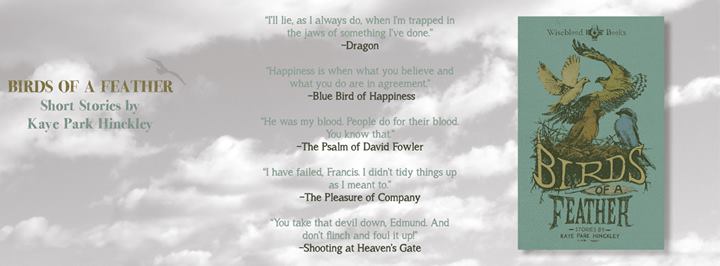
The ten stories in Birds of a Feather are now launched and flying!  And I’m flying with them—to the last mile.  I hope both people of faith and people who have no faith will enjoy reading them, and when they’ve finished the last page and close the book, that something of these stories will stay with them.

Some Praise:

The first story in this collection sits a reader bolt upright. Two stories in, you marvel at this storyteller, who sends us flying over new country, a landscape of modern parables where faith runs river-deep. Kaye Park Hinckley seems to overflow with beautiful, heartbreaking love and lessons. A world with broken wings can surely make use of such stories.
—Charles McNair, author of Pickett’s Charge and Land O’Goshen

“With masterful control and skillful writing, Kaye Park Hinckley boldly explores a wide range of wounded souls in this amazing collection of stories, ultimately finding love in the unloveable, and grace in the sufferings of a complex world.”
—Cassandra King, author of The Sunday Wife

Kaye Hinckley writes deeply textured stories with a distinctive voice.  Characters caught up in complex relationships, against the background of a fraying South, seeking yet often rejecting redemption. Sin as thick as grits and gravy pervades her stories…and Salvations lurks coyly, always just out of sight – it flitters through the pages like the birds who flitter through her stories. This is a wonderful volume, and I recommend it to all who contemplate our human condition.
–Arthur Powers, A Hero For The People, and The Book of Jotham

http://www.amazon.com/Birds-Feather-Kaye-Park-Hinckley/dp/069223473X/ref=sr_1_3?s=books&ie=UTF8&qid=1405273546&sr=1-3&keywords=kaye+park+Hinckley

OR

http://www.wisebloodbooks.com/kaye-park-hinckley.html

Or your favorite bookstore.

speech-bubblesA human characteristic is the ability to speak, to converse, to give instruction, to make our opinions known. We talk. We use our tongues–sometimes without thinking, and sometimes very intentionally.

Our speech is directed to another, a listener. The listener may be a child, a friend, a family member, or a stranger in the grocery store. Regardless of who or where, what we say to each other matters. Speech is a gift to be used with care. I would suggest loving care, though I’m often guilty of overlooking that.

Matthew 12:36 says, “But I tell you that every careless word that people speak, they shall give an accounting for it in the day of judgment. For by your words you will be justified, and by your words you will be condemned.”

Wow! That’s a lot of personal responsibility.

Yet what we say to each other is not always done with words. Often it’s what we D0 that speaks loudest. How do our actions speak to our vulnerable children, or the friends and family who learn from us? Are we responsible in our actions as parents and teachers, leaders and co-workers? Do we practice what we preach? Again, many of us often fall far short of that. It’s a good thing we have personal control over what we do, and if needed, the ability to correct ourselves.

There are times though, when we’re not the ‘speakers’ or the ‘doers,’ but the receivers, the targets of speech and action. Over this, we have less control, and no doubt the voices and actions are loud–the media, movies, TV, newspapers, books, and even our own government.

Except each of these voices are made up of individuals like us. Are these individuals any less responsible than us for what they say or do? Don’t they, too, have the ability to correct themselves–or have greed and power simply struck them dumb and immobile?

And for our part—do we listen to them as if they rule us, as if they rule the world? Do we obey when ‘they say’ don’t talk back?  Or do we use our own judgment as to what we’ll allow to take root inside our  minds, and use personal courage–and responsibility– to express it?

The Restorers

Posted: July 10, 2014 in World On The Edge

file0001038191191You know them. You’ve probably welcomed them into in your home: the painters, floorers, plumbers, electricians—all those who help to keep up the house in which you live.

Some of us try to do these tasks ourselves, and some of us know better than to try.  So, we call in the Restorers. Because we want order. Because we want things to work as they were made to work–and because we know what happens if we let it all go.

When the refrigerator goes out, the food goes bad. When the toilets stop up, the bathroom floods, and maybe even ruins the floors. When sparks come from an electrical socket,  fire is a definite possibility. No one can deny that these  problems need attention. No one can deny that to ignore them is foolhardy, even irresponsible. We must use our heads and solve the problem in our house.

But don’t we have another house for which We The People are responsible? And don’t we call her The United States of America? It’s my opinion, she’s in a problematic, even deadlocked, situation, especially when it comes to our ever-degrading culture. Many feel this deeply, and are attempting to right the wrongs. But most of us only comment and move on to something more pleasurable. We are not Restorers. Instead, we are letting our cultural problems go without doing much to fix them. In fact, some even believe our Country’s too far gone to fix at all. I don’t share that opinion.

When my children were little and complaining about a problem and how they couldn’t fix it. I usually sang them a few verses from the following children’s song about using commonsense. It makes a good point about those who are problem-solvers, and those who are not.

You’ll see the progression: Henry’s whining about all the reasons why fixing his problem with the bucket can’t be done, while Liza offers suggestion after suggestion as to how it can be done.

kph52013's avatarTranslating a World on the Edge

walk while ye have lightWe Christians are in need of a spiritual awakening. We are dulled to our own lives as children of God. We are blunted to examining the actions of our lives in that context. Have we lost our religion, big time?

Catholic historian Christopher Dawson, (1889-1970), an Englishman who strongly believed in the importance of religion’s influence on society, wrote: “A society which has lost its religion becomes sooner or later a society which has lost its culture.”

Look at our culture today. Read about it in the news. We, as human beings, are on front pages and prominent media screens, with scandal after political scandal, murder after gruesome murder–including well over 50 million aborted children since Roe v Wade. Seventy four per cent of students admit to cheating. Premarital and extramarital sex have nearly become the norm. http://realtruth.org/articles/130530-005.html

And still, most people believe in God or in a higher power.

View original post 147 more words

The Cove Hotel

Posted: July 3, 2014 in World On The Edge

c018036

Once a month, when I was about thirteen years old, I used to accompany a friend to The Cove Hotel in Panama City, Florida, where her father did the books for the elderly lady who owned the hotel. But even then, The Cove was older than she was. Built in 1926, it was two stories of pink stucco, surrounded by huge trees, and set on the shore of St, Andrews Bay off the Gulf of Mexico. I thought it was beautiful.

For my trips to the Cove, my mother made sure I took the proper clothing. That meant a dress for dinner, along with the right shoes. Usually, that was a sun dress and strappy white sandals. Dinner was served at a certain time, on spotless white tablecloths, with starched white napkins and a lot of heavy silverware, properly set. My friend and I felt like princesses. But always, there was something we looked forward to that was even better. The Miracle. And we could make it happen ourselves.

After dinner, we walked down to the bay, tossed our sandals on the sand, tucked up our pretty dresses, and walked calf-high in the dark water. With each movement, bursts of light, like stars, surrounded us. Light out of darkness. Our Miracle. Our Gift.

In my novel, A Hunger in the Heart, Coleman is shown the same gift by his father, when he thrusts a hand into dark water. There, it’s a symbol of hope in the middle of heartbreak. But for many years, I knew nothing of serious heartbreak.

Later on, at twice the age I was then, I faced heartbreak for the first time. One of my children was diagnosed with a malignant brain tumor. She was five years old. The word, heartbreak, could not come close to what I felt. I didn’t know how to deal with such a dark situation—and it did seem so dark!

For years, our entire family struggled valiantly with a situation we could not control. And it made us stronger. Then, one evening, in intensive care, I was holding her hand after her third operation, and the doctor came in to give an assessment of the tumor. He said he thought they’d finally ‘gotten it all.’ Talk about the opposite of heartbreak! I was filled with JOY. We had been in the dark water and now were surrounded with stars.

Only later, did I remember the Cove Hotel and the miracle I found within the dark water of the Bay.

But isn’t this the way life is? When we look back, haven’t the hard times made us stronger? Didn’t we cling to the hope that things would get better? This is why a writer of Catholic fiction can say that God is now, and always will be, present in our world. He is our Hope—in times of sorrow and tragedy, as well as in times of happiness and joy.


Freedom is a BIG word

Posted: July 2, 2014 in World On The Edge

long black train Because this is the week of the Fourth, I’m going to re-blog a few popular posts, so here goes:

Freedom is a big word. A weighty word. A lengthy word. The locomotive of Freedom is championed by words, like Liberty and Independence. But the locomotive’s steam is often the lack of any restriction or inhibition.

The train of Freedom runs two ways, and on conflicting tracks. One is a track of lies, the other a track of truth.

Before you buy a ticket on one train or the other, there are questions to ask: Where does it come from? Where is it going? And most especially, who is its engineer?

The lying train of Freedom can be very long and black. It can come from jumbled and defective thinking. It can take us to foolishness and death. And its engineer can be a faulty entity of propaganda.

Do we really have the freedom to kill innocent babies? The engineers of society and our government say we can.

Do we honestly have the freedom to forget our marriage vow, or steal another person’s wife or husband, or to have sex with whomever we want? The engineers of Hollywood say we can.

Do we truthfully have the freedom to knock ourselves out with dope at the expense of the life of our family and our own life as well? The enormous drug trade says we can.

Who is your engineer? Who is driving your Freedom train? We do have a choice. On which train will you buy a ticket?

For you were called for freedom, brothers and sisters.
But do not use this freedom as an opportunity for the flesh;
rather, serve one another through love. For the whole law is fulfilled in one statement, namely, You shall love your neighbor as yourself. But if you go on biting and devouring one another, beware that you are not consumed by one another.–Gal 5:1 13-18

Be Someone?

Posted: June 30, 2014 in World On The Edge

file000475070896Young people are often asked, “What do you want to be when you grow up?” Many answer with a plan to follow in the footsteps of a person who is well-known –a popular singer or musician, a sports hero, a movie star, etc. As a general rule, when we’re young we say we want to Be Someone. Many times that means Someone Famous. These are the dreams of children, but often a child’s dream doesn’t come true.

These unattained dreams are what Robert Burns refers to in this line from his poem “To a Mouse:” “The best laid schemes o’ mice an’ men / Gang aft agley.” (The best laid schemes of mice and men / Often go awry.)

We can’t control everything in our lives, or everything about who we are, much as we’d like to think so. There is no fast car to take us to our dream–no free ride. But there is also no certainty that even if we have the talent, even if we put in the work, that we will obtain our dream of notoriety. There are many singers, musicians, athletes, and actors who are as talented and hard-working, or even more talented and hard-working, that those ones who actually become famous. So why don’t those talented people ‘make it?’

Let’s consider that ‘making it’ may not the reason God gives us talents. His plan is not one of ‘Mice and Men.’ It is far more reaching and complicated than that. We are advised by scripture to use our talents, not hide them; but that doesn’t mean God is ready with a contract in hand for a movie deal, a hit recording, or a football championship. God does not give us talents for our personal notoriety, though some may attain personal fame. But our talents–those things we love to do, or feel called to do–are given to us as personal expressions and as joyful gifts for reaching out to others.

What is Joy?

Posted: June 27, 2014 in World On The Edge

images (7)“When he awakens to the world, does not man feel, in addition to the natural desire to understand and take possession of it, the desire to find within it his fulfillment and happiness?

As everyone knows, there are several degrees of this “happiness.” Its most noble expression is joy, or “happiness” in the strict sense, when man, on the level of his higher faculties, finds his peace and satisfaction in the possession of a known and loved good. Thus, man experiences joy when he finds himself in harmony with nature, and especially in the encounter, sharing and communion with other people.

All the more does he know spiritual joy or happiness when his spirit enters into possession of God, known and loved as the supreme and immutable good. Poets, artists, thinkers, but also ordinary men and women, simply disposed to a certain inner light, have been able and still are able, in the times before Christ and in our own time and among us, to experience something of the joy of God.” — Pope Francis,  Evangelii Gaudium (The Joy of the Gospel) 

“This is the true joy in life…being used for a purpose recognized by yourself as a mighty one… being a force of Nature instead of a feverish selfish little clod of ailments and grievances complaining that the world will not devote itself to making you happy.” — George Bernard Shaw

“Joy is our goal, our destiny.  We cannot know who we are except in Joy.  Not knowing Joy, we do not know ourselves.”– Marianne Williamson

“The beating heart of the universe is holy joy.” —Martin Buber

“Joy is the flag you fly when the Prince of Peace  is in residence within your heart.”– Wilfred Peterson 

“Weeping may endure for a night, but joy cometh in the morning.” — Psalm 30:

Passing it Down?

Posted: June 25, 2014 in World On The Edge

file4771280701846

On my kitchen counter is a stone bowl on a stem–a fruit and vegetable compote that once belonged to my mother, and her mother before her. In it, I keep bananas and tomatoes, same as my mother did.

Some of the tomatoes are still green when I put them in the bowl, but that’s okay because the bananas have a way of ripening them. My mother likened it to friendship and love. “One ripens first and then helps the other along.”

file4661328230562

And like her, I cannot waste the uneaten bananas. I simply cannot bring myself to discard a banana only because it’s past its prime for peeling and eating. I have to make something else out of it. Banana nut bread, muffins, cake—something!

Naturally, my children always liked this family quirk, when an aging fruit they might have discarded is changed into something fresh, new–and edible. (more…)

Do You Flit?

Posted: June 24, 2014 in World On The Edge

file000429279301Are you an ant, or a butterfly?

Are you self-motivated enough to finish what you start? Or do you flit from one thing to another?

Sometimes we have a great plan, with great goals and values. But when the plan doesn’t achieve immediate success, we jump quickly into something else.

We flit, like a butterfly, dipping from flower to flower. Maybe we do this out of fear of failure, or financial pressure, or some other distraction–but we do it. And we do it too frequently.

Butterflies are beautiful, but in their days as a caterpillar they can eat through a garden. You’ve heard of The Hungry Caterpillar?

The tiny ant can teach us self-motivation. Ants get organized. They stay focused. They see their plan through to a completed anthill. (Unless someone comes with ant-killer!) And in the end, working together, they have created something good—not only for themselves, but for their cohorts.

So, I’m going to stay a little bit longer with what I’m doing. I’m going to ignore the beauty of the butterfly and concentrate on the ant. I’m not going to fold up my chair and leave the hall. I might miss the music of something really grand. I’m going to stay with it, and stay alive!