I am going to a funeral today, a Mass of Christian Burial. I am going to celebrate a life lived in a marriage that lasted over seven decades.
I am going to share in the rhythm of Mass, its recitation of prayers and rituals that echo back through the years to a little white church made of bricks, much smaller, much closer than today.
I am going with memories sliding through my thoughts like the moon passing behind the branches of pines.
I am going to a burial ground that is sacred, a spot where those who have gone before us, marked with the sign of faith, await resurrection.
I am going to a hill where I’ll step near my own parents, grandparents, other relatives and friends.
I am going to the inevitable closing of life on earth to the opening of life everlasting.
In the life of each of us, there are a few people we can count on. For some of us it’s our spouse, or children. For others it’s a good friend.
What is it that causes us to set those people apart from others?
Is it that we are certain they have our best interests at heart? That at a given time, they put us ahead of their own self-interests?
Some people are users; they like us because they need something from us. Mostly, we’re able to see that, but sometimes, not. Sometimes, we’re fooled—and often disappointed.
Turn it around. Do we hang around some people only because we need/want something from them?
This is a test of character. Character that is, or isn’t, LOVE in action. Because we all know that LOVE means action, not words. There are people who can “tickle our ears” with what they think we want to hear; but they are not people who will stand by us, regardless. Let the first wind come–a wind that requires them to step forward and actually stand up for us–and they are nowhere to be seen.
Most people believe in angels, and that God created them, but many don’t believe in the devil. Yet the devil was created by God before God created Man.
Frankly, especially today, I don’t see how it’s possible not to believe in the devil, who is evil itself. We don’t have to go to the Middle East to find Satan in action—because he’s certainly here, too—-but what is happening there surely points a finger at personified evil. Consider the recent beheadings of Americans, the crucifixion of Christian children and the burning out of their eyes, the raping of women, burying people alive, destroying their homes, stealing, torturing, defaming, and on and on!
Be sober and vigilant. Your opponent the devil is prowling around like a roaring lion looking for someone to devour. Resist him, steadfast in faith, knowing that your fellow believers throughout the world undergo the same sufferings.– 1 Peter, Chapter 5:5-9
The devil hates goodness, and goodness is all about God.
So, what is the nature of Satan’s game?
The devil attacks us in our complacencies, where we are, through what we love. And sometimes the devil has a very attractive face–one that’s hard to resist. He lures us by our addictions, the things we think most about, the things we’ve tied ourselves to. He yanks on the chain of those addictions, leading us further and further away from what is good, to what is evil–until we become his devoted ‘pet.’ Then he’s got us just where he wants us.
No, we don’t want to hear this. We say, “Look, I am who I am, and who I am is okay.”
Well, that depends. Because we weren’t given life on earth in order to fulfill ourselves. Believe it or not, each of us has a greater mission than our own existence. There is a reason for our having been born. God knows our mission even if we haven’t yet discovered it. And it has nothing to do with evil, and everything to do with good.
To determine what is good for us requires an informed conscience—an objective conscience, based on what we know to be true. We have to be able to stand outside of ourselves and look into the mirror of what we are becoming. And then, we have to (pardon the expression but I can’t think of a better word)… ..we have to have balls enough to admit it.
The Devil is a liar, who will use any means to get to us–flattery is one of them. That misguided axiom we hold to–“I’m okay, you’re okay no matter what I do, or what you do” is one of his tools. We see it growing day by day in our present society.
The word Satan comes from the Hebrew verb satan meaning to oppose, to harass someone.The word devil is derived from the Greek diabolos meaning an accuser, a slanderer.The Bible says that in the beginning, God created Satan as a good angel, as a beautiful cherub called Lucifer. Lucifer had a superabundance of spiritual gifts, he was also endowed, as we are, with the gift of free will. God left him free to choose good over evil, and, as we know, he chose evil, rebelling against God and taking one third of the angels (now referred to as demons) with him into rebellion.
And war broke out in heaven: Michael and his angels fought with the dragon; and the dragon and his angels fought, but they did not prevail, nor was a place found for them in heaven any longer. So the great dragon was cast out, that serpent of old, called the Devil and Satan, who deceives the whole world; he was cast to the earth, and his angels were cast out with him. —Revelation 12:7-9
These angels irrevocably chose through their free will to rebel against God and not to serve Him. When we do the same in our lives, Satan would be the tempter, the one to bring out the fallen nature in ourselves, the one to assist us in tripping and falling, the one to turn us from God.
How can we say he’s not real? And how can we honestly say that we haven’t personally learned a thing or two from him?
When you prepare for an action, how do you gear yourself up? We could learn a lot about preparing from Bumble Bees.
At rest a bumblebee’s body temperature will fall to that of its surroundings. If it wants to fly the temperature of its flight muscles must be raised high enough to enable it. What does the bumblebee do? It shivers. Sort of like we do when we are cold. This shivering can easily be seen in a grounded bee when her abdomen pumps to ventilate the flight muscles. And then she’s up!
If we want to succeed in something, we need to prepare ourselves. If we are involved in sports, we train hard. If we want a good job, we educate ourselves. If we want to go on a great vacation, we plan it. If we want to be successful parents, we learn patience. And if we want to play a musical instrument, we have to practice. (Can’t wait for you to see the video below!)
But above all the training, education, planning, patience, and practice, there is an even greater preparation, and that is the sincere trust that God will lead us in our endeavors, all of our endeavors no matter how big, or small. We can achieve this through prayer.
We don’t have to be on our knees to pray. We can pray anytime, anywhere, in any circumstance. Our prayer does not have to be rote, or long, or complicated. A sincere “Jesus help me,” or “Lord lead me,” or any heartfelt words that link us to God, is enough. So when you want to do something beyond yourself, and are shivering like the Bumblebee, PRAY.
I simply couldn’t do anything without prayer–I mean that literally. I know many of you feel that way. But for those who haven’t tried it, I have one word. DO. And keep doing it. Why? Because prayer is a conversation that opens, and then continues, our relationship with a God who loves us and wants us to love him back.
For me prayer is a surge of the heart, it is a simple look towards Heaven, it is a cry of recognition and of love, embracing both trial and joy. – Saint Therese of Lisieux
In ‘The House of Self,’ where does our moral center lie? Are we all about what’s good for ME only?
What is our motivation when we build ‘The House of Our Self?’ And we do, you know. We build our own house, over and over again. Sometimes it’s an honorable house, sometimes a dishonorable one.
We have been given the perfect tools to build our house. God’s grace offers us love and mercy, but often we reject God’s tools, and instead use flawed tools and build a defective dwelling place for ourselves.
In a post on The Catholic Imagination, I talk about finding God’s love and mercy in the direst of circumstances, and amid the worst actions of people. I am in the last stages of another novel and it, too, shows the availability of those tools God uses. But since it isn’t yet complete, I’m using example from my first novel, A Hunger in the Heart.
In that novel, each of the characters, at one time or another, chooses either the tool of God’s love, or the malfunctioning tool of a saturated self-love. Here is a comparison between the choices of two of those characters; Fig and Clayton.
Both Fig and Clayton are Christians, both believe in God. Clayton’s belief is a ploy, a tool to prosper himself. But Fig’s belief is an authentic expression of love. He acts–which is what legitimate love is—and his action is for another’s benefit because he allows himself to be spurred by the tool of grace.
EXCERPT FROM A Hunger in the Heart. FIG and C.P. Bridgeman are speaking:
“But Boss wasn’t here. He was down at the doctor’s, where Fig had driven him an hour earlier. “You keep my business to yourself,” C.P. had said, huffing up the back steps to theclinic, so he wouldn’t be seen and thought to be afflicted.
Boss hadn’t wanted to go. Fig made the appointment for him after one too many nights of sweats and vomiting and pain in his chest when he woke Fig to sit with him, when he gripped the sheets and sometimes Fig’s hand until the pain subsided. It was then that he wanted Fig to retell the stories about Mama Nem’s good virtues. Just today, the old man wanted to hear how his wife had forgiven his unfaithfulness.
“You sure she said that?” C.P. asked in a halted breath that yanked at the center of Fig’s own chest.
Waiting now until it was time to pick up his boss, Fig rubbed an olive-colored circle into the dust on the hood of the Jeep and saw his reflection there. “Are you good stuff?” he asked the image. And the image clearly answered him. “Well sure, Fig. Ain’t I always behind you?”
Now, quoting from a Goodreads Review of A Hunger in the Heart by Mike Sullivan of The Southern Literary Trail.
Mike says this about CLAYTON JACKSON:
“In Clayton, evil is a palpable force. For Clayton, Jesus is an entity with whom he can bargain. Escaping from prison, he carries with him, a Madonna he had stolen from Putt, the man who saved his life. “‘Remember how you saved me once? Okay, okay. So I fell out of your boat and got sent up the river again. You don’t want me to spend another ten years in that prison do you?’ Then he remembered the statue and felt for it in his pocket. See here? I got your mama. I’m gonna take care of her too, if you just come on, Jesus’ and save me.'”
“Ms. Hinckley addresses the issue of whether a life is so without value it is not worth saving. The resounding answer is no. Every life has value because each person has the possibility to change. It’s a matter of choice.
Without any doubt, the moral center of A Hunger in the Heart is “Fig,” a black man taken into the Boss’s home as a child from Aunt Aggie’s. For Fig there is no black and white. He is in a sense color blind, not only to race, but to all human frailty. He is the Boss’s right hand man. He is the purveyor of forgiveness, the moral compass for young Coleman, and the ultimate key to redemption. Fig serves as the perfect foil to Clayton, or “Sarge.” They are respective representatives of good and evil.”
……..
Like Fig, and like Clayton, we are capable of both genuine faith and superficial faith. We are human. We are flawed. Often we use the wrong tools for the wrong reasons. When we take up the tools that will build our own House of Self, shouldn’t we think hard about the eternal repercussions?
So, because you are lukewarm, and neither cold nor hot, I will spew you out of my mouth.- Revelation 3:16
What are your convictions? The principles you live by?
If you were asked to list them, could you?
And if you can list them, would they be honestly YOURS?
Or would the list be only the opinions of someone else?
We need to have well-formed, personal convictions that we will stand up for, regardless of danger, embarrassment, or our own timidity .
How do we get that? Oftentimes, our convictions come from our family upbringing. We develop ideas from the ideas of our parents. Of course, many of us discard those convictions as we get older, believing them old-fashioned, or out-of-date in a fast, high-powered world.
Today, many of the principles we once lived by seem to have been thrown out the window and traded-in for popular opinion. We don’t want to appear different from others, so we look at media personalities and take on their personas rather than develop our own.
Why do we do this? Is it because creating convictions requires deep thought and we simply don’t have, or take, time to do that? We have little silence in our world. And the multitude of noises that daily assault us don’t allow for much critical thinking.
Well, we have to make time. Carve it out of our day; it’s that important. Because our thoughts always precede our actions. Our thoughts present us with a choice, and our choice is based on the convictions we hold.
Each of us as an individual is so very important to life itself. We may not think we are, but we are part of a plan in the mind of a God who loves us. He has given us a part to play in this world that He put us in. In this time, in whatever place we are, our convictions are important.
Indeed, the strong convictions of even one person can better the universe in ways we may never suspect or understand.
Let’s think about our convictions. Let’s not be without principles.
Let’s not be afraid to express them, and to act on them.
Let’s not be wishy-washy about what we believe.
People disagree. But God allows for heart-felt belief on every side of any issue. He expects that we will have thought about it though. In fact, I believe He demands us to come up with our own personal, and well-thought out, convictions of the heart.
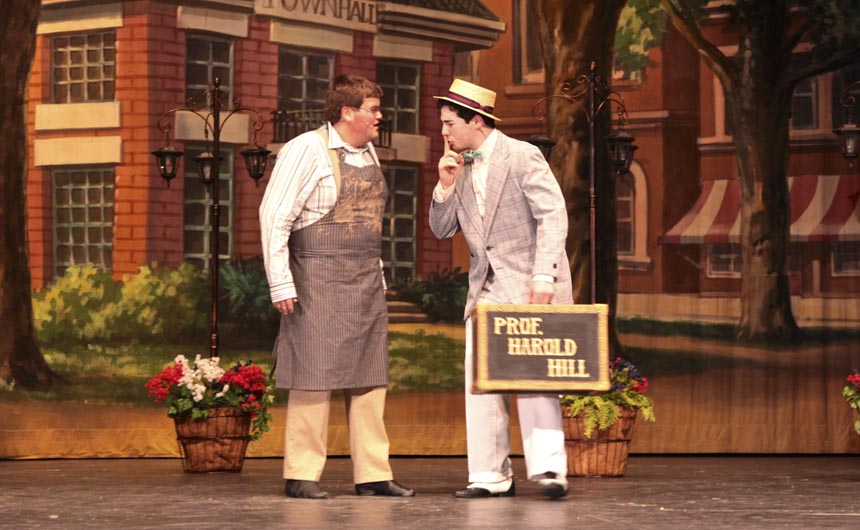
Last weekend, my husband and I went to New Orleans to see one of our grandsons in “The Music Man,” playing the role of the infamous Professor Howard Hill. Our grandson, a junior at Jesuit High School, was fabulous, and so was the production! You can see from the above picture how professional it was.
From the onset of the play, the audience instantly recognizes Professor Hill as a Con-man who gains the trust of a small town in order to sell them a bill of goods (in this case, band instruments) and make money for himself. Of course, in the end, he changes his tune, so to speak. The very successful Broadway play was the fantasy of American composer, Meredith Wilson.
But in real life, con-men, or women, are not fantasy. There are many, and they are real.
Can you recognize a Con-man? (i.e. a Confidence man, or woman)
He or she is a practitioner of confidence tricks–an attempt to defraud a person or group after first gaining their confidence, used in the classical sense of trust. He/she makes himself a false shepherd that people will follow. And next, he or she exploits the characteristics of the human psyche such as dishonesty, honesty, vanity, compassion, credulity, irresponsibility, naïveté and greed.
If we practice awareness, we’re able to see con-men all around us. We deal with them everyday in our government, in business, and perhaps even in our own families.
They stir up trouble and create distractions so that their selfish ways can be accomplished.
A fanciful Con-man (or Con-woman) is great fodder for a play or musical. But a real Con-man is dangerous. This so-called shepherd of the people, does not genuinely work for, or care, for his sheep. He works only for himself and leads people astray to accomplish his personal ends.
Today, more than ever, we need good shepherds to lead our government, our businesses, our families. And I pray that we find the persons to do that–and that they will mirror our ultimate Good Shepherd, whose grace is always present, and available to everyone–even to the worst of Con-men.
I am the good shepherd.
A good shepherd lays down his life for the sheep.
A hired man, who is not a shepherd
and whose sheep are not his own,
sees a wolf coming and leaves the sheep and runs away,
and the wolf catches and scatters them.
This is because he works for pay and has no concern for the sheep.
I am the good shepherd,
and I know mine and mine know me,
just as the Father knows me and I know the Father;
and I will lay down my life for the sheep.
I have other sheep that do not belong to this fold.
These also I must lead, and they will hear my voice,
and there will be one flock, one shepherd.
This is why the Father loves me,
because I lay down my life in order to take it up again.
No one takes it from me, but I lay it down on my own.
I have power to lay it down, and power to take it up again.
This command I have received from my Father.– Jn 10:11-18
I think it’s that he welcomes sinners. In other words, He forgives.
Isn’t that wonderful? No matter how we fail, we can always be welcomed back by God.
When it comes to welcoming others back into our hearts, how do we compare to our wonderfully welcoming God?
Do we hold grudges? Do we plan for the downfall of someone who’s hurt us? Or do we open our arms to them despite what they’ve done to us.
If we hold a grudge against someone, the door to God will be closed. It will be absolutely closed, with no way to him. Only if we forgive others will we be forgiven. I am sure that many prayers are not heard because the person praying has a grudge against someone, even if he is not aware of it. Jesus says more than once that before we pray we must forgive. If we want Jesus, we must have a forgiving heart.
– J. Heinrich Arnold
It all comes down to this question: Can we forgive others as Jesus did on the Cross? Are we able to accept that we are sinners, too?
Welcoming back into our world those who have hurt us, is a Christian requirement. And God is waiting for us to do it.
A seesaw is a long, narrow board pivoted in the middle so that, as one end goes up, the other goes down. A person sits on each end, and they take turns pushing their feet against the ground to lift their side into the air. Playground seesaws usually have handles for the riders to grip as they sit facing each other.
Life is like that, isn’t it? We face each other. We go up and down. Up and down.
One minute all seems right, the next minute our world comes crashing down. It might be divorce, death of a loved one, debilitating disease, loss of livelihood, a dream gone wrong, or hurtful words or lies, targeted at us by another.
Or we may be the one who brings down our own world by the bad choices we make. We are made to be people of goodness, but sometimes we corrupt ourselves through addictions, hanging around bad company, forgetting who we are—-children of God.
We are on a dangerous end of the seesaw then. We might think it’s over for us. But we should never give up trying to find our balance again.
One problem with a seesaw’s design is that if a child allows himself/herself to hit the ground suddenly after jumping, or exits the seesaw at the bottom, the other child may fall and be injured. For this reason, seesaws are often mounted above a soft surface such as foam or wood chips. In other words, a soft place to fall.
Because in life, we will certainly fall at one time or another. None of us is perfect yet. All of us here on Earth sin against our innate goodness.
And in doing so, we condemn ourselves. Still, don’t give up.
Strangely enough, God doesn’t condemn us. He forgives when we ask Him to. The softest place for us to fall is into His merciful and loving arms.
First of all–why can’t we get it through our heads who we really are?
Why can’t we get it through our heads that each one of us is a child of God, and that He created us for a purpose? We are meant to be Christ-like.
We have something to do here on earth, something like Jesus did. We are not here to puff ourselves up, or to grab all we can before someone else does.
We are here for such a short time, but in that time we can make a real difference by how we live our lives. That difference can be a benefit or a hindrance to our fellow human beings. Why would we choose to be a hindrance? Yet many of us do.
Why can’t we get it through our heads that we ought to treat others with dignity?
When we interact with another person, and actually see him or her as they are–made in the image and likeness of God, the same God who created us–how can we cheat them, or physically abuse them, or even kill them? For heaven sake–and I mean that literally–our purpose is to love them!
But secondly–love isn’t easy.
Loving someone presents many problems. One of the biggest is that even if we love a person, we don’t always love what they do. This is going to be true with parents and children, with spouses, with friends and co-workers. There will be times when we know they’re going in a wrong direction. There will be times when we recognize that they are actually sinning, a word that our society often choses to overlook or bypass. Are we to simply ignore this?
It would be foolish for us to ignore or tolerate sin, especially in someone we truly love and care for, because doing so puts them in danger. Sincere loving requires action, and that action is not to bury our heads in the sand because we don’t want to rock the boat of our beloved. Would we allow our toddler to continue peddling down a busy highway on a tricycle, or would we run out to snatch them back before they are literally killed? Would we watch our ten year old put a loaded gun in his or her pocket, and then smile as they go out of the door? Would we allow our teenager to pump himself or herself full of drugs just because he or she thinks it’s fun? Would we allow our spouse to jump into bed with a co-worker without a word from us?
But confronting sin in those we love (and in ourselves) requires courage. A loving action often requires courage, a compassionate courage to, at the very least, express to our loved one that we believe he/she may be in enemy territory.
If we do not care enough to act, if we do not care enough to attempt to unravel risky behavior in those we love, then we do not truthfully care about them at all.
We simply must have the courage to help those we are meant to love. We cannot be afraid to open our mouths. We are called to love. We are created to love. If we are children of God ourselves–and we are–then we must see that others are our brothers and sisters, and that we are intended to reach out to them in loving ways, without pomposity or self-righteousness. We must see Christ in others, and in turn we must act as Christ would act.
As Jesus went on from there, he saw a man named Matthew sitting at the tax collector’s booth. “Follow me,” he told him, and Matthew got up and followed him.
While Jesus was having dinner at Matthew’s house, many tax collectors and sinners came and ate with him and his disciples. 11 When the Pharisees saw this, they asked his disciples, “Why does your teacher eat with tax collectors and sinners?”
On hearing this, Jesus said, “It is not the healthy who need a doctor, but the sick. But go and learn what this means: ‘I desire mercy, not sacrifice.’ For I have not come to call the righteous, but sinners.–Matthew 9: 9-13











 Translating a World on the Edge