10547268_879692692045782_1839296699511975566_o

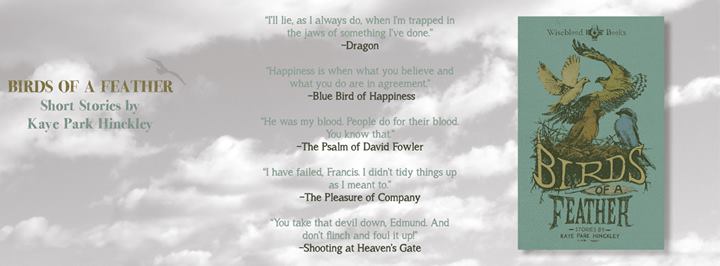
The ten stories in Birds of a Feather are now launched and flying!  And I’m flying with them—to the last mile.  I hope both people of faith and people who have no faith will enjoy reading them, and when they’ve finished the last page and close the book, that something of these stories will stay with them.

Some Praise:

The first story in this collection sits a reader bolt upright. Two stories in, you marvel at this storyteller, who sends us flying over new country, a landscape of modern parables where faith runs river-deep. Kaye Park Hinckley seems to overflow with beautiful, heartbreaking love and lessons. A world with broken wings can surely make use of such stories.
—Charles McNair, author of Pickett’s Charge and Land O’Goshen

“With masterful control and skillful writing, Kaye Park Hinckley boldly explores a wide range of wounded souls in this amazing collection of stories, ultimately finding love in the unloveable, and grace in the sufferings of a complex world.”
—Cassandra King, author of The Sunday Wife

Kaye Hinckley writes deeply textured stories with a distinctive voice.  Characters caught up in complex relationships, against the background of a fraying South, seeking yet often rejecting redemption. Sin as thick as grits and gravy pervades her stories…and Salvations lurks coyly, always just out of sight – it flitters through the pages like the birds who flitter through her stories. This is a wonderful volume, and I recommend it to all who contemplate our human condition.
–Arthur Powers, A Hero For The People, and The Book of Jotham

http://www.amazon.com/Birds-Feather-Kaye-Park-Hinckley/dp/069223473X/ref=sr_1_3?s=books&ie=UTF8&qid=1405273546&sr=1-3&keywords=kaye+park+Hinckley

OR

http://www.wisebloodbooks.com/kaye-park-hinckley.html

Or your favorite bookstore.

Video  —  Posted: July 14, 2014 in World On The Edge

speech-bubblesA human characteristic is the ability to speak, to converse, to give instruction, to make our opinions known. We talk. We use our tongues–sometimes without thinking, and sometimes very intentionally.

Our speech is directed to another, a listener. The listener may be a child, a friend, a family member, or a stranger in the grocery store. Regardless of who or where, what we say to each other matters. Speech is a gift to be used with care. I would suggest loving care, though I’m often guilty of overlooking that.

Matthew 12:36 says, “But I tell you that every careless word that people speak, they shall give an accounting for it in the day of judgment. For by your words you will be justified, and by your words you will be condemned.”

Wow! That’s a lot of personal responsibility.

Yet what we say to each other is not always done with words. Often it’s what we D0 that speaks loudest. How do our actions speak to our vulnerable children, or the friends and family who learn from us? Are we responsible in our actions as parents and teachers, leaders and co-workers? Do we practice what we preach? Again, many of us often fall far short of that. It’s a good thing we have personal control over what we do, and if needed, the ability to correct ourselves.

There are times though, when we’re not the ‘speakers’ or the ‘doers,’ but the receivers, the targets of speech and action. Over this, we have less control, and no doubt the voices and actions are loud–the media, movies, TV, newspapers, books, and even our own government.

Except each of these voices are made up of individuals like us. Are these individuals any less responsible than us for what they say or do? Don’t they, too, have the ability to correct themselves–or have greed and power simply struck them dumb and immobile?

And for our part—do we listen to them as if they rule us, as if they rule the world? Do we obey when ‘they say’ don’t talk back?  Or do we use our own judgment as to what we’ll allow to take root inside our  minds, and use personal courage–and responsibility– to express it?

Video  —  Posted: July 11, 2014 in World On The Edge

file0001038191191You know them. You’ve probably welcomed them into in your home: the painters, floorers, plumbers, electricians—all those who help to keep up the house in which you live.

Some of us try to do these tasks ourselves, and some of us know better than to try.  So, we call in the Restorers. Because we want order. Because we want things to work as they were made to work–and because we know what happens if we let it all go.

When the refrigerator goes out, the food goes bad. When the toilets stop up, the bathroom floods, and maybe even ruins the floors. When sparks come from an electrical socket,  fire is a definite possibility. No one can deny that these  problems need attention. No one can deny that to ignore them is foolhardy, even irresponsible. We must use our heads and solve the problem in our house.

But don’t we have another house for which We The People are responsible? And don’t we call her The United States of America? It’s my opinion, she’s in a problematic, even deadlocked, situation, especially when it comes to our ever-degrading culture. Many feel this deeply, and are attempting to right the wrongs. But most of us only comment and move on to something more pleasurable. We are not Restorers. Instead, we are letting our cultural problems go without doing much to fix them. In fact, some even believe our Country’s too far gone to fix at all. I don’t share that opinion.

When my children were little and complaining about a problem and how they couldn’t fix it. I usually sang them a few verses from the following children’s song about using commonsense. It makes a good point about those who are problem-solvers, and those who are not.

You’ll see the progression: Henry’s whining about all the reasons why fixing his problem with the bucket can’t be done, while Liza offers suggestion after suggestion as to how it can be done.

Video  —  Posted: July 10, 2014 in World On The Edge

file6311301609831Do you see yourself as ‘part’ of something? Do you play a big part, or a small part?

Maybe you  think “big” is more important than “small.”

The strirrup bone inside the eardrum is the smallest bone in the human body. And the femur is the biggest bone in the human body. Which is most important?  Well, I wouldn’t want to do without either of those parts, would you? How powerful those parts are!

On the other hand, many of the deadliest creatures on Earth are also some of the tiniest (like the deathstalker scorpion) It’s the diminutive size of these animals that makes them so terrifying because they’re hard to see. Their small size gives them power, too

A few weeks ago, one of my sons put a new radiator in his car–all by himself! It took him time, many hours on quite a few days to do it, mostly because he was missing a tiny little part of what it would take to complete the job–a disconnect tool. Everything was fine except he needed that tiny tool to get his big radiator running like it should.

Whether a thing is “big” or “small” is not important. What’s important is that it do the job it was created to do.

Each of us has a part to play in life. It may seem a small part to us, but small things can literally change the world for the better—if we are  not so absorbed in ourselves, if we remember that everyone we meet is journeying through life with us, and if we hold out a hand to another fellow traveler every now and then.


Image  —  Posted: July 9, 2014 in World On The Edge

file0001873407070Today–unless we’re involved in a church, or have parents who are believers, or Christian friends who influence us–we don’t hear much about God. We might wonder: Does God really see me and care about me personally?

Not so  long ago, if you turned on a local radio station in Dothan, Alabama, the music that came up was Gospel. You might hear The Blackwood Brothers, or the Blind Boys of Alabama. You might hear Mahalia Jackson or even Elvis Presley, but all of them were singing about the presence of God in our world.

Many times the songs were a sort of reaching up out of pain, and there was no question that God would reach back. For example, “His Eye is on the Sparrow,” verse Three:

Whenever I am tempted, Whenever clouds arise, When songs give place to sighing, When hope within me dies, I draw the closer to Him, From care He sets me free: His eye is on the sparrow, And I know He watches me. 

Today’s world is filled with pain and sorrow. We all recognize it, and at times personally feel it, but after pain and sorrow hit us, do we feel as safe as that old gospel song says we should? Do we reach up in order for God to reach back?

Sometimes, when tragedy or disappointment strikes, all we want to do is crawl in a hole and stay there. And personally, I think that’s fine for a while. We have to get used to loss, or disillusionment, or whatever it is that has dented our life. But we can’t stay there forever.

We have to climb out of the hole and look up to realize we are  loved, and that we will always be loved by God.

Image  —  Posted: July 8, 2014 in World On The Edge

kph52013's avatarTranslating a World on the Edge

walk while ye have lightWe Christians are in need of a spiritual awakening. We are dulled to our own lives as children of God. We are blunted to examining the actions of our lives in that context. Have we lost our religion, big time?

Catholic historian Christopher Dawson, (1889-1970), an Englishman who strongly believed in the importance of religion’s influence on society, wrote: “A society which has lost its religion becomes sooner or later a society which has lost its culture.”

Look at our culture today. Read about it in the news. We, as human beings, are on front pages and prominent media screens, with scandal after political scandal, murder after gruesome murder–including well over 50 million aborted children since Roe v Wade. Seventy four per cent of students admit to cheating. Premarital and extramarital sex have nearly become the norm. http://realtruth.org/articles/130530-005.html

And still, most people believe in God or in a higher power.

View original post 147 more words

Video  —  Posted: July 7, 2014 in World On The Edge

672x446xOneNationUnderGod.jpg.pagespeed.ic.TXssaXxg8yAs a people, we are more divided than ever. This is not how our country was meant to be. As we say in the Pledge of Allegiance, we are meant to be ONE nation, under God. Generations have fought and died for our right to be free Americans, to think as we want to think, to live as we want to live–as long as we do not trample on the rights of others to think as they want to think, to live as they want to live. In the sight of God, we are–all of us–his children. So, why won’t we act as brothers and sisters?

Here, expressed in the lyrics of songwriters and through the performance of their work, are reminders of why we should act as brothers and sisters:

The second and third stanzas of America the Beautiful. Katherine_Lee_BatesThe lyrics were written by Katharine Lee Bates, and the music was composed by church organist and choirmaster Samuel A. Ward.

O beautiful for pilgrim feet
Whose stern impassioned stress
A thoroughfare of freedom beat
Across the wilderness!
America! America!
God mend thine every flaw,
Confirm thy soul in self-control,
Thy liberty in law!

O beautiful for heroes proved
In liberating strife.  Who more than self their country lovedimages (8)

And mercy more than life!
America! America!
May God thy gold refine
Till all success be nobleness
And every gain divine!

255px-Julia_Ward_Howe-_History_of_Woman_Suffrage_volume_2_page_793

The Battle Hymn of the Republic“, also known as “Mine Eyes Have Seen the Glory” outside of the United States, is a song by American writer Julia Ward Howe, using the music from the song “John Brown’s Body”.  The song links the judgment of the wicked at the end of time (New Testament, Rev. 19) with the American Civil War.  Since that time, it has become an extremely popular and well-known American patriotic song.


eagle
225px-Dan_Emmett_portrait


Although most sources credit Ohio-born Daniel Decatur Emmett with the song’s composition, other people have claimed to have composed “Dixie”, even during Emmett’s lifetime. Compounding the problem of definitively establishing the song’s authorship are Emmett’s own confused accounts of its writing, and his tardiness in registering the song’s copyright. The latest challenge has come on behalf of the Snowden Family of Knox County, Ohio, who may have collaborated with Emmett to write “Dixie”.

Image  —  Posted: July 4, 2014 in World On The Edge

c018036

Once a month, when I was about thirteen years old, I used to accompany a friend to The Cove Hotel in Panama City, Florida, where her father did the books for the elderly lady who owned the hotel. But even then, The Cove was older than she was. Built in 1926, it was two stories of pink stucco, surrounded by huge trees, and set on the shore of St, Andrews Bay off the Gulf of Mexico. I thought it was beautiful.

For my trips to the Cove, my mother made sure I took the proper clothing. That meant a dress for dinner, along with the right shoes. Usually, that was a sun dress and strappy white sandals. Dinner was served at a certain time, on spotless white tablecloths, with starched white napkins and a lot of heavy silverware, properly set. My friend and I felt like princesses. But always, there was something we looked forward to that was even better. The Miracle. And we could make it happen ourselves.

After dinner, we walked down to the bay, tossed our sandals on the sand, tucked up our pretty dresses, and walked calf-high in the dark water. With each movement, bursts of light, like stars, surrounded us. Light out of darkness. Our Miracle. Our Gift.

In my novel, A Hunger in the Heart, Coleman is shown the same gift by his father, when he thrusts a hand into dark water. There, it’s a symbol of hope in the middle of heartbreak. But for many years, I knew nothing of serious heartbreak.

Later on, at twice the age I was then, I faced heartbreak for the first time. One of my children was diagnosed with a malignant brain tumor. She was five years old. The word, heartbreak, could not come close to what I felt. I didn’t know how to deal with such a dark situation—and it did seem so dark!

For years, our entire family struggled valiantly with a situation we could not control. And it made us stronger. Then, one evening, in intensive care, I was holding her hand after her third operation, and the doctor came in to give an assessment of the tumor. He said he thought they’d finally ‘gotten it all.’ Talk about the opposite of heartbreak! I was filled with JOY. We had been in the dark water and now were surrounded with stars.

Only later, did I remember the Cove Hotel and the miracle I found within the dark water of the Bay.

But isn’t this the way life is? When we look back, haven’t the hard times made us stronger? Didn’t we cling to the hope that things would get better? This is why a writer of Catholic fiction can say that God is now, and always will be, present in our world. He is our Hope—in times of sorrow and tragedy, as well as in times of happiness and joy.


Video  —  Posted: July 3, 2014 in World On The Edge

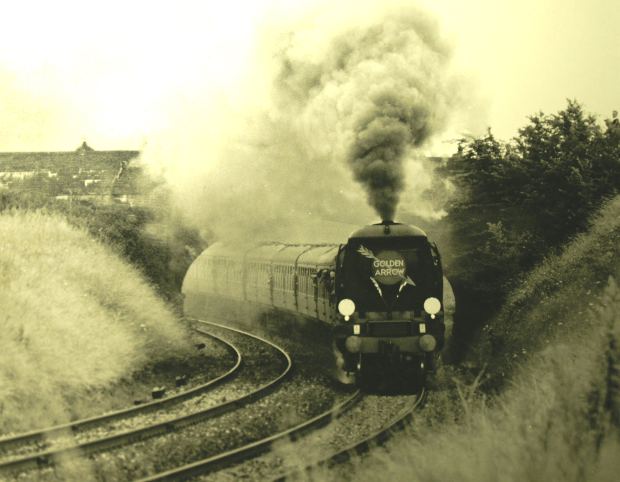
long black train Because this is the week of the Fourth, I’m going to re-blog a few popular posts, so here goes:

Freedom is a big word. A weighty word. A lengthy word. The locomotive of Freedom is championed by words, like Liberty and Independence. But the locomotive’s steam is often the lack of any restriction or inhibition.

The train of Freedom runs two ways, and on conflicting tracks. One is a track of lies, the other a track of truth.

Before you buy a ticket on one train or the other, there are questions to ask: Where does it come from? Where is it going? And most especially, who is its engineer?

The lying train of Freedom can be very long and black. It can come from jumbled and defective thinking. It can take us to foolishness and death. And its engineer can be a faulty entity of propaganda.

Do we really have the freedom to kill innocent babies? The engineers of society and our government say we can.

Do we honestly have the freedom to forget our marriage vow, or steal another person’s wife or husband, or to have sex with whomever we want? The engineers of Hollywood say we can.

Do we truthfully have the freedom to knock ourselves out with dope at the expense of the life of our family and our own life as well? The enormous drug trade says we can.

Who is your engineer? Who is driving your Freedom train? We do have a choice. On which train will you buy a ticket?

For you were called for freedom, brothers and sisters.
But do not use this freedom as an opportunity for the flesh;
rather, serve one another through love. For the whole law is fulfilled in one statement, namely, You shall love your neighbor as yourself. But if you go on biting and devouring one another, beware that you are not consumed by one another.–Gal 5:1 13-18

Video  —  Posted: July 2, 2014 in World On The Edge

file3511244468063I’ve entitled my blog “A World on the Edge” for a reason. I believe our world, created by God, is in many ways eroding. Nowhere is this more evident than in the present fight for religious freedom all over the world. And now, the fight comes to our beloved America, founded on principles of liberty that reflect the individual rights God gave each one of us: One of the basic rights is Freedom OF Religion. Not Freedom FROM Religion. That means your religion and mine.

Imagine yourself standing in the sand at dusk on the edge of the beautiful, blue-green Gulf of Mexico while waves, with each rush, pull the sand from beneath your feet. At first, you may not notice, but if you stand there long enough, a hole will occur around each foot, and you will lose your balance. This is what is happening to our religious freedom in the United States of America. And we are barely noticing it.

As they did last year,  from June 21 to July 4, Catholics across the nation are observing a Fortnight for Freedom. Not a special freedom just for us, but the right of all citizens for religious freedom.

In the words of George Washington: “If I could have entertained the slightest apprehension that the Constitution framed in the Convention, where I had the honor to preside, might possibly endanger the religious rights of any ecclesiastical society, certainly I would never have placed my signature to it.”

A year has passed since the first Fortnight for Freedom. Things are no better. We are in danger. Take notice that America is tottering on The Edge. Help keep her balanced. Join us again as we stand up for Freedom of Religion.

Share this:

Image  —  Posted: July 1, 2014 in World On The Edge