For Catholics, Ash Wednesday (the day after Mardi Gras) is the beginning of Lent, which lasts for forty days. For every Catholic, it is a day to confront the inevitability of his or her death, and for that day, we wear the sign of that inevitability on our foreheads in ashes.
The ashes we receive on our forehead in the shape of a cross serve as an outward sign of our sinfulness and need for penance. The ashes also symbolize our mortality, a reminder that one day we will die and our bodies will return to dust. Traditional words when we receive the ashes are: Remember that thou art dust and unto dust thou shalt return.
So, Ash Wednesday is a time of self-examination, and of our faith in the promise of eternal life. Can we turn down the noise in our lives for forty days and listen to what God wants to tell us? Because if we don’t listen, we won’t hear him call us by name–our name. We won’t hear that we should not be afraid. We won’t hear that God is madly in love with each one of us. We won’t hear what we can do to change ourselves.
Is there something in our lives that might prevent eternal life? If there is, we have an opportunity to change it. We know who we are. We know we’ve done. Shouldn’t we examine ourselves and work on the problems we may have?
Forgive those things we have done
which have caused you sadness,
and those things we should have done
that would have brought you joy.
In both we have failed
ourselves,
and you.
Bring us back to that place
where our journey began,
when we said that we would follow
the way that you first trod.
Lead us to the Cross
and meet
us there.
DEAR MAMAS, You are the wives. You are the mothers. You are the nannies. You are the teachers. You are the cooks–no, the gourmets! You are the washerwomen and the scrubbers. You are the taxi drivers. You are the gardeners. You are the counselors You are the peace-makers. You are the judges. You are the juries. You are the nesters. You are the consolers. You are the planners. You are the confessors. You are the dream-makers. You are the caterers. You are the celebrators. You are the lovers. You are the listeners.
YOU ARE THE GLUE.
YOURS IS THE HEART THAT TEACHES A CHILD TO LOVE.
YOURS ARE THE HANDS THAT PUT THE PUZZLE OF FAMILY TOGETHER.
YOU ARE IMPORTANT.
YOU ARE NECESSARY, NOT ONLY TO YOUR FAMILY,
BUT TO HUMANITY.
The Hand That Rocks the Cradle Is the Hand That Rules the World–William Ross Wallace
The next time you’re feeling down, instead of being swept along by an ocean of stress, you might try sharing your problems with a trusted friend.
Talking about our problems and sharing our negative emotions with someone we trust can be profoundly healing—reducing stress, strengthening our immune system, and reducing physical and emotional distress (Pennebaker, Kiecolt-Glaser, & Glaser, 1988).
For Christians, the most trusted friend is God, and God is who they first go to for help. Absolutely anyone can talk directly to God through prayer. Our prayers are conversations with God. But God can speak to our minds and hearts through anything — books, television, movies, music, other people. Yet for some people, the idea of talking to God is ridiculous because they insist they do not believe in Him.
Belief in God
Belief in God has fallen the most in recent years among young adults and people on the left of the political spectrum (liberals and Democrats). These groups show drops of 10 or more percentage points comparing the 2022 figures to an average of the 2013-2017 polls.
Most other key subgroups have experienced at least a modest decline, although conservatives and married adults have had essentially no change.
The groups with the largest declines are also the groups that are currently least likely to believe in God, including liberals (62%), young adults (68%) and Democrats (72%). Belief in God is highest among political conservatives (94%) and Republicans (92%), reflecting that religiosity is a major determinant of political divisions in the U.S.
Nearly three-quarters of the most religious Americans, defined as those who attend religious services every week, say they believe God hears prayers and can intervene, as do slightly more than half of conservatives and Republicans, as well as 25% of liberals and 32% of Democrats. Thirty percent of young adults believe God hears prayers and can intervene.
Hearing God
Recently, I read the delightful account of a kindergarten teacher in a Catholic school–when one of her students, a little boy, came up to her desk and proudly announced that he knew the Our Father by heart. She asked him to show her, and every word of his prayer was perfect — until the little boy ended the prayer with: “Lead us not into temptation, but deliver us some E-mail, Amen.”
Maybe He won’t send us an email, but God is speaking to us all the time. We only have to listen. Hearing God is essential to building an intimate relationship with Him and learning to clearly distinguish God’s voice is invaluable. The “still, small voice” inside our heads called conscience is often God attempting to speak to us. Maybe we don’t listen. Maybe we tune God out because we don’t like what He’s saying. We may tune Him out so often (to do what we want, instead of what we know He wants) that we lose all contact with Him.
Still, God does not lose contact with us — ever. He loves us. God is always near enough to hear us call to him throughout our life on Earth. Because, in the end, absolutely everybody will talk to God.
“What I wanna know is who’s in charge?” one woman says to the other. She is shaking her head as if speaking of something too horrible to be believed. “Well, today it’s a scary world. Who is in charge of anything these days? You can take all the precautions you want, but things still happen,” the other comments. “Mama said she heard on Big Bam radio the guy went crazy and started shooting at everybody in the clinic. People killed for no reason at all. You can’t predict something like that.” “Yeah, just innocent bystanders doing their jobs, and some nut-case in a face-mask walks in with a gun.” “What’s worse, he got away! Who knows if they’ll ever find him?” She gives a depressing sigh. “We live in a dangerous world.”
How could it happen?
In An Age of Mass Shootings, This Psychological, Southern Gothic Novel, Considers the Answers.
I thought about writing this novel, “Shooting at Heaven’s Gate,” several years ago after being shocked that in a small town near mine, a disillusioned and angry young man took up his shotgun and killed many of his family and co-workers. Why had he done it? Jealousy, greed, revenge, drugs, or some mental disfunction? Why had he destroyed the people he most cared for? Seemingly senseless shootings/murders like these seem to be becoming more prevalent. But the reasons behind them are ancient.
Most of us can retell the story of Cain and Abel, a story of one brother murdering the other. Genesis 4. When the Father (God) favored Abel’s gift over Cain’s, a few narcissistic traits began to itch in Cain, and then finally took him over — jealousy, greed, anger, and revenge, leading to Cain’s murder of Abel. Did God love Cain? Of course. But the sin of Cain separated him from God, just as sin separates us today from God.
Jealousy, Greed, Anger, and Revenge
I have no idea what caused the shootings in this nearby small town, but I suspect some of the above narcissistic traits were involved.
Our life is an ongoing drama between God and each of us. Whether we accept it or not, no matter who we are or what we do, each of us has an inborn, spiritual relationship with the God who created us, the God who loves us infinitely. We can deny it or shout our disagreement. We can act out in reprehensible ways to destroy God’s sovereignty over us. Our God-given free will allows that behavior. But truth cannot be altered. We were made to be good. We live in a world that God made to be good. And yet moral and physical evil exists in spite of the goodness — and therefore, human suffering exists. Yet, God is still merciful.
Goodness Left Behind
In the novel, “Shooting at Heaven’s Gate, goodness is left behind for a time, and evil runs rampart in Bethel, Alabama. Dr. Malcolm J. Hawkins, III, narcissistic, arrogant head of psychology at Bethel University feels his position and his credibility threatened by the impressive, up-and-coming English professor, Ginnie Gillan, because that is the way of narcissists.
“Good and evil do not exist when searching for the best way to scratch an itch. The only question is, Can I get away with it? “says Dr. Malcolm J. Hawkins, PH. D.
If someone threatens Mal’s narcissist’s ego, he shifts into a war-like predator mode and scratches that ‘itch.’ Jealousy, greed, anger and revenge take over him, and Mal decides to use Ginnie’s husband Edmund’s fear and weakness against her. Feeding Edmund a steady diet of drugs and manipulation, Mal then lights the fuse of the greatest tragedy Bethel has ever known. Beyond understanding? Yes!
And yet there are explanations.
Though Edmund acts from a motive of jealousy and anger, he is not a ruthless man, but a victim of Hawkins, and of his own sad life story. Out of an impotence that leads to drugs and the easy way out, Edmund K. Gillan gives himself over to Dr. Hawkins’s control in an effort to relieve his debilitating headaches, stemming from his childhood.
An extremely envious and narcissistic man, Mal Hawkins sees every situation and person as a threat; so when he hears that Edmund’s wife, Ginnie, is seen as an upcoming superstar at the college, and may soon be a department head, Mal views her as deadly competition, and decides to bring her down, using her own husband as his pawn. Edmund loves his wife, but he also loves the drugs Mal gives him. The drugs, his headaches, and the voice of his grandfather, keep Edmund in constant conflict.
Opposition to Wickedness
Just as in a novel, there are real-life compassionate and loving people that shine in opposition to wickedness. Loving teenager, Alma Broussard, lives with her quirky mother Moline, who works in a dental office, and her feisty Aunt Pauline, who runs the chicken farm on which they live with Jose Alvarez and his teenaged daughter, Angelina who has leukemia. Their lives seem wholly separate from the feuds of academia—but again, revelations emerge, and dark secrets lurk in Moline’s past that will bring the people she loves straight into the path of a murderous madman.
Mercy
Even after Cain’s murder of his brother, God showed him mercy. The same mercy He shows not only in this novel, but upon repentance, to us as well. After Cain killed his brother Abel, God declared to Cain, “Now you are under a curse and driven from the ground, which opened its mouth to receive your brother’s blood from your hand. When you work the ground, it will no longer yield its crops for you. You will be a restless wanderer on the earth” (Genesis 4:11-12). In response, Cain lamented, “My punishment is more than I can bear. Today you are driving me from the land, and I will be hidden from your presence; I will be a restless wanderer on the earth, and whoever finds me will kill me” (Genesis 4:13-14). God responded, “Not so; if anyone kills Cain, he will suffer vengeance seven times over.” Then the Lord put a mark on Cain so that no one who found him would kill him” (Genesis 4:15-16).
Shooting at Heaven’s Gate is a “Theology of the Cross” novel, a battle between good and evil. A bona fide WAR, in which genuine goodness and grace are confronted by wickedness. In the wake of death and destruction, Bethel, the town that used to be called Heaven’s Gate, will find no easy answers, but always, there is hope for mercy and redemption.
PRIORPRAISE forShooting at Heaven’s Gate:
Family relations and lifelong secrets, human brokenness and the grace of transformation, mass shootings, deception, sin and forgiveness. These fundamental themes of the human search for meaning, of the challenge of faith, reconciliation and conversion, are woven throughout this story of a small town in rural Alabama. The complexities of each character, from university professors to farm hands, become the stage for an exploration of the human condition, in the style of C.S. Lewis, with echoes of T.S. Eliot, Geoffrey Chaucer, Macbeth and many others. The novel is followed by a list of themes, questions for book discussions and selected quotes, making it all the easier for study groups of any kind. — Fr. Christopher Viscardi, SJ, Chair and Professor of Theology at Spring Hill College, Mobile, Alabama
Kaye Hinckley has more than earned her keep as a significant contender vying for a living Catholic literature. —Joshua Hren, How to Read (and Write) Like a Catholic, Co-Founder of the MFA at University of St. Thomas, Houston
With a brisk narrative pace, Shooting at Heaven’s Gate by Kaye Park Hinckley invites readers to explore the complicated lives of characters suffering with loss, illness, addiction, and deception. The plot twists make this novel both entertaining and thought provoking with the reassurance that good does win. — Johnnie Bernhard, award-winning author of Sisters of the Undertow and Hannah and Ariela.
Faith and faithlessness do battle in Kaye Park Hinckley’s thought-provoking, unsparing new novel. She reveals the hellish torments … and heavenly convictions … of everyday people in a small Alabama town in an age of mass shootings. Bring faith as you enter Heaven’s Gate. — Charles McNair, author of The Epicureans
Don’t be lulled by the easy, descriptive manner of the beginning chapters. They introduce opposing characters whose thoughts and actions display the good and bad of human nature. Soon, you’ll be put on high alert, and move at lightning speed to satisfy a need to know how these characters interplay with each other. Mal, the manipulator and Edmund’s muddled loss of reality, cause the reader to begin to question, even fear what’s coming, hoping it’s the dream state of a sick, delusional man. Of course, it is no dream. Once the sound of metal is heard, the energy and climax of the book literally explode. Throughout the entire novel, the belief in salvation and forgiveness through confession, suffering, and atonement surfaces as a tenet of Catholic belief, symbolized not only in the characters, but in minute details…about flowers, and guns, geography, and history. Topics of current world concern are touched upon and mentioned briefly, without political overtones, but enough to generate reflection about good and evil, and how they come to be in the human person. A great read. – Terry Lonergan, Longtime Educator, Principal, and reader, Atlanta, Georgia
“Shooting at Heaven’ Gate is different from Hinckley’s other books as the moral themes are explicit and upfront, rather than subtle. I believe this work is a masterpiece. But then I love Kaye’s books because of how she writes (with the eloquence of angels) and for her choice of gritty topics (life is messy). “Shooting at Heaven’s Gate is not Pollyanna and cotton candy. Rather it is filled with real-world brokenness and the need for redemption, accurately painting the struggles on this side of the grave. — Denise-Marie Martin, author of “Tangled Violets.”
A human characteristic is the ability to speak, to converse, to give instruction, to make our opinions known. We talk. We use our tongues–sometimes without thinking, and sometimes very intentionally.
Our speech is directed to another, a listener. The listener may be a child, a friend, a family member, or a stranger in the grocery store. Regardless of who or where, what we say to each other matters. Speech is a gift to be used with care. I would suggest loving care, though I’m often guilty of overlooking that.
Are you certain what you say is the Truth? If you are not certain, then Do Not Speak. That’s more than just common sense, it’s a human being’s responsibility toward others.
But I say unto you, That every idle word that men shall speak, they shall give account thereof in the day of judgment.For by your words you will be justified, and by your words you will be condemned.” — Matthew 12:36
Wow! That’s a lot of personal responsibility.
Yet what we say to each other is not always done with words. Our actions speak for us as well. How do our actions speak to our vulnerable children, or the friends and family who learn from us? Aren’t we especially responsible for our actions as parents and teachers, leaders and co-workers? Do we practice what we preach? Again, many of us often fall far short of that. It’s a good thing we have personal control over what we do, and if needed, the ability to correct ourselves.
There are times though, when we’re not the ‘speakers’ or the ‘doers,’ but the receivers, the targets of speech and action. Over this, we have little control, and no doubt the voices and actions are loud from those with agendas which they will lie to preserve. This includes the news media, and of course, politicians. If they are liars, are they worthy of their high positions?
The new media and politicians are made up of individuals like us. Are these individuals any less responsible than us for what they say in today’s world? Shouldn’t they be TRUTHFUL? Don’t they, too, have the ability to correct themselves? Or have the two prime motivators for LYING — greed and power — overtaken them completely?
Words and actions by those in prominent places can make or break this country. Will the words and actions they use as weapons against others be ignored, or inevitably condemned by those they are supposed to serve?
Beware. The devil, the most famous liar, is on our doorstep now.
He was a murderer from the beginning, and does not stand in the truth, because there is no truth in him. When he lies, he speaks out of his own character, for he is a liar and the father of lies. — John 8:44
Our leaders ought to be telling us the Truth, yet a majority of those in charge are not. And if we do not challenge them, we will lose our American way of life. A serious danger. Really serious.
Every person we meet has what it takes to be a character in a novel.
Every person we meet has a propensity to do certain things, and because of this, his/her intellect judges those things as good for them or not good for them, depending upon what their goal is.
Every person, including ourselves, makes choices, knowing what we should do, or should not do; then we play out our choice through action that in some way, always involves another person.
Oh yes, in real life, each of us has a story, too! And that story–our own story–follows us to the end of our days on Earth, taking us to eternal life, or eternal damnation, depending upon the choices we make and the actions we take.
The main characters in novels must change, one way or the other, or there is no novel. Each of us on Earth has the same capability of change in order to achieve our highest end. But not every novel has a happy ending. Not every protagonist wins, same as in human life. However, a novel is based on an author’s chosen standard with which the characters are charged. The world’s greatest novels point to the higher standard, though the characters may never achieve it.
It is the same for us. As human beings, we are charged with certain standards. We are not meant to hate, but to love. We are not meant to lie, but to speak the truth. We are not meant to steal, but to share what we have. We are not meant to kill–not an innocent child in the womb, an enemy, or a neighbor. We know within ourselves what is right and just, but sometimes we do the opposite. Why? Because we choose wrongly when we forget who we are. This is so obvious today.
In the words of one great novelist: If we Americans are to survive it will have to be because we choose and elect and defend to be first of all Americans; to present to the world one homogeneous and unbroken front, whether of white Americans or black ones or purple or blue or green… If we in America have reached that point in our desperate culture when we must murder children, no matter for what reason or what color, we don’t deserve to survive, and probably won’t.– William Faulkner
In a novel, the actions of evil often shine out the good. Struggle or suffering by the protagonist often shows him or her a way to the good because he chooses to make his way through the struggle. Struggle is the way of all life; all of life struggles to be born, and then struggles to stay alive. And all of life yearns for love. We can certainly see this in animals, in our pets that want to be stroked or held. It is obvious that every human life needs love because we all aspire to it.
Each of our life stories has been given to us by the loving God who made us, by the Creator who designed us as innocent children, designed us in His likeness with free will, the ability to imagine, the ability to remember and act on those memories, the capability of loving and accepting love from others, and most of all, the capability of showing mercy, even to those who have hurt us.
A great novelist puts purpose into the words he/she writes. Characters have purpose, settings have purpose, everyday actions and words have purpose. Nothing is insignificant or unimportant to the ultimate novelist. Therefore, I see God as the most perfect and greatest novelist, giving each of His characters everything they need to achieve their end in this great scheme of life, but also the freedom to choose or not to choose HIM. We are all writing the novel of our lives, the only novel for which we alone will be responsible. If presently, it seems to be a novel we are not proud of, we still have time to change it into one that will be pleasing to ourselves, and to God.
For you created my inmost being; you knit me together in my mother’s womb. I praise you because I am fearfully and wonderfully made; your works are wonderful, I know that full well. My frame was not hidden from you when I was made in the secret place, when I was woven together in the depths of the earth. Your eyes saw my unformed body; all the days ordained for me were written in your book before one of them came to be. –Psalm 139: 13-18
If we stand back from our gift-buying busyness, if we look to the manger, we will see the core message of Christmas which we are to follow: Be humble.
The son of God came to earth as a newborn baby. Why did he come as a helpless baby from a poor family?
Simple humility. The first lesson taught us by Jesus Christ that leads us toward human goodness.
Humility is the tool of human goodness. The opposite of humility is pride. Pride is the tool of evil, causing haughtiness, jealousy, or anger over slights or insults.
Pride is when we worry constantly about what others think of us. When we must be the center of attention, and feel frustrated if we are not. When it is all about us, and not about God and our neighbor, this is pride.
So, how do we grow in humility, and not pride?
This prayer for the virtue of humility has been around a long time, and it is certainly one that I need to pray! It asks for our Lord’s assistance in humbly following in His footsteps and casting aside, or at least offering up to Him, all those nagging doubts and fears that come with our self-centeredness.
Deliver me, Jesus:
From the desire of being loved,
From the desire of being extolled,
From the desire of being honored,
From the desire of being praised,
From the desire of being preferred to others,
From the desire of being consulted,
From the desire of being approved,
From the fear of being humiliated,
From the fear of being despised,
From the fear of suffering rebukes,
From the fear of being calumniated,
From the fear of being forgotten,
From the fear of being ridiculed,
From the fear of being wronged,
From the fear of being suspected,
From the fear that others may be loved more than I.
Grant me the grace to desire: That others may be esteemed more than I, That in the opinion of the world,others may increase and I may decrease, That others may be chosen and I set aside, That others may be praised and I unnoticed, That others may be preferred to me in everything, That others may become holier than I, provided that I may become as holy as I should.
HUMILTY IS SUCH A GIFT. LET’S LIVE IT, AND SHARE IT!!
My husband and I have been married for fifty-six years, so I know a little bit about the subject. Marriage can be viewed through many spectrums: love, of course; sacrifice; commitment; responsibility; patience, forgiveness, and courage. But since I’m a writer, I’ll use the poetic analogy of a boat for the married state. I began the adventure of marriage sailing in one boat with a man I fell in love with. In time, five children took up resident in our boat, as well as thirteen grandchildren plus suitcases of sporadic joys and sorrows, constantly opening and closing. Yet, the vessel never seemed too small for any of us. And even on very wide waters, in sometimes frightening weather, our little boat never stopped its aim for the farthest shore. Looking back, I call that a mystery.
I have asked myself the question: How did my husband and I last through for these fifty-six years? Because there were times. . . .Oh yes, there were times, when each of us may have wanted to ‘get out of the boat’ and be done with the trip, but again, because of some mystery, we remained.
My husband and I met when we were seventeen years old as freshmen at Spring Hill College in Mobile, AL. He was from North Alabama, a transplanted Yankee only a year before. I was a dyed-in-the-wool Southern girl born and raised in South Alabama. He borrowed a pencil from me in Theology class, and broke it. Later he told me he’d broken it purposely so he could stop me after class and give me a verbal apology. We were at once attracted to each other. Who knows why that happens–instant attraction—except it did. And what is that fragile web of affection between a man and a woman that teases by word and touch, by sight and appetite, and fastens two separate souls into one? Well, I call that a mystery, too.
I was an art major, and he was a history major with an eye to Law School. In ways, we were complete opposites. I saw our life together as a painting in progress, a changing of colors from dark to light to brilliant, and sometimes back again to start all over with darkness, requiring a complete and utter gesso of the canvas. He saw it measured against the annals of what succeeds and what doesn’t. He was–and is–the logical foundation. I am a believer in imagination, always wanting to paint things a little brighter. But we are the same when it comes to seeing our marriage as our most important vocation, the vehicle which will take us to heaven. We see our marriage as a sacrament. Another mystery? I think so.
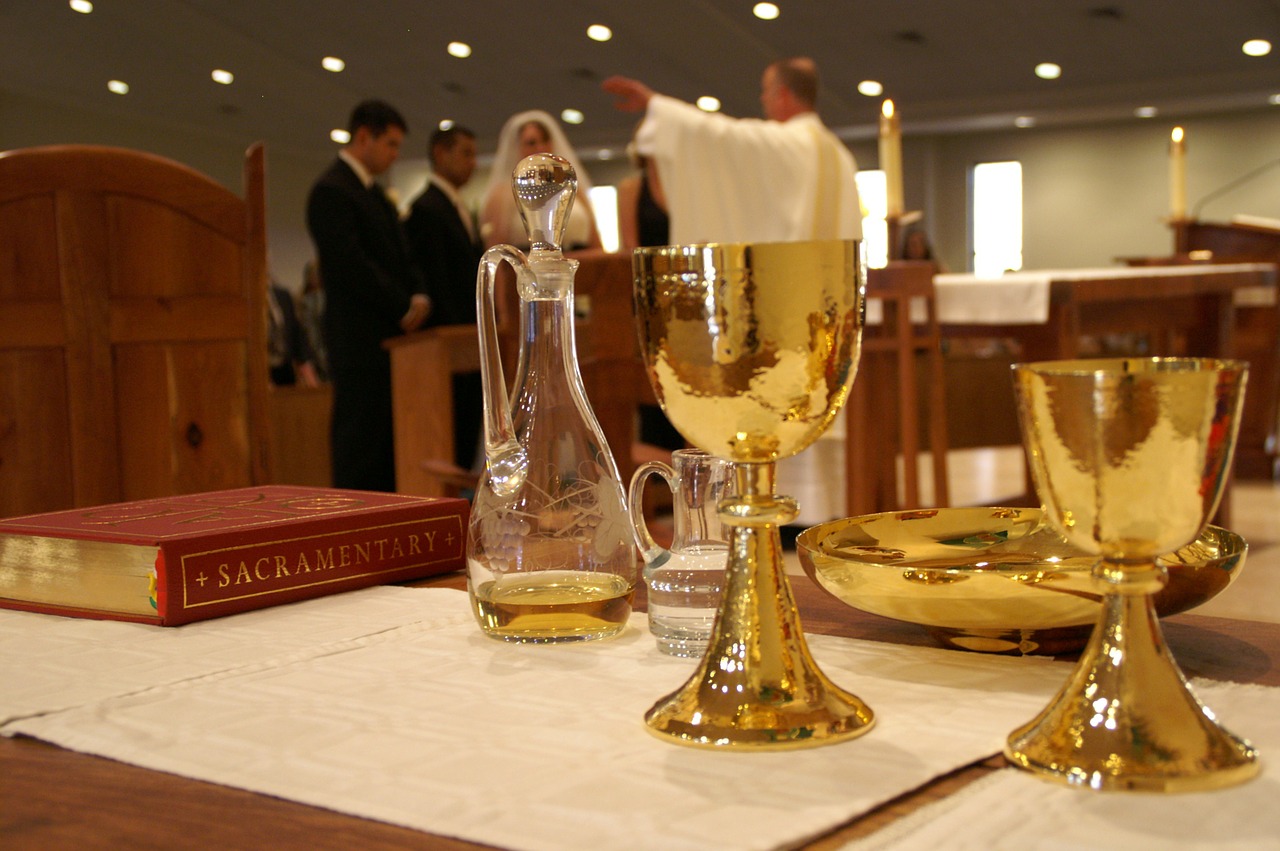
In the original Greek scripture, the word for “mystery” actually meant “sacrament.” The sacrament of marriage was intended to reflect the unremitting love that Christ has for His people, the Church. My husband and I never considered that we could, or would, get out of our Catholic marriage, no matter how many bad times we would go through–and there have been many. In other words, we believe in the mystery and in the sacrament.
Today, the concept of marriage, who and what it’s for, has changed in the eyes of many people who are unwilling to take on the honest commitment that marriage requires. These are spouses– husband and wife, or both–who have been led to believe that “Life is all about ME.” That statement is poison to marriage and family, because it makes marriage as disposable as a paper plate, a sign of our times. Today, many weddings seem to be only expensive occasions to party, and afterwards, the marriage sometimes bears little resemblance to the sacrament of Holy Matrimony as God intended it to be–husband and wife holding on to each other through good and bad times in a vehicle of His grace, helping each other to become the best person each can be.
And if any vocation needs grace to survive, it is surely marriage. Because if we fall out of the marriage boat and drown, we may watch our children drown with us.
No matter how well matched they may be, it is not easy for any two people to live together day in and day out, year after year, with their inescapable faults and personality defects grating upon each other. It’s not easy to help one another grow in goodness and nobility in spite of those faults—little by little adjusting to one another so that the faults of one “fit in” to the perfections of the other and unity arises from the very differences of the two persons. This is a beautiful evolution, like the emergence of the butterfly from its chrysalis; but it is not easy. No matter how selfless a couple may be, it is not easy for them to face the prospect of responsible parenthood, with all the sacrifices that entails. Especially it is not easy to face the prospect of an ultimate judgment, in which they will have to answer to God for the souls of the children who have been entrusted to them..–beginningcatholic.com
Traditional marriage is a sacrament instituted by God who loves us. It is His grace that gives us commitment to keep going. And yes, the water IS wide, the boat sometimes constricting, and the trip often difficult. But love that works through difficulties can lead to holiness and everlasting life with God.
The distance between intent and actual result can be very wide indeed. Is it because we lose sight of our intention? Is it because we allow an opportunistic evil to chip away at our noble intent?
Take a look America–a long look at the distance between what we intended our nation to be, and what our nation is becoming.
Here are the intentions for America by our first President, George Washington in his Thanksgiving Proclamation, New York, 3 October 1789
Whereas it is the duty of all Nations to acknowledge the providence of Almighty God, to obey his will, to be grateful for his benefits, and humbly to implore his protection and favor– and whereas both Houses of Congress have by their joint Committee requested me to recommend to the People of the United States a day of public thanksgiving and prayer to be observed by acknowledging with grateful hearts the many signal favors of Almighty God especially by affording them an opportunity peaceably to establish a form of government for their safety and happiness.
Now therefore I do recommend and assign Thursday the 26th day of November next to be devoted by the People of these States to the service of that great and glorious Being, who is the beneficent Author of all the good that was, that is, or that will be– That we may then all unite in rendering unto him our sincere and humble thanks–for his kind care and protection of the People of this Country previous to their becoming a Nation–for the signal and manifold mercies, and the favorable interpositions of his Providence which we experienced in the course and conclusion of the late war–for the great degree of tranquility, union, and plenty, which we have since enjoyed–for the peaceable and rational manner, in which we have been enabled to establish constitutions of government for our safety and happiness, and particularly the national One now lately instituted–for the civil and religious liberty with which we are blessed; and the means we have of acquiring and diffusing useful knowledge; and in general for all the great and various favors which he hath been pleased to confer upon us.
And also that we may then unite in most humbly offering our prayers and supplications to the great Lord and Ruler of Nations and beseech him to pardon our national and other transgressions– to enable us all, whether in public or private stations, to perform our several and relative duties properly and punctually–to render our national government a blessing to all the people, by constantly being a Government of wise, just, and constitutional laws, discreetly and faithfully executed and obeyed–to protect and guide all Sovereigns and Nations (especially such as have shewn kindness unto us) and to bless them with good government, peace, and concord–To promote the knowledge and practice of true religion and virtue, and the increase of science among them and us–and generally to grant unto all Mankind such a degree of temporal prosperity as he alone knows to be best.
Wonderful words, yet for many years, we have watched the principles of America decay. Will we continue to ignore what is happening?
The following, very prophetic radio warning was given in 1965! Remember this old English adage–“The road to hell is paved with good intentions.”
May God have mercy on us. This is truly a time for prayer.
Mary’s Mountain, my novelette, is FREE on Kindle from now until election day–the week before a very important midterm election that could affect America and her traditional values forever. It’s a short read, so I hope you’ll take me up on my offer. Just click on the book cover.
The setting is much like America today where already there is an attempt to revise our history, and many have accepted it. Already, Truth is being debunked, and we swallow it–especially if what is replacing Truth agrees with our personal opinions, or tickles our indulgences. Already, our religious faith and American values are being challenged. Already, our right to hear the truth on television and social media is being meddled with. Already, our country’s enemies are at our throat, and yes, crossing our border in unbelievable numbers. And some of them actually mean us great harm. This is more than tolerance. This is dangerous!
Mary’s Mountain is a story about Tolerance taken to the extreme. It is Paul Dunaway’s struggle to re-shape his affluent but joyless life, as the opposing forces in an out-of-control, politically correct America–that he helped to create–now, threaten to take him down.
A description of the infamous Institute of Tolerance found in the novelette: Today, inside its progenies, rigid rooms are covered in fiddle-faddle flowers and sentimental hearts beating warm and fuzzy pizazz into nearly every state of the union. Outside each building, a neon sign blinks: Tolerance Today, Tolerance Tomorrow, Tolerance Forever! The signs have fingers, virtual reality, to motion the people inside. The signs move. The lights move. And the people inside are moved, to tolerate anything.
Why don’t we fight back against any of this? Many of us don’t want to be labeled intolerant. Except intolerance has nothing to do with keeping our country safe. Keeping our country safe is called plain Common Sense.
Many of us have become tolerant cowards, we have become tolerant of coarseness, we have become tolerant of laziness, we have become so tolerant that whenever we are fed lies by social media, the entertainment industry, and the fake news, we gobble it all up like a favorite dessert.
We are supposed to be flesh and blood human beings, on the lookout for ourselves and others; but instead we’re becoming sponges, soggy with wrong information– when what we need to be are heroes.
And one vote–one thoughtful vote, stemming from what America was founded to be–can make each one of us a hero.
We once considered wrong as actions against the commandments of God. Now many of those wrongs have been propagandized to seem right. In other words, we are being asked by far left progressive liberals to tolerate the intolerable. And worse, we’d better put up with it, or else be called deplorables, bigots, racists, or religious zealots; all, while they twist the United States Constitution until it is unrecognizable, and then cut down our American roots, fought for long and hard by our ancestors.
The woman asked Paul. “Who cut down the tree?”
“The tree rotted from within,” he said, catching the attention of a few others still chewing the goodies. “At first, there was no outward sign of its decay. It appeared unusually beautiful and produced an abundance of delicious fruit, so much that the people lay in its shade, stuffing themselves. Still, there were some who knew the tree was decomposing, yet did nothing to heal it.” Paul intended to follow with the truth about himself, but a young priest at the table spoke up first.
“Yes,” the priest said. “They knew; and they did nothing.” — Mary’s Mountain
We can no longer afford to do nothing. Our positive vote matters!!
What is honest tolerance anyway? And what is intolerance?
Bishop Fulton J. Sheen said: “The important point here is this: Tolerance applies only to persons, but never to truth. Intolerance applies only to truth, but never to persons. Tolerance applies to the erring; intolerance to the error…America is suffering not so much from intolerance, which is bigotry, as it is from tolerance, which is indifference to truth and error, and a philosophical nonchalance that has been interpreted as broad-mindedness.”
G.K Chesterton said: “Tolerance is the virtue of the man without convictions.”
Kaye Park Hinckley’s novella “Mary’s Mountain” was so captivating that I read it in one sitting without putting the book down once. It has apocalyptic flavors, much like the “1982” or “Brave New World” or “Animal Farm” type stories from decades prior. But the novelty of Hinckley’s tale is refreshing, because she portrays a society that embraces liberalism in such a way that traditionalists are ostracized and even banned. She foretells what our nation could look like politically, socially, and morally in a frighteningly and chillingly realistic portrayal of how technology plays into the degradation of an entire generation. Hinckley is a fantastic writer who uses vivid imagery through the written word for character and plot development. I was duly impressed with the power of this story in such a short novella. Brilliantly done!–Jeannie Ewing, author of Waiting With Purpose.
And from a recent reader of Mary’s Mountain: Tolerance – I will never look at the word in the same way again. Kaye, I don’t know where to start in telling you how I am affected by your book. So for the time being, just let me say thank you, while I gather and reflect on what I have learned from you through Mary’s Mountain. Thank you for writing it. I’ll be in touch again.
The question in Mary’s Mountain, is whether Paul Dunaway–someone like you and me– will continue to indulge in his so-called broad-mindedness, or return to his honest convictions, enough to become a white-knight for America.
Becoming a white knight takes only one committed vote in this election to turn back the awful tide that is upon the threatened nation we love.
A feeling of loss fell upon him. Today, there were few churches worshipping an invisible Supreme Being. People worshipped what they could see, with a whipped-up tolerance for anything that pleased them. The People of God, as Irene predicted, had become gods themselves.– Mary’s Mountain
I hope you’ll read Mary’s Mountain as a warning–BEFORE the midterm election.
 For Catholics, Ash Wednesday (the day after Mardi Gras) is the beginning of Lent, which lasts for forty days. For every Catholic, it is a day to confront the inevitability of his or her death, and for that day, we wear the sign of that inevitability on our foreheads in ashes.








 Translating a World on the Edge