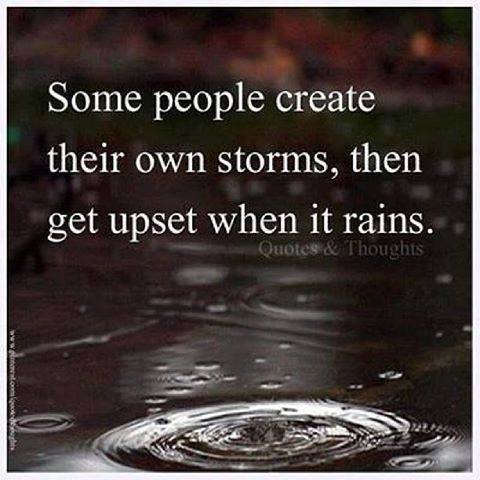
Often we create our own storms, and then do what the poster says–get upset.
Why? Because the turmoil we created could have been avoided. When we know something is sinful, but do it anyway, we break the levee holding back the storms of consequence. We are inundated with self-imposed rain in our life.
Three factors come to the forefront in this mess we have created for ourselves. The first is Guilt.
Guilt is an affective state in which we experience conflict at having done something that we believe we should not have done—or conversely, having not done something we believe we should have done. It gives rise to a feeling which does not go away easily. And guilt is driven by conscience.
Conscience is the second factor—though it precedes our actions (if we’re listening to it). Conscience is the part of our minds that makes us aware of our actions as being either morally right or wrong. And this awareness ought to come before we do anything–always.
Now, that’s hard due to the many distractions around us. It is surely hard for me. Yet can’t we make a consistent commitment of even a few seconds of silent questioning before we make decisions? After his conversion to a much more moral life, Saint Augustine advocated a return to one’s conscience and an actual questioning of it.
And what will come from this questioning of ourselves? The third factor: Divine Grace.
Divine grace is a theological term present in many religions. It has been defined as the divine influence which operates in humans to regenerate and sanctify, to inspire virtuous impulses, and to impart strength to endure trial and resist temptation.
Guilt can turn us around. Conscience can deter us next time. But Divine Grace can thoroughly heal and change us if we are open to it. It can shelter us in our self-created storms. It can turn us from the old, flawed years, and create something brand new within us.
Do you want change? How long will you wait for it to happen? Because it won’t, without you. For anything to happen there must first be a personal action.
I’m a great procrastinator. I know what I want to happen. I know what it will take to make it happen. Yet I wait. Why? Because I’m lazy, or overwhelmed by the task, or fearful I won’t succeed? Do you ever feel that way?
What does it take to get ourselves going?
The sluggard does not plow in the autumn; he will seek at harvest and have nothing–Proverbs 20:4.
We tell ourselves that happening things take time. No one builds a house in a day. A business doesn’t start off amazingly successful in its first week. An education can take twelve plus years. But each of these require a first step, a starting point–an action. Otherwise they are only wishes blown in the air.
The first step toward change is not physical. It is spiritual. It cannot be touched or seen by those outside us, because the change first comes from within us in the form of belief in something greater than our procrastinating self. That belief–that we can change–begins and ends with God, our maker.
Change creeps in when we reach out to put ourselves in His hands, under His protection. But this is not easy. There will be silent voices in our heads that tell us: You can’t do this, and then, give us all sorts of excuses as to why we should continue with the same behavior we want to get rid of.
So we lie, again and again, to ourselves about what we think makes us happy. Except all the while, we’re coming closer and closer to sinking to the bottom, not giving ourselves a chance to know what True happiness can be.
Will we continue to wait for the wreckage of our lives to come? Or will we take the first step toward being the person we were meant to be, and allow ourselves to rest in the protection of mighty arms?
Southern writers have often been insecure with their history which has been balled into one word: racism. And many have overcompensated and run away from their heritage. But you can’t run away from history, or the evil in it, anymore than you can run away from your sins.
A few decades ago, when a native southerner looked at the whole of America, it was often from a fixed point of distance, as an outsider. Because Southerners are the only part of the nation who ever knew defeat. Even though today’s south is more like the rest of the country, native southerners are still oriented toward their history; a history that encompasses their family lines, losses, and loves.
As a writer of southern fiction and a Catholic with deep roots in the Bible Belt South, I come from a line of courageous women who passed down their faith–women who married Protestant husbands they loved. In fact, these three generations of women literally loved their men into the Catholic Church.
Like the Catholic Church, a southern writer recognizes evil. And we may experience a sense of hypocrisy in other regions of our nation who point fingers. We may feel that some from those other regions are so concerned with the morals of southerners that they ignore the evil occurring where they live. Other countries have oppressed a people, and even now, are oppressing entire populations. Oppression is a human problem–on a large basis and on a small basis, one individual to another. And you will find it everywhere, especially in the stories of southern authors.
Some say southern writers have lost their identity, that they are no different from other writers. But we are different. Today, we don’t have to defend ourselves, we only have to forgive ourselves. And because we can forgive ourselves, southern writers and southern people have a distinctiveness, perhaps enough distinctiveness to enlighten and even humanize today’s American culture. A huge plus in that humanization might be that southerners are talkers, and listeners, which is always better than political polarization or hiding from the problem.
So what happens when a southern writer is also a Catholic writer? Great things, according to a great southern Catholic writer and subjective thinker, Walker Percy who said, “Science cannot make a single statement about the individual man, but a novel can. What it is to be a man struggling in a particular time, with a particular problem, in a particular place.”
The subjective thinker is not a scientist-scholar; he is an artist. To exist is an art. The subjective thinker is esthetic enough for his life to have esthetic content, ethical enough to regulate it, dialectical enough in thinking to master it. The subjective thinker’s task is to understand himself in existence.– Soren Kierkegaard, Concluding Unscientific Postscript
A subjective thinker understands that we exist only because God exists.
Catholic fiction shines out the existence of God when our human deficiency keeps us from recognizing it. A Catholic writer seeks a truth that is higher than anything material. And he must have passion enough to do it because everything worldly will speak against him. So he goes about trying to understand himself as a person. He/she must think and write subjectively as a human being related to God. He must see himself as a child with a Father who loves him. A child who is often disobedient, and yet, at times completely in line. And he must see that his Father’s love does not disappear in either situation. When a Catholic writer sees himself as both ugly and beautiful, but nevertheless loved, he or she will write about that. But the subjective thinking comes first.
And this takes me back to the subjective Southern writer in general, mastering his past in the section of the country that shouldered the evil of slavery like the Jews shouldered the Crucifixion of Jesus. Forced to stand on a scaffold with a scarlet letter, exposed to public humiliation like Hester Prynne. The historical Southerner was a wayward child, like the prodigal son–except that the Southern child was not forgiven as was the Prodigal Son in the Bible. He was punished—and became defensive. A guilty child standing in the middle of his condemning brothers and sisters with stones in their hands.
The South is used to vindictiveness and human violence. The South is used to crucifixions, but at the same time we’re used to familiarity with others, and a set of manners that we still hold to, based in the Christian faith about the way things ought to be. On the worst of days, we become defensive if attacked. But on the best of days, we accept our history, and we accept our people—all of them.
And then, we do what we do best–we talk and we listen. We talk about the lives of people in our towns from generations back. We know what happened to them and why it happened. We listen to the ways good and evil singularly affected them, and to how it affects us today. Native southerners think as subjectively as Catholics do.
Some stories may be embellished—southerners are great at that. Some stories may be so entirely malevolent, or heartbreaking, that they’re hard to hear, but like the Catholic Church, a writer of southern fiction expects her characters to sin. And also like the Church, the writer creates an open door to forgiveness and offers a welcoming home.
The writer, like any artist, is called to bring people closer to God through beauty expressed, truth told, and virtue taught. Simple as that. — Father George Rutler
“In a time when traditional religion is viewed as suspect, passé, or offensive, many authors and artists are uncomfortable talking about their personal religion or spirituality, while others grope for new ways to say “God.” They attempt to articulate an amorphous truth in an “elsewhere beyond language,” in the words of Fanny Howe, but use language to explore their way toward it. The Institute for Scholarship in the Liberal Arts at the University of Notre Dame—together with Sick Pilgrim, Patheos, Image, and St. Michael’s College in Toronto—will bring together both well-known and emerging writers, artists and musicians who are wrestling with religious experience and traditions in new ways. We will feature authors in all literary genres: poetry, fiction, creative nonfiction and memoir, fantasy, and science fiction. We want to create a community of support, encouraging each other in a world that is dismissive and outright hostile toward our faith to continue Trying to Say God in our own distinctive way.” —Trying to Say God website https://www.tryingtosaygod.com/
I am so happy to be a small part of this conference from June 22-24, 2017, at the University of Notre Dame. I’ll be serving on a discussion panel entitled, “The Marian Effect: Building Strong Women in Writing and Life,” along with these strong and talented women: Angela Carlson, Suzanne Wolfe, Karen Beattie, Caroline Langston Jarboe, and my good friend, Karen Ullo. Our moderator will be Angela Cybulski.
“The writer, like any artist, is called to bring people closer to God through beauty expressed, truth told, and virtue taught. Simple as that.” — Father George Rutler
If you’d like to attend, Trying to Say God, click on the website.
Our personal demons never really leave us. They hover very close to the things we desire, waiting to turn us in harmful directions. So often, and in various ways–through people, or events– we are warned to beware of them, but just as often, we set the warnings aside. And we can do that, why? Because each of us has Free Will. And this is central to the books I write.
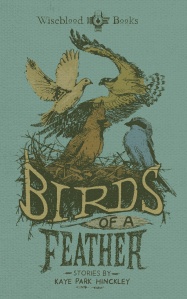
Each story in my collection, Birds of a Feather, published by Wiseblood Books, is about a character with personal dragons who utilizes his or her free will in keeping or dismissing them.
Lucy Adams, Lake Oconee Living Magazine journalist and reviewer, gave Birds of a Feather one of my favorite reviews. She understood that my collection is propelled by curiosity about human nature. Here’s Lucy Adam’s entire review:
“No one lives without despair and hope, grief and joy, tears and laughter, selfishness and gratitude, jealousy and empathy, self-loathing and self-love, destructiveness and creativity. Though we focus on differences, attempt to elevate our worth above others, justify our righteousness by comparing deeds, we essentially are all the same. As Kaye Park Hinckley’s collection of short stories is titled, we are Birds of a Feather.
The theme of all the stories is sin and salvation,” says Hinckley, “the sinfulness of everyone and the opportunity for everyone to take advantage of God’s mercy.” Raised in the Catholic Church in the deep South, Hinckley crafts each story in Birds of a Feather out of her Southern heritage and her Catholic faith. “What I want people to take away from this book,” says Hinckley, “is that we are all created in the divine image of God.” Intertwining religion with regional culture, the collection is classic Southern literature in the same vein as short stories by the likes of Flannery O’Connor, whose work strongly influences that of Hinckley.
Hinckley writes characters who are shocking, flamboyant, disturbed, unkind. She writes characters who are merciful, gracious, empathic, loving. She writes characters who demonstrate the dualities of human nature. Edmund, in “Shooting at Heaven’s Gate,” allows himself to be used by evil. Rather than condemn his actions, Hinckley pushes her reader to acknowledge the frailties of the human heart. “We all are capable of doing great evil,” explains Hinckley. “Why does a person do this? I like to know reasons.” Curiosity about human nature propels her plots.
Don’t seek clearly defined protagonists and antagonists here, however. Hinckley’s characters are complicated. They’ve done horrible things, witnessed horrible things, been the victims of horrible things, yet they continue rising each morning and putting one foot in front of the other. They fulfill their obligations to each other while these horrible things gnaw at them from the inside out. Hinckley deftly presents the repulsiveness of her character’s actions, while also revealing her characters’ drive toward love.
In the story “Dragon,” Liz harbors guilt and secrets about a vengeful act that she believes revealed her true nature, which she pours out to a roadside café waitress as if making a confession. Her confessor comforts her, saying, “Listen Shugah, we all got to pass by the dragon . . . Don’t give him nothing else to eat.” The power of sinfulness is juxtaposed against the power of God’s mercy. The capability to do great evil lies next to the ability to advance great good.
In the midst of turmoil and wrestling with truth, Hinckley injects humor so familiar, it causes the reader to recognize himself. “Red Bird” poignantly traces the ocean of dementia into which the main character, Jude, drifts without fighting the tide. His wife, conflicted in her anger over his past wrongs and her duty to care for him in his illness, addresses him with irritation, asking, “Don’t you know who I am, Jude?” He doesn’t, so he grins and replies, “Don’t you know who you are?”
Birds of a Feather contains ten short stories that hearken to Hinckley’s Alabama childhood, Georgia roots (on her mother’s side), and Catholic faith. She masterfully manipulates the English language and the vernacular to generate fully developed plots and well-rounded characters. Drawing on the influences of Flannery O’Connor, William Faulkner, and others, she infuses her writing with a bounty of symbolism. Most of all, she is fair, always fair to her characters and her reader. She allows them to make their own choices and to draw their own conclusions. Because, at the very core of the human condition, of us all, of Birds of a Feather, is free will.–From Lake Oconee Living Magazine
We are the world’s arms. We are the caretakers of human hearts. We are natural lovers.
But today’s modern world has confused many of us as to who, and what, we’re meant to love.
This is a time of self-love. Well, we should love our self. Why?
Because we know exactly who we are. And it’s who we are that gives our lives meaning and purpose.
Both men and women spend lots of time looking in mirrors, but there is much more to us than what we see there. Our true image is far beyond the mirrored one. The mirror, like the world, would have us see our wrinkles, a bad-hair day, or the extra twenty pounds we don’t want. The mirror says we have to do something about the way we look to others. It doesn’t show our true self.
The mirror doesn’t see is what’s inside us–all that makes us who we are. Our memories, our intellect, and every choice we have made, and will make, through our free will. These are gifts directly from God that either show, or do not show, the authentic person we are.
We are not meant to be God’s beauty queen or His handsome prince. We are meant to love. We are meant to act, and act lovingly. We are the message of His love in our world.
And that is not something we can see in a mirror, but something we do when there is no mirror around.
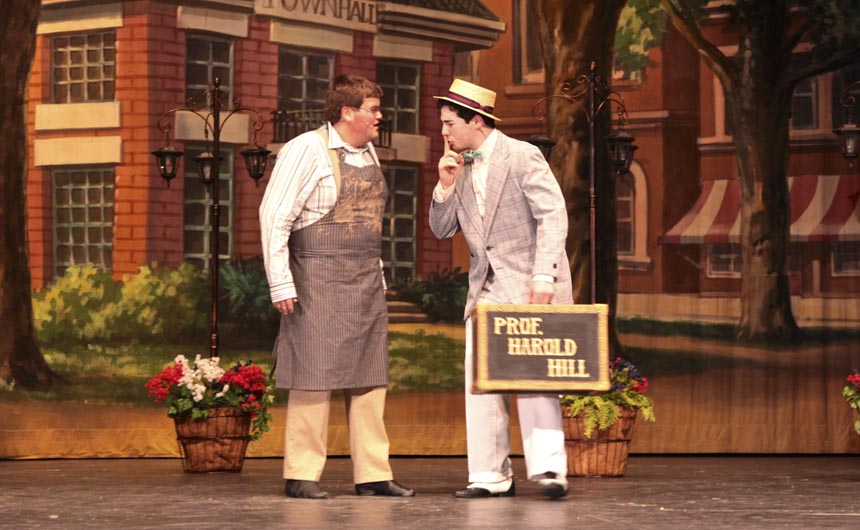
Two years ago, my husband and I went to New Orleans to see one of our grandsons in “The Music Man,” playing the role of the infamous Professor Howard Hill. Then, our grandson was a junior at Jesuit High School. Now he’s a freshman at Catholic University, studying Theatre Arts. I will never forget The Jesuit High School production. It was fabulous, and so was my grandson. 🙂 You can see from the above picture how professional it was.
From the onset of the play, the audience instantly recognizes Professor Hill as a Con-man who gains the trust of a small town in order to sell them a bill of goods (in this case, band instruments) and make money for himself. Of course, in the end, he changes his tune, so to speak. The very successful Broadway play was the fantasy of American composer, Meredith Wilson.
But in real life, con-men, or women, are not fantasy. There are many, and they are real.
Can you recognize a Con-man? (i.e. a Confidence man, or woman)
He or she is a practitioner of confidence tricks–an attempt to defraud a person or group after first gaining their confidence, used in the classical sense of trust. He/she makes himself a false shepherd that people will follow. And next, he or she exploits the characteristics of the human psyche such as dishonesty, honesty, vanity, compassion, credulity, irresponsibility, naïveté and greed.
If we practice awareness, we’re able to see con-men all around us. We deal with them everyday in our government, in business, and perhaps even in our own families.
They stir up trouble and create distractions so that their selfish ways can be accomplished.
A fanciful Con-man (or Con-woman) is great fodder for a play or musical. But a real Con-man is dangerous. This so-called shepherd of the people, does not genuinely work for, or care, for his sheep. He works only for himself and leads people astray to accomplish his personal ends.
Today, more than ever, we need good shepherds to lead our government, our businesses, our families. And I pray that we find the persons to do that–and that they will mirror our ultimate Good Shepherd, whose grace is always present, and available to everyone–even to the worst of Con-men.
I am the good shepherd.
A good shepherd lays down his life for the sheep.
A hired man, who is not a shepherd
and whose sheep are not his own,
sees a wolf coming and leaves the sheep and runs away,
and the wolf catches and scatters them.
This is because he works for pay and has no concern for the sheep.
I am the good shepherd,
and I know mine and mine know me,
just as the Father knows me and I know the Father;
and I will lay down my life for the sheep.
I have other sheep that do not belong to this fold.
These also I must lead, and they will hear my voice,
and there will be one flock, one shepherd.
This is why the Father loves me,
because I lay down my life in order to take it up again.
No one takes it from me, but I lay it down on my own.
I have power to lay it down, and power to take it up again.
This command I have received from my Father.– Jn 10:11-18
“I decline to accept the end of man… I refuse to accept this. I believe that man will not merely endure: he will prevail. He is immortal, not because he alone among the creatures has an inexhaustible voice, but because he has a soul, a spirit capable of compassion and sacrifice and endurance. The poet’s, the writer’s, duty is to write about these things. It is his privilege to help man endure by lifting his heart, by reminding him of the courage and honor and hope and pride and compassion and pity and sacrifice which have been the glory of his past. The poet’s voice need not merely be the record of man, it can be one of the props, the pillars to help him endure and prevail.” ― William Faulkner
If we believe there is a God who created each of us, then each of us is a child of God. And each human person has the divinity of God within him, or her. We call this divinity within us, the soul. It is the only part of us that doesn’t die. That makes the soul, and what happens within it, essential.
As Faulkner says, the soul is spirit, just as God is spirit, and capable of great compassion, enormous sacrifice, and inexhaustible endurance. We see these capacities expressed in many good people that we know, and sometimes we express those same qualities ourselves.
But often, compassion, sacrifice and endurance are not expressed by a person’s spiritual nature. Sometimes, he expresses the opposite. To an author, this is food for a story. This is the opportunity to illuminate the battle between good and evil as Faulkner and many other writers of substance do in their work.
Because there is today, and always has been, a battle between what is inherently good, and what is inherently evil, it is natural for an author to write about it. In a story, this plays out in particular characters—-people like us who struggle with what they believe is right and what they know is wrong. All of this happens in the soul, where our intentions lie. And we either shine our soul, or sully it, by our various decisions to accept good, or evil.
Most of us don’t like to hear that we can choose between good and evil. Some of us don’t even recognize evil anymore. We can’t put a face on it because today’s humdrum, saccharine tolerance for ‘anything goes’ has blocked it out and blinded us to the better call in our own souls. But a thing is not good or evil because it’s trendy or popular.
I think, deep down, most of us know that truth is truth. Deep down, we know that absolute Truth endures, that it is not relative to public opinion, and that it is a twin of immortality. For me, it is most important for a writer to remember that, too.
A seesaw is a long, narrow board pivoted in the middle so that, as one end goes up, the other goes down. A person sits on each end, and they take turns pushing their feet against the ground to lift their side into the air. Playground seesaws usually have handles for the riders to grip as they sit facing each other.
Life is like that, isn’t it? We face each other. We go up and down. Up and down.
One minute all seems right, the next minute our world comes crashing down. It might be divorce, death of a loved one, debilitating disease, loss of livelihood, a dream gone wrong, or hurtful words or lies, targeted at us by another.
Or we may be the one who brings down our own world by the bad choices we make. We are made to be people of goodness, but sometimes we corrupt ourselves through addictions, hanging around bad company, forgetting who we are—-children of God.
We are on a dangerous end of the seesaw then. We might think it’s over for us. But we should never give up trying to find our balance again.
One problem with a seesaw’s design is that if a child allows himself/herself to hit the ground suddenly after jumping, or exits the seesaw at the bottom, the other child may fall and be injured. For this reason, seesaws are often mounted above a soft surface such as foam or wood chips. In other words, a soft place to fall.
Because in life, we will certainly fall at one time or another. None of us is perfect yet. All of us here on Earth sin against our innate goodness.
And in doing so, we condemn ourselves. Still, don’t give up.
Strangely enough, God doesn’t condemn us. He forgives when we ask Him to. The softest place for us to fall is into His merciful and loving arms.
How you ever wished for an imaginary “help button” that would give you immediate assistance with a significant problem? Well, you do have one.
You have the mercy of God.
What do we know about God’s mercy? Have we seen it work in our lives, or do we notice it at all? Do we notice that despite our sinfulness, God still loves us–and waits for us to love Him in return?
Think of the parable of the merciful father whose son returned to him after taking his inheritance and squandering it. Always, the father is waiting for his son to come home. Finally, when he catches sight of his wayward boy slinking back because he has no place else to go, the father runs to meet him with joy, despite what his son has done.
Did you know you are loved like that? You are loved by God.
Do we think our sins are too big, too disgusting to be forgiven? Are we afraid of what God might do to us because of our sins? But again– He loves us.
I am certain that He will do nothing except love us–loves us through our sins, and His love will rid us of them if we let it. Trust in that.
“Let us always remember this in our lives as Christians: God always waits for us, even when we have left him behind!” Pope Francis, The Church of Mercy



 “In a time when traditional religion is viewed as suspect, passé, or offensive, many authors and artists are uncomfortable talking about their personal religion or spirituality, while others grope for new ways to say “God.” They attempt to articulate an amorphous truth in an “elsewhere beyond language,” in the words of Fanny Howe, but use language to explore their way toward it. The Institute for Scholarship in the Liberal Arts at the University of Notre Dame—together with Sick Pilgrim, Patheos, Image, and St. Michael’s College in Toronto—will bring together both well-known and emerging writers, artists and musicians who are wrestling with religious experience and traditions in new ways. We will feature authors in all literary genres: poetry, fiction, creative nonfiction and memoir, fantasy, and science fiction. We want to create a community of support, encouraging each other in a world that is dismissive and outright hostile toward our faith to continue Trying to Say God in our own distinctive way.” —Trying to Say God website







 Translating a World on the Edge