imagesCXCYE23Z

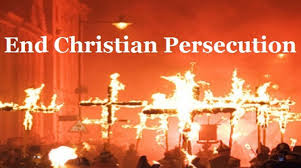
We must take notice of what is happening in our world today. Evil in the form of The Islamic State is knocking at the front door of America and we need to stand against it.  Many  have warned about this evil in the past.

BpSheenBishop Fulton J Sheen wrote in 1950:

“Today (1950), the hatred of the Moslem countries against the West is becoming hatred against Christianity itself. Although the statesmen have not yet taken it into account, there is still grave danger that the temporal power of Islam may return and, with it, the menace that it may shake off a West which has ceased to be Christian, and affirm itself as a great anti-Christian world Power”.

Bishop Sheen again, in 1952:

“The Christian European West barely escaped destruction at the hands of the Moslems. At one point they were stopped near Tours and at another point, later on in time, outside the gates of Vienna. The Church throughout northern Africa ws practically destroyed by Moslem power, and at the present hour, the Moslems are beginning to rise again. If Moslemism is a heresy, as Hilaire Belloc believes it to be, it is the only heresy that has never declined. Others have had a moment of vigor, then gone into doctrinal decay at the death of the leader, and finally evaporated in a vague social movement. Moslemism, on the contrary, has only had its first phase. There was never a time in which it declined, either in numbers, or in the devotion of its followers.”

300px-Belloc_sideHilaire Belloc wrote in 1938:

“Will not perhaps the temporal power of Islam return and with it the menace of an armed Mohammedan world, which will shake off the domination of Europeans — still nominally Christian — and reappear as the prime enemy of our civilization? The future always comes as a surprise, but political wisdom consists in attempting at least some partial judgment of what that surprise may be. And for my part I cannot but believe that a main unexpected thing of the future is the return of Islam”.


Sir Winston Churchill gave the following speech in 1899:

“How dreadful are the curses which Mohammedanism lays on its votaries! Besides the fanatical frenzy, which is as dangerous in a man as hydrophobia in a dog, there is this fearful fatalistic apathy. The effects are apparent in many countries, improvident habits, slovenly systems of agriculture, sluggish methods of commerce, and insecurity of property exist wherever the followers of the Prophet rule or live. A degraded sensualist deprives this life of its grace and refinement, the next of its dignity and sanctity. The fact that in Mohammedan law every woman must belong to some man as his absolute property, either as a child, a wife, or a concubine, must delay the final extinction of slavery until the faith of Islam has ceased to be a great power among men.

untitled (3)

Individual Muslims may show splendid qualities, but the influence of the religion paralyses the social development of those who follow it. No stronger retrograde force exists in the world. Far from being moribund, Mohammedanism is a militant and proselytizing faith. It has already spread throughout Central Africa , raising fearless warriors at every step; and were it not that Christianity is sheltered in the strong arms of science, the science against which it had vainly struggled, the civilization of modern Europe might fall, as fell the civilization of ancient Rome .”


Pope Francis, Last Sunday, 2014:

images (12)

“Hatred is not to be carried in the name of God…War is not to be waged in the name of God.”
The Vatican’s Pontifical Council for Inter-religious Dialogue said Isis had committed “and was continuing to commit unspeakable criminal acts”. To reinforce the point, it listed some of the atrocities for which Isis is reported to have been responsible. They included “the massacre of people solely for reasons of their religious adherence”; “the execrable practice[s] of decapitation, crucifixion and hanging of corpses in public places”; “the choice imposed on Christians and Yazidis between conversion to Islam, payment of a tax (jizya) and exodus”; “the forced expulsion of tens of thousands of people, including children, old people, pregnant women and the sick”; “the abduction of women and girls belonging to the Yazidi and Christian communities as war booty (sabaya)”, and “the imposition of the barbaric practice of infibulation”.

images (11)In 1967, Martin Luther King, Jr. said:

“He who passively accepts evil is as much involved in it as he who helps to perpetrate it.”


We have to be aware of  the tragedies taking place.  And be courageous enough as a nation–the greatest nation on Earth—to take a substantial stand against evil.

We cannot use fatigue or fear as an excuse not to act. ASAP.

To be honest……well,  we may need to be Rambo.

OLYMPUS DIGITAL CAMERAWhen we assess our lives,  it’s  often  from a superficial point of view.

We  look at how popular we are, how successful we are, how much money we make, how big our house is, what clubs we belong to, and then we ask ourselves, “Who is noticing my successes? How do I look in their eyes?” Many times, our very self worth is contained in the dubious answers to those questions.

But if we spend our whole lives chasing after people who might notice us, and ‘stuff’ that makes us feel important, then we have seriously missed the boat.

There is only one question we need to ask ourselves–and it is crucially important to us in the ‘here and now’ because the answer to it will determine our eternity. The question is: What does God, in all His magnificence, expect from Me?

God does not care if you are pretty, handsome, or just plain. He does not care if you have a fan club of thousands reading your Facebook page and clicking “like.” He does not care if you live in a big house, a trailer, or a shack. And He certainly does not care about your bankroll.

It’s really very simple. What He cares about is how much you love and the way you love.

Attempting to understand and be patient with a trying person or child is a way to love. Loyalty to a spouse despite the difficulties in marriage is a way to love. Self-sacrifice for a greater purpose is a way to love. Toning down anger toward someone who’s hurt you is a way to love. And I’m sure you could list numerous other ways.

The point is, what God expects of us has nothing to do with making ourselves large in life, but in making ourselves small enough to consider the needs of others.

We may think we’re so smart, and maybe we have more educational degrees than anybody we know, but we’ll still be only ‘educated fools’ —unless we realize that right here, right now, we’re creating our own eternity, based only on how much we’ve loved others and respected ourselves as children of God.

In a nutshell, that’s all that is truly important.

What Are We Waiting For?

Posted: August 12, 2014 in World On The Edge

3f6fb1bWe are beings with the ability to make choices. But often we’re reluctant to make them. Sometimes that’s because we don’t want to take on the responsibility of what might happen after we make our choice, or our stand on some issue. Is this laziness, or a lack of courage? I think it might be both.

But there are some choices that are so important we must find the courage to make them–and not later, but now. Oh, I’ll get to it someday just doesn’t cut the mustard when it comes to something as important as our soul and where it will spend eternity.

As a youth, Saint Augustine lived a hedonistic lifestyle for a time, associating with young men who boasted of their sexual exploits with women and men. They urged the inexperienced boys, like Augustine, to seek experience or to make up stories about their experiences in order to gain acceptance. It was during this period that he uttered his famous prayer, “Grant me chastity and continence, but not yet.”

Like Saint Augustine, some say they will wait for the right moment to change their errant ways. But what if we aren’t given a right moment? What if we’re suddenly given no more moments at all.

We can go on and on for some time in our addictions, selfishness, meanness, and refusal to listen to the Word of God. But we cannot go on forever. There will come a time when our earthly life will be extinguished.

So how long will we wait to do what we know in our hearts we need to do? How long will it take for us to quit slapping God’s love  away and instead,  turn toward it?

Brick House?

Posted: August 7, 2014 in World On The Edge

kph52013's avatarTranslating a World on the Edge

OLYMPUS DIGITAL CAMERAFor the last week or so, I’ve been watching The Three Little Pigs on Netflix. It’s Disney’s original 1933 version and my grandchildren love it as much as their parents did. You know the story. The first little pig builds his house of flimsy straw, the second pig builds his house of destructible sticks, and the third little pig builds a model house, a house of sturdy bricks. The first and second pigs hurry to get through quickly so they can go to play. The third little pig builds slow and methodically, mortaring between each brick. He doesn’t have time to kick up his heels. And then comes the Big Bad Wolf. He blows down the haphazard houses of the first and second little pigs and threatens to eat them. So they run for safety to their brother’s house of brick.

My husband and I met at seventeen and married…

View original post 218 more words

Brick House?

Posted: August 7, 2014 in World On The Edge

OLYMPUS DIGITAL CAMERAFor the last week or so, I’ve been watching The Three Little Pigs on Netflix. It’s Disney’s original 1933 version and my grandchildren love it as much as their parents did. You know the story. The first little pig builds his house of flimsy straw, the second pig builds his house of destructible sticks, and the third little pig builds a model house, a house of sturdy bricks. The first and second pigs hurry to get through quickly so they can go to play. The third little pig builds slow and methodically, mortaring between each brick. He doesn’t have time to kick up his heels. And then comes the Big Bad Wolf. He blows down the haphazard houses of the first and second little pigs and threatens to eat them. So they run for safety to their brother’s house of brick.

My husband and I met at seventeen and married when we were twenty one. At that time, we were probably a lot like the first and second little pigs. We weren’t worried about safety, we wanted to play. (more…)

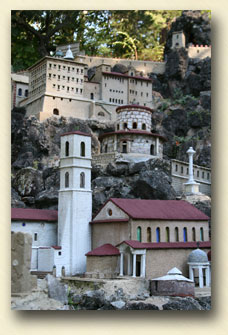
grotto1Some years back, when I taught Religion to Catholic teenagers, I was responsible for a group trip to Ave Maria Grotto in Cullman, Alabama. Known throughout the world as “Jerusalem in Miniature,” the Grotto is a beautifully landscaped, four-acre park designed to provide a natural setting for the 125 miniature reproductions of some of the most famous historic buildings and shrines of the world.

The masterpieces of stone and concrete are the lifetime work of Brother Joseph Zoettl, a Benedictine monk of St. Bernard Abbey. Begun as a hobby, with various materials he could find, and infinite patience and a remarkable sense of symmetry and proportion, Brother Joseph re-created some of the greatest edifices of all time.

Before the teens and I visited the Grotto, we took a trip about TRUST through the nearby woods. On that trip the teenagers, another teacher and myself, divided into pairs. One person in each pair took a turn wearing a blindfold while the other person led him or her through the trees, over stones, across a stream. The one in blindfold had to trust completely in the other to give him verbal instructions to keep from bumping into a tree, tripping on a stone, or falling into the winding stream. Then the partners changed places, with the other putting on the blindfold. I will never forget the trust I had to put into the other teacher–because I’m a control freak and to be walking blind was something I didn’t like to do.

But this is what we have to do when we put our Trust in God. We don’t know where we’re going, but we love and trust Him enough to allow Him to lead us there. We even don’t know if we’re actually following His Will when we go through our daily lives in our families, or jobs.

The important thing is that we try to please God in whatever we’re doing. And if we do this, He will be at our side.

The idea from the trip into the woods came from a prayer–one of my favorite prayers–by Thomas Merton, an American Catholic writer, mystic, and Trappist monk of the Abbey of Gethsemani, Kentucky.

Here it is on video.  Isn’t it a wonderful prayer for each and every day?

Is God Talking To ME??

Posted: August 5, 2014 in World On The Edge

0 (2)How do we know if–and when–God is talking to us? Does he talk only to Saints? Or does he talk to ME?

Sometimes all we have to is shut our own mouths, and listen. God often speaks in the silence of our thoughts, or if we’re reading something spiritual, like the Bible. When you read God’s Word, you must constantly be saying to yourself, ”It is talking to me, and about me.”” –Soren Kierkegaard

But conversation is a two-way street. If we want God to talk to us, we must talk to him. Ask questions, and expect an answer just as we would from a relationship with a friend.

And this is the point–a relationship. Relationships with friends, co-workers, boyfriend/girlfriend husband/wife, and family are important components of our lives. So, why shouldn’t we be in a relationship with our Creator? The spiritual part of us is equally as important as the physical part of us, yet so many shy away from it. And others negate it altogether.

I think I’m so fortunate to live where I do, in a place that often discusses God, and these are people who even talk about ‘talking’ to God. There’s no ‘hush, hush’ in speaking the name of Jesus Christ, no hesitance to ‘give God the Glory,’—a phrase often used by local Protestants. I don’t mean in church either. I mean in the grocery store, the Mall, or the dentist’s office. If you want to talk about God, or to God, you just do it.

Make no mistake, God is talking to us–to you and to me. It may be through prayer, it maybe through other people, it may be through difficult circumstances–but He is talking. And it is very important in our relationship with God that we respond. Friend to friend. Child to parent. Lover to lover.

330px-Viktor_Frankl2 (2)Viktor Frankl was an Austrian neurologist and psychiatrist as well as a Holocaust survivor whose concentration camp experiences shaped both his therapeutic approach and philosophical outlook. His life as a concentration camp inmate led him to discover the importance of finding meaning in all forms of existence, even the most sordid ones, and thus, a reason to continue living.

After three years of imprisonment during the Holocaust, he wrote Man’s Search for Meaning

He often said that even within the narrow boundaries of the concentration camps he found only two races of Men to exist: decent men and unprincipled men–and that these were to be found in all classes, ethnicities, and groups. And it stemmed from Attitude.

Here is what he said about Attitude: …Everything can be taken from a man but one thing: the last of the human freedoms — to choose one’s attitude in any given set of circumstances, to choose one’s own way.” Viktor E. Frankl

One definition of attitude is that it’s an expression of favor or disfavor toward a person, place, thing, or event (the attitude object). Prominent psychologists describe attitudes as the most distinctive and indispensable concept in contemporary social psychology. But a deeper look at our attitudes will often expose our personal Character.

Character is what we are when we don’t have an audience–and also, at times, when we do have an audience–because it takes Character to stand up with courage if something  crucially  important needs to be said, or expressed with an action.

Of course,  our attitudes reflect what we think is important, and attitudes can change. What’s important to a teenager is not what’s important to an adult. Some believe that a person’s Character is set and cannot be changed.  Not so.  But what can change  it?

The character of Paul, the apostle, changed dramatically when he surrendered to God. Once he’d been a murderer of those who  believed in Jesus; but his character was re-formed and he  spread the good news of Jesus Christ all over the Gentile world.  How did this happen?

In Paul’s words from First Corinthians: By God’s grace I am what I am, and His grace toward me was not ineffective.

Paul’s new life in Christ is Biblical evidence that the grace of God can change character. And give that person’s character a new meaning.  Haven’t you seen the character of some people change for the better?  Don’t you know of people who have changed the entire meaning of their lives from insignificant to significant?  I know I have.

This change may come after surviving a crisis, through a prompt of Grace that brings about  a personal  re-assessment of our life.   Or it may come during great suffering, when we search for meaning.  Or it may come because God keeps giving you those divine pushes, and all you have to do is go along.

No matter the circumstance, and however it comes, change is always possible.  It’s part of our humanity as children of God, longing to be like Him.

Last night, I received this excellent review of my short story collection and wanted to share it. Jeannie Ewing is quite a lovely lady and blogs at http://www.lovealonecreates.com/

Book Review: Birds of a Feather

Birds_of_a_Feather_FRONT_PUBLICITY_JPGKaye Park Hinkley’s new release, a collection of short stories entitled Birds of a Feather, is difficult to categorize and yet birds of a feather is one of the most artistic pieces of literature I have read in quite some time. Hinkley has been compared favorably to Flannery O’Connor, but I confess I have not read O’Connor’s works and therefore am unable to make an honest and adequate comparison between the two.

Hinkley’s writing in Birds of a Feather is as diverse as literature can get, though her voice is steady, unique, clever and grabs the reader with fascinating and thrilling hooks almost immediately. Each story followed a theme of sin and redemption, peppered with deep spiritual underpinnings and rich with colorful Catholic heritage and imagery. Hinkley’s use of language is innovative and powerfully descriptive; her writing is one of the most vivid and raw depictions of human character and emotion I have read from any modern piece of literature.

The tales in Birds of a Feather are ones of humanity, with our commonality of brokenness and longing for healing threaded throughout; I am astounded at Hinkley’s ability to accurately capture myriad settings, eras, and cultures: from late nineteenth century high society to stereotypical hillbillies, from modern psychological thrillers to tender romances, Hinkley wrestles with the very real and raw emotions, struggles, and darknesses that plague humanity throughout history and time. She is honest, mingling grief and love, life and death, in nearly every story. I was often left processing each one for hours after I read it; her narratives aren’t clean with happy endings, but rather they depict the complexity of our interminable striving for the good while battling our vices.

Hinkley writes from the perspective of the main character – sometimes in first person, sometimes in third, immersing her words into their very psyches and souls, which is what strips this collection of any cliched and stereotyped categories of fiction. For at least a few of the tales, she echoes Edgar Allan Poe with disturbing brilliance, which both stunned and fascinated me.

Birds of a Feather is not written for the novice or recreational reader; it is not for the faint of heart. It is written for the reader who is self-aware, who thinks and feels deeply, who recognizes the interrelated existence among all of humanity. It tugs at the core of one’s soul, begs for a tear or two, and challenges one’s intellect while breaking down layers of personal and social barriers related to religion, personality, age, gender, culture, and socioeconomic status.

In essence, everything written in Birds of a Feather reminds the reader that everyone has a story, every life has value and purpose, and it is impossible to speculate about another person’s life journey. This realization necessitates an increase in humility and empathy for the united struggle of humanity, the fact that no one is exempt from sin and suffering in this life. And yet we are all beckoned beyond ourselves into a realm of eternal hope and joy. This is the ultimate message of Birds of a Feather.




Mama’s Love

Posted: July 25, 2014 in World On The Edge

IMG_5553“Mama’s Love”  is not a noun with a possessive adjective preceding it.  It’s an action, one that lasts a lifetime. I know this from loving my own children. But I also know it from the love of my  mother.

I was a shy child, always I wanted my hand in the hand of my mother. And her hand was always there. Sometimes not physically–after all, I had to grow up, be courageous, lose my timidity. She helped me do that. She saw that I loved to draw and gave me art lessons. Everything I drew or painted, she was proud of and showed it off–especially to her Bridge Club, a group of ladies who ended up playing bridge together, once a week for fifty years!

But still,  the idea of  her hand in mine, and the knowledge she would be there for me, no matter what, was  pasted into my thoughts. It gave me security. SHE gave me security. She gave me confidence in myself.

And she prayed for me, and for our family and friends. I remember kneeling around her bed at night for the rosary. Many times I wanted to do something else. For those who are not Catholic, the five decades of the rosary usually end with a prayer to the Blessed Mother, “Hail Holy Queen.” But not for my mother! She went on, with prayers to St. Jude for the sick and hopeless, prayers to St. Michael for our protection, prayers to the Holy Spirit that we might have courage, and on and on. And me? I used to pray for the phone to ring!

My mother was a beautiful woman—really. She received many compliments for that, but she knew people, too.  She knew when words were just show, and when they were sincere.  “People will sometimes tell you what they think you want to hear. Use your head to determine the truth.”  Not to be taken in by everything I read or heard was another thing she passed to me.

My mother had an ability to read people. And sometimes I thought she read them a little too harshly.  She was honestly compassionate, but occasionally, she dug her heels in when it came to who I was allowed to be around, or date. My mother had standards, and in her mind, people would either accept her principles,  or –should I say?–depart from  her company—because she changed her deepest principles for no one. One more characteristic she set into me.

As far as her Faith–it  was simple. Simple,  yet astounding at times. She grew up Catholic in the Protestant South, one of only three or four Catholics in her high school. She never denied it. She never shrank from it around her Protestant, and Jewish, friends–and she had many, caring about each one.  But it was  her church she loved and was faithful to, the same little white church I grew up in. One more precious gift–my Faith.  So, thank you, Mama. You were and always will be, my Rock.