morguefile free photo

Kakisky 2010 morguefile.com photo

Oh, I would love to be perfect! I’d love to make a commitment and stick to it–all the way to the end–for once! I hate that I slip and slide when I say I’m going to stand firm and climb. What makes me do this? What makes you do this? Is it because we’re Only Human?

Well, it’s true: you and I are human. But we are more than that. We are humans with ‘privileges.’ Spiritual privileges. We believe that we can do better. We have faith that we can do better.

And where does our belief come from?

Grace. And Grace comes from God.

Catholics call it Actual grace, those everyday pushes from God to keep going. We may ignore them. We may say, “Not now. Maybe tomorrow.” Well, God will there tomorrow, too; still pushing us. Because He never leaves us. He is there to lift us, help us up after we fall.

So, I will continue to make commitments. I will be relentless in my attempts to stick to them. And so will you, because we are blessed by our Faith, that invisible strength that God gives us. And we need it most when we’re failing, or stumbling, or falling into despair. We need it when we find it so hard to let go of what we know in our hearts we need to release.

We need it to love as we should. We need it to come to the aid of others. We need it to become aware of what is true in this world, and what is not true. And ultimately, we need it to stay on track in working out our own salvation.

Therefore, my beloved, as you have always obeyed, so now, not only as in my presence but much more in my absence, work out your own salvation with fear and trembling; for God is at work in you, both to will and to work for his good pleasure. Do all things without grumbling or questioning, that you may be blameless and innocent, children of God without blemish in the midst of a crooked and perverse generation, among whom you shine as lights in the world, holding fast the word of life, so that in the day of Christ I may be proud that I did not run in vain or labor in vain. (Phil. 2:12–16).


morguefile free photo

morguefile free photo

Because we are human, there is in each of us the desire to acquire. Often we are after ‘things;’ bigger houses, cars, vacations, and lots of ‘stuff.’ Other times, we are after ‘power;’ some authority over others whether it be through our job or relationships.

What is this common personality trait–our desire to acquire–really all about? I think it’s because we are searching for meaning–in our own eyes and in the eyes of others. No one wants to be thought as passing insignificantly through this world, and so we strive to be relevant in some way.

But the desire to acquire can get out of hand. We must use self-discipline, or the very things that we work so hard to get will not give us relevance, but enslavement.

Aesop’s fable of The Boy and the Filberts: “A boy put his hand into a jar of filberts and grasped as many as his fist could possibly hold. But when he tried to pull it out again, he found he couldn’t do so, for the neck of the jar was too small to allow of the passage of so large a handful. Unwilling to lose his nuts but unable to withdraw his hand, he burst into tears. A bystander, who saw where the trouble lay, said to him, “Come, my boy, don’t be so greedy. Be content with half the amount, and you’ll be able to get your hand out without difficulty.”

I wonder if the boy made the decision to curtail his desire to acquire?
Some people just can’t let go. Their possessions and power command them. And always, they want more. Nowhere is this more apparent than in our own misguided government.

“How can men control the growing monstrousness of power when they cannot even control their own appetites? How can they shape political or cultural decisions affecting countless others, when they are continually failing themselves?”

That question was asked by Romano Guardini, a Catholic priest, author, academic, and one of the most important figures in Catholic intellectual life in the 20th century. Guardini advocated that command over the world presupposed a command of self. In other words—clean up your own backyard first, if you’re going to lead or influence others.

Guardini’s question is even more relevant today. When we look around—-maybe even under our own noses—we see people grasping for more.

What we need today, in those who run our government, is self-discipline. We need men and women who acquire a certain distance from things, who refuse to capitulate to the promise of more and more personal power at the expense of those they pretend to serve.

And what we need from ourselves is the same: a curtailment of our desire to acquire. Just as we ask of our leaders, we must recognize the excesses within ourselves and set about to right them.

How about emptying ourselves of all that selfishness and pride we’ve acquired? Only then can we expect it of others, even our leaders.

st-patricks-day-jokes-one-liner-riddles

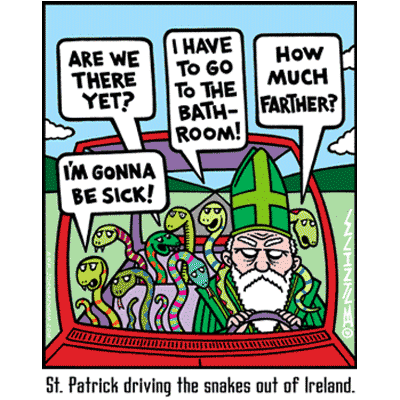
St. Patrick is said to  have driven the snakes out of Ireland, a symbolic way to describe his victory over Paganism in Ireland.

The beautiful prayer of St. Patrick, popularly known as “St. Patrick’s Breast-Plate”, is supposed to have been composed by him in preparation for his victory over Paganism. The following is a literal translation from the old Irish text:

I bind to myself today
The strong virtue of the Invocation of the Trinity:
I believe the Trinity in the Unity
The Creator of the Universe.

I bind to myself today
The virtue of the Incarnation of Christ with His Baptism,
The virtue of His crucifixion with His burial,
The virtue of His Resurrection with His Ascension,
The virtue of His coming on the Judgement Day.

I bind to myself today
The virtue of the love of seraphim,
In the obedience of angels,
In the hope of resurrection unto reward,
In prayers of Patriarchs,
In predictions of Prophets,
In preaching of Apostles,
In faith of Confessors,
In purity of holy Virgins,
In deeds of righteous men.

I bind to myself today
The power of Heaven,
The light of the sun,
The brightness of the moon,
The splendour of fire,
The flashing of lightning,
The swiftness of wind,
The depth of sea,
The stability of earth,
The compactness of rocks.

I bind to myself today
God’s Power to guide me,
God’s Might to uphold me,
God’s Wisdom to teach me,
God’s Eye to watch over me,
God’s Ear to hear me,
God’s Word to give me speech,
God’s Hand to guide me,
God’s Way to lie before me,
God’s Shield to shelter me,
God’s Host to secure me,
Against the snares of demons,
Against the seductions of vices,
Against the lusts of nature,
Against everyone who meditates injury to me,
Whether far or near,
Whether few or with many.

I invoke today all these virtues
Against every hostile merciless power
Which may assail my body and my soul,
Against the incantations of false prophets,
Against the black laws of heathenism,
Against the false laws of heresy,
Against the deceits of idolatry,
Against the spells of women, and smiths, and druids,
Against every knowledge that binds the soul of man.

Christ, protect me today
Against every poison, against burning,
Against drowning, against death-wound,
That I may receive abundant reward.

Christ with me, Christ before me,
Christ behind me, Christ within me,
Christ beneath me, Christ above me,
Christ at my right, Christ at my left,
Christ in the fort,
Christ in the chariot seat,
Christ in the deck
Christ in the heart of everyone who thinks of me,
Christ in the mouth of everyone who speaks to me,
Christ in every eye that sees me,
Christ in every ear that hears me.

I bind to myself today
The strong virtue of an invocation of the Trinity,
I believe the Trinity in the Unity
The Creator of the Universe.

wolf

Yesterday, the second day of Lent, we considered the seven virtues, those attributes that lead us toward being moral human beings. We also considered the seven deadly sins, those choices that allow us to act without morality.

But what is Morality? Most dictionaries define it as principles concerning the distinction between right and wrong, or good and bad, behavior.

Today, there are many who don’t give a thought to the morality of a situation. And if they do, the word is twisted with statements such as: “Your morality is not my morality.” Or “Don’t impose your morality on me!”

Every human being has within him or her a set of morals, good or evil, to handle the inevitable problems that come with being a person upon on this earth. And that set of morals is expressed in both individual and universal ways.

Individually, do we pose a threat of danger to others? For example, as parents are we showing morality or immorality through our personal actions? Are we greedy, vindictive, angry, selfish? Because children will imitate, no doubt about that!

Are we moral in our dealings with others–spouses, friends co-workers? Do we lie to them, cheat them, or steal from them?

Are we personally moral to ourselves–do we overindulge in our habits or addictions to the point of ruining our health, messing up our minds?

We can decide to follow the path of Morality or Immorality. We have free will. We can choose evil or good.

Our personal choices will affect our actions in more universal ways, too; for example in a group, a school, an institution, a governing council–anywhere group decisions are made. In this capacity, does our group profess, teach, and insist upon destroying the beliefs of other groups as the means to our own ends?

Today, We NEED universal morality more than ever. By that, I mean discriminating between those things which are inherently good or inherently evil. From the ancient Platonist and Stoics until today, long traditions and great thinkers have moral universalism., of what is good and what is bad. Take as an example, The United Nations’ Universal Declaration of Human Rights. Of course, it hasn’t worked very well! But isn’t that a kind of moral universalism? The morality is that every human being has certain rights. The immorality is when those rights are destroyed. So there is, in humanity, a universal morality.

And Universal Morality must be put into action when a country, or terrorist group with the desire, is able to kill vast numbers of people at a time. The only hope for humanity is a moral system that makes it immoral to hurt other people.

But actually, all this begins with each individual’s daily human choices, those that become habit within us, those that affect others. So–which set of choices are we feeding?

Receiver and Donor of Love??

Posted: December 8, 2014 in World On The Edge


bookcoverAll of us have a hunger within us to be loved and nurtured. The desire to be loved, as experiments have shown, is one of our most basic and fundamental needs. One of the forms that the need to be loved takes is contact comfort–we want to be held and touched. Findings show that babies who are deprived contact comfort, particularly during the first six months after they are born, grow up to be psychologically damaged.

Most of us believe that a significant determinant of our happiness is whether we feel loved and cared for. In conducted surveys, people rate “having healthy relationships” as one of their top goals—on par with the goal of “leading a happy and fulfilling life.”

In our pursuit of the need to be loved, however, most of us fail to recognize that we have a parallel need: the need to love and care for others. This desire, it turns out, is just as strong as the need to be loved and nurtured. The desire to love and care for others is  hard-wired and deep-seated because fulfillment of this desire enhances our happiness levels.

If the need to love is hardwired and universal and is also a powerful determinant of happiness, how come many of us aren’t aware of it? Why, for example, don’t we respond to the question, “What would make you most happy?” with “serving others” of “showering love on someone” than with “money” or “being loved”?

The answer, in my opinion, has to do with the messages to which we are routinely exposed from our care-takers and the media. These messages suggest to us that our happiness lies in being the recipient of others’ attention, love, and respect, rather than in being the donor of attention, love, and respect. For example, most of us are explicitly or implicitly told that happiness lies in achieving self-enhancing goals such as career success, wealth, fame, or power. The need to love and care for others, in contrast, is rarely emphasized, except perhaps in the arts. (summarized from Psychology Today)

My novel, A Hunger in the Heart, is about a boy who needs not only to be loved, but has a desperate need to love. Winston Groom described A Hunger in the Heart as “a story of hope, forgiveness, and redemption–a great read in the tradition of southern fiction.”  Mark Childress said, “Kaye Park Hinckley is a writer with a sensitive ear and a keenly developed sympathy for her characters.”

A Hunger in the Heart is available in Paperback, Kindle, and Hardcover. In this season of love, I think it would make a very special Christmas gift. I hope you’ll consider it. Just click on the cover shot above to order.

My interview with Brian Patrick of Sacred Heart Radio follows the novel’s promotional video!


The Ghost of Yesterday

Posted: November 12, 2014 in World On The Edge

dark_tree_walkSome of the happiest people, I think, are those who accept  life as it is. They look at the good things around them with appreciation.  They let go of the less than ‘good’ things with the idea that they learned something from them.   They do not walk backward toward past hurts.  Of course,  this is hard to do.

Many of us are disposed to holding grudges about what he or she did to me.  We can’t let it go. We have to have some recompense–to balance things, we say. We let the ghost of yesterday take over today. And some of us allow that vindictive ghost to run our lives.

This will not bring harmony to family life.

Pope Francis questioned pilgrims about the harmony of their home lives at the Sunday Mass held on October 27, 2013,  during the “Day for the Family” in Rome. “I would like to ask a question today. Everyone – how will you carry joy home in your heart? How’s the joy in your home? How’s the joy in your family?”

What is our answer to his question?  Harmony denotes peace. Holding a grudge is hardly peaceful. Real joy comes when we accept that not every one has our best interests at heart, but that some do. And shouldn’t we focus on the ones who do, rather than the ones who didn’t?

What he or she did to me is in the past. No one can change the past. We have only the Present. And  we can  most assuredly make our Present, and possibly our Future,  worse when we concentrate on a grudge. We may even destroy what is good in the here and now by our vindictiveness.

So let’s turn our backs on those ghosts. Let’s look around to those family and friends who bring us real joy, and concentrate on them. Then, I think we’ll be able to see ourselves in the Present. We’ll see ourselves as ‘doing just fine.’

file0001931487912How many times have we acted wrongly—and known it?

How many times have we regretted hurting someone, even hurting them badly?

Have we tried to make it right? Have we asked for forgiveness?

Before forgiveness can be given by someone we’ve hurt, that person should be able to trust that we are contrite.

What is contrition, really? True contrition comes from the soul, and by God’s grace. It involves not only sincere sorrow for our offenses, but a firm purpose of committing them no more.

It’s more than just saying we’re sorry. It’s changing our very selves, if need be.

I don’t know about you, but for me, changing myself is HARD.  I know what I need to do, but I don’t do it, or maybe I do it a little and then excuse myself. One step forward, two steps back–but I don’t want to give up trying, do you? And I won’t have to.

We do have strength that will be given to us—and it comes, as the following song says–from a higher window. It is the strength of our Redeemer who will help us to contrition, to change, to asking for forgiveness, and then to love. It’s never too late. The possibility is here.  Is today the day?

Preparing to Fail?

Posted: August 29, 2014 in World On The Edge

images28CR8SER

Would you build a new house without a blueprint? Would you take a trip without knowing where you’re going?  The blueprint and the knowledge are important preparations to success.

“By failing to prepare, you are preparing to fail.” –Benjamin Franklin

These words from a great American leader reinforce the need to prepare.

But wait. Have  today’s American leaders neglected to realize that  our enemies are preparing, too—against us?

Remember the Emperor Nero who ‘fiddled’ while Rome burned?   In other words, he was so full of himself, he  did not prepare for the hard times to come.

Perfect example: The Ant and the Grasshopper

It was summer, hot and sunny, and, instead of working and preparing for winter, a Grasshopper preferred to dance, sing and play his violin at his leisure, not minding that these wonderful days will soon be over, that cold and rainy days will soon be near.

On seeing a hardworking Ant passing by him, preparing for the hard winter that was to come one day, he invited him to join him and share his fun.
“Unfortunately, I don’t have time for this”, the Ant answered, “I must work hard, so that winter won’t find me without shelter and food.”
“Stop worrying so much, there is still plenty of time to prepare for winter. Let’s sing and dance together, let’s laugh and enjoy life”.
But Ant was very wise and wouldn’t pay attention to the Grasshopper’s words and continued to work hard and store food for the long winter that was to come.
The winter came sooner than expected, and the Grasshopper found himself without home and without food. He went to the Ant’s house and begged him for food and shelter.
“I’m sorry, but I can’t help you”, the Ant said. “I only have room and food for me and my family, so go find help somewhere else.”

Moral:  Prepare for the hard days to come.

Once again: “By failing to prepare, you are preparing to fail.”

We must prepare. Because—right under our noses– there are those who, for years, have been preparing for terrible evil against us. Sadly, we either ignored it, or some of us were too busy playing King. And now, like the grasshopper’s, our survival may be in great danger

Hard to Figure the Reasons?

Posted: August 28, 2014 in World On The Edge

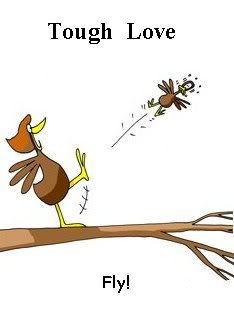
tough-loveWhen raising your children, have you ever practiced what is called Tough Love?

This might come about if they want something badly, but you know it isn’t good for them and so refuse their request. Of course, a child may pitch a fit, cry, stomp, scream that you are being unreasonable. He or she might even say you don’t love them–because if you did, you’d give them what they want.

But there are situations when we know what a child does not know. We are experienced enough to see that a certain thing or situation will harm them. And it’s precisely because we Do love them that we refuse–even when we know that our refusal will cause them pain.

As Christians who pray, we adults do not always receive what we pray for. How do we handle it? Do we pitch a fit, cry, stomp, scream that God is being unreasonable. Do we lose faith that He loves us? Sometimes we do.

Maybe we’ve lost someone dear to us, or are fired from a job. or maybe a huge tragedy out of our control comes upon us as a people–hurricanes, earthquakes, floods, and war? It would seem, then, that  God is forcing us to our knees.

Can we believe that all this comes from a God who loves us as a parent?

The answer is difficult.  Just as a child questions her parent’s reasoning, we question God’s reasoning. OR at the very least, we wonder about God’s intent.  A wonderful priest I know wouldn’t venture an answer as to why awful things happen to people. “If you want to know why human beings suffer, don’t ask me–ask God,” he said.

So the question goes unanswered because for a human being to know the reasoning of God  can be compared to a grasshopper attempting to know the reasoning of a human being. It cannot be done. Yet what we often see happening  is that  uncontrollable tragedies, like those mentioned above,  have an ability to pull people together. People stand together, and pray together,  in the face of great disasters.

So, in situations of suffering when it seems God has brought us to our knees, what should we do?  I think we  trust that God loves us as a parent, and that because of that great love, He will give us what we need to get through, to get up, and even  to become better people.

confidence-farzana-featured

There are times when we’re young that we are also confident. Someone will ask, “What do you want to be when you grow up?” And we can give a quick answer. But as we grow, things are not so clear as when we were children. Life gets complicated because we have more and more responsibility–for our own lives, and the lives of those in our care.

We may feel lost. We may not be sure where we’re going anymore. We may not  even have a direction in mind. We look around and think we see everyone else in a situation we’d like to be in, too; but we’re just not there–and don’t know if we’ll ever be.

We can feel pretty depressed in times like these. We can feel very alone and unimportant.

Then something happens.

No, we don’t win the lottery.

The something that happens may not seem profitable at the time. It may not be fun.  In fact, we may want to avoid suffering through it.

But we do suffer through it. And afterwards, it’s possible that we find some good in it. We may find our true self in it, too.

When this something happens, we are changed by it. We may be so changed that we begin to live for someone else. And in the process we find our own self–the person we were meant to be.