Life jackets come in all different shapes, sizes and colors. They are made to fit both adults and children. The main purpose of a lifejacket is to keep a person’s head above the water. They are designed to help us stay afloat even when unconscious. A life jacket is supposed to protect us.
Sometimes we think of another person as our life jacket: our spouse, our parents, our friends.. We’re not Supermen or Superwomen. We need others. We need to be able to trust others. Husbands need to be able to trust their wives, and wives their husbands. And children surely need to be able to trust that their parents will protect them.
But in some circumstances, the very ones we look to for protection are the ones who betray us. Rather than holding our heads above water, or helping us float when we need it, those so-called ‘life jackets’ leave the pool. They leave us alone to fend for ourselves.
So what do we do when we’re in deep water, and our life jacket unstraps itself and skitters away?
For a child, still unable to swim, it’s catastrophe. A child will cry for help, “Save me!”
If we are a husband or wife who has been betrayed, or if a close friend has left us in a less than safe position, we might still say, “Come back. Save me.” But we are not children.
“Save me” is not a sensible, adult response, to the one who’s left us in a lurch. Neither is, “I’ll get you back if it’s the last thing I do!”
The adult response is not to whine, not to seek revenge, but to bolster ourselves by recognizing that we are created for dignity by God. Lean on Him. Listen to His words. He will teach us how to swim on our own.
Because this is what we must sometimes do–be on our own. Life is difficult. People are not always going to be there for us.
But God will always be there for us. Call out to Him.
I love Netflix! Last night I watched “Death of a Salesman,” a classic, Pulitzer-winning play by Arthur Miller that I studied in college and never quite forgot.
The movie was beautifully acted by Dustin Hoffman as Willie Lohman, the salesman. Here is a man in his sixties who’s never quite made it because he’s had the wrong dream, trying to be a successful businessman when he was actually not equipped for it.
Unable to accept that he’s failed, Willie unloads his same dream onto his two sons, especially Biff, who Willie imagines will rise to greatness because of his looks, athletic ability, and the fact that “he was well-liked.”
The play is a tragedy, mostly in Willie’s role as a father. That he loves his sons is made apparent, but the kind of love he shows them is ruinous. He has a dream for them–his dream, not theirs. And he’s a man who cannot accept the reality that he is a failure in the job chose to build his life around, so he lies to make himself seem successful. He lies to his sons, and even to himself.
The greatest love we can give our children is Truth–to show them who they are–valuable human beings created by God. But we should never sugar-coat their mistakes. And often, we do that, maybe because their mistakes are similar to ours and we don’t want to personally own up either.
It’s important that we don’t selfishly implant in children our own dreams and expect them to play them out with any success. We have to realize each child’s uniqueness. But most of all we have to realize where we ourselves have failed in our lives so far, and make an attempt to keep our children from doing the same–by being truthful, not dishonest.
Getting to know our children and their personalities is so important. We cannot guide them properly if we look through the rose-colored glasses of what WE want them to be. Always, we need to see them as individuals, children who came through us—but are NOT US.
Parents and children—and I think especially Fathers and sons—no matter how deeply they love each other, often have many regrets. But there will always be a certain bond there.
So, may Fathers and Sons respect each other for who they are, and may each forgive the other for being a fallible human being.
In my novels, short stories, and blog, I write a lot about freedom.
What does freedom mean to you?
For many it means to do whatever I want, which indicates that a personal choice is involved. What we want is at least possible because of basic freedoms that other Americans throughout history have fought for, even died for. And the rest of us benefit from that.
But if an Iraqi or Syrian Christian was asked what freedom means, what would their answer be? What would the answer of a WWII Jew under Hitler have been? Or an African American, under slavery? Or further back, an Irish Catholic under the Penal Laws of Oliver Cromwell? Where is/was freedom for these?
In my yet unpublished historical novel, Echoes of the Risen, Nell Dugan, who along with her family, fought against British tyranny both in England and the new America, has this to say at the end of the American Revolution: The others celebrated our victory for weeks, but I had no enthusiasm after the ghastly murders of Robin and William. All my life I’d dreamed of freedom, strived for freedom, killed for freedom. Now it was here, and I thought only of its lavish price.
Freedom does have a lavish price–a price paid through the personal choices of individuals to be courageous.
Every individual who attempts to make the world a more noble place will pay the price. They will pay a price when lies are told in order to smother their voices of belief, and bring them down. They will pay a price when the courage of their convictions are twisted by the less noble, and they are called bigots, or racists, or homophobics. They will pay a price when the forces of political correctness stomp on their heart-felt values in an attempt to destroy them.
But without their courage, those heart-felt values will surely vanish—exactly what happens in my novelette, Mary’s Mountain when God, and the liberty He has given us, is annihilated.
And it’s still FREE on Kindle for a few more days.
If someone were to ask me about wasting things and about wasting time, I’d say I don’t like it. Yet, if I’m honest, there’s been much in my life that I’ve wasted.
I’d love to relive those moments of waste and fill them instead with something of value. We all know that can’t be done though. A moment lived, wasted or not, is gone forever. That’s why we have to be so careful of how we spend our time. So careful of how we treat others. So careful of our immortal souls. Because we are indeed immortal. There is life after this one.
Our individual choices on Earth mean a great deal. What happens in our one, long moment here affects not only ourselves, but others as well. When we are born, we are charged to make a difference in the world around us. And…
If someone were to ask me about wasting things and about wasting time, I’d say I don’t like it. Yet, if I’m honest, there’s been much in my life that I’ve wasted.
I’d love to relive those moments of waste and fill them instead with something of value. We all know that can’t be done though. A moment lived, wasted or not, is gone forever. That’s why we have to be so careful of how we spend our time. So careful of how we treat others. So careful of our immortal souls. Because we are indeed immortal. There is life after this one.
Our individual choices on Earth mean a great deal. What happens in our one, long moment here affects not only ourselves, but others as well. When we are born, we are charged to make a difference in the world around us. And each of us will surely make a difference in some way.
Sometimes the difference we make here on Earth will be very constructive and valuable, though we may not realize it at the time.
And sometimes the difference we make will be destructive. This usually comes when we consider only ourselves and not others, when we act in anger, when we neglect our responsibilities, when we put inanimate things ahead of the living hearts who need us.
Have you experienced a “dark night of the soul?” Deep depression, a spiritual crisis, the collapse of meaning and purpose in your life, the loss of something, or someone, who meant everything to you?
I have experienced something like that. And I can tell you that it is temporary. You will come out of it. And you may be a better person because of it. You may even be a totally different person than you thought you were.
So, hang on.
Trust in God.
Even if you feel completely alone. Even if you think no person and no thing can help you. Even if you’ve tried everything, but there’s nowhere to go, no one to turn to, and you feel helpless. And even if you think you’re defeated—hang on.
And in the luck of night
In secret places where no other spied
I went without my sight
Without a light to guide
Except the heart that lit me from inside.
It guided me and shone
Surer than noonday sunlight over me,
And lead me to the one
Whom only I could see
Deep in a place where only we could be.
………..two stanzas from Dark Night of the Soul, by Saint John of the Cross
No one else can actually see your dark night. You can create an appearance that all is well, while inside your heart is breaking. At times, I even thought if I had a fatal disease, it would be better than what I was going through–at least it would be apparent to someone. But what I didn’t realize is that I wasn’t alone. Even if I couldn’t see where I was going myself, someone was seeing me along the way. I trusted I would be lead. And I was.
Dark nights are temporary. I can’t stress that enough. On any day— within a minute, or second— what was so dark can take on light again.
You are so loved by God!
Don’t give up. Surrender to divine guidance. And Trust.
When you’ve lived a lot of life, you tend to see patterns in generations that follow yours. And of course, if you’re like me, you can’t keep from relaying it.
A danger for young girls today is the same danger their mothers and grandmothers once faced: an attraction to ‘bad boys.’ How that fascination comes to sit in a young mind, I honestly don’t know, but long ago, I remember feeling it myself.
You know a particular boy is bad, that he’s made terrible choices, yet you’re drawn to him. Worse, you think you can change him.
He may tell you he really wants to change, yet he never takes the first step. And then, he talks about the freedom to do whatever he wants, as if that sort of freedom is always good. He tries to make you see that you should want it, too.
But be aware. That kind of freedom is far from good. It’s in disguise. It isn’t really freedom. It’s just another case of addiction to drugs, sex, or cheating, just plain laziness, or maybe even fear of the world itself. In any case, stay away. Bad boys hold nothing but grief for you.
This doesn’t mean that they won’t eventually change–without you, by the way. Many honorable men, even many saints, were first horrible sinners. But often bad boys stay that way.
A young teenage girl who thinks she can change a bad boy and shape him into a prince is living a fairytale. And she may live it for a year or two until she matures enough to understand that the boy she needs, the prince for her, won’t be a bad boy at all.
When my youngest son was in college, there were times when I was more than a little worried about him. He had such great potential, but I felt he was ignoring it for… well… a good time, at least what he thought was a good time.
I decided to do an email campaign. Every other day or so, I sent him two important messages.
The first was the Hail Mary, a prayer of petition to the Blessed Mother. The second was the song in the video below.
The question to him was: are you ready to get real and play in the most important game–the game of life?
Don’t we, too, often play, but not for the reality in our lives?
What is that reality?
We are children of God, created by Him for a specific purpose in this life. Are we ready to discover that purpose? Are we ready to act on that purpose, and give it our best?
The answer to that is very personal to you and me. Only we know what we’re being called to do. But one thing we can be sure of: We ARE being called.
And to hear that call, we must listen carefully. Our call may come slowly in a very subtle way, or it may be loud and challenging–and come suddenly. But when we discover it ourselves, we need to be ready to say to the greatest coach we have in life: “I’m ready. Put me in the game.”
I am thrilled to say that my son heard the call, and answered the coach. He’s been in the game for quite a while now, and he plays like a pro!
Twice now, I’ve addressed The Daughters of Mary at St. Ignatius Church in Mobile, Alabama. This group of beautiful women, founded by my longtime friend, Deborah Madonia, is special. Their purpose is a renewal of faith and family. Believe me–they do it well!
This post, about the first married couple to be proposed for canonization, is written by Mary Ann McConnell, one of the members of The Daughters of Mary, and was sent out in a newsletter to its members. I think it’s wonderful, very interesting, and I know you will, too. So, here it is. Thank you, Mary Ann!
…. ….. ….. ….. …..
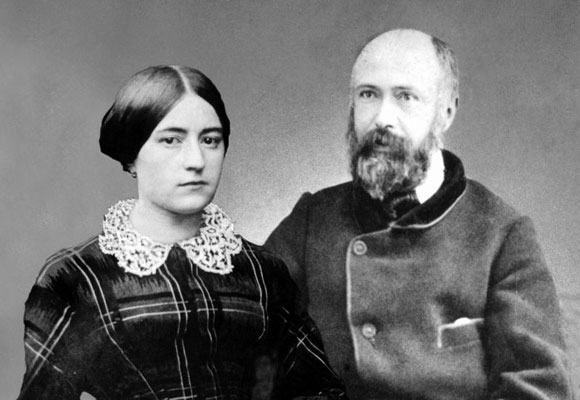
Zelie and Louis Martin: These are the parents of St. Therese of Lisieux or St. Therese of the Little Flower of Jesus. This couple were the first parents of a saint to be beatified and the first married couple to be proposed for canonization. The canonization should take place during the world synod of bishops on the family in October 2015. I was amazed when I heard Father announce this in church a few weeks ago. My thoughts were “They raised a saint and now they are going to be canonized saints too!” What role models for us! Isn’t that what we want to do – raise our children to be holy – but to be saints? Wow! What did they do? I wanted to know.
I researched the web and one article stated, “They were not saintly because they raised a saint; they raised a saint because they were saintly.” What do married saints look or act like?
Both Zelie Guerin and Louis Martin came from prosperous French families. They each were masters of crafts: Zelie was a maker of point d’Alencon lace and started her own business. Louis learned clock making and eventually opened his own watch-making and jewelry business. As each were growing up they were blessed with a strong faith. Each hoped to become a religious and had very close relationships with religious but this was not to be. Zelie and Louis met in Alencon and were married in 1858. Each of their businesses prospered and attained financial stability. Within the next 15 years had nine children – 2 Boys and 7 girls. Zelie wrote; “We lived for them, they were all our happiness.” Within three years the two baby boys, a five year old girl and and a six-and-a half week old infant girl died. Zelie and Louis were numb with sadness but their faith sustained them through these tragedies. Their last daughter was born weak and frail. They feared she too would die but she survived the illness and became strong. This was daughter was Marie Francois Therese later know as St. Therese of the Little Flower.
Zelie died of breast cancer in 1877 at the age of 45, when Therese was only 4 years old and leaving Louis to raise their 5 daughters. The first 3 daughters entered the convent before Louis’ death in 1894 and the other 2 joined after his death. So the question of qualities of saintliness do Zelie and Louis Martin possess? Fr. Antonio Sangalli, vice-postulator of the cause for canonization of the Martins, on the significance of their lives, miracles and canonization states “They give witness that the conjugal and marital experience is not an obstacle to holiness, but rather that two spouses who love each other can become saints….
The example they show us today is: The Martin family have faced all under God’s gaze, placing Jesus Christ in the first place of every situation, both of joy and anguish, always certain of this great embrace of the Lord and with His help they would be able to do anything and overcome any difficulty. Bishop O’Toole stated, “Life came at them unexpectedly, just as it comes at us. Their genius lay in how they accepted what happened to them.” In her autobiography, Therese conveyed the goodness of her parents and the sense of prayerfulness and care for others which was instilled in her home. She wrote God gave me a father and mother more worthy of Heaven than of earth.
Pope Francis has a special devotion to St. Therese. The pope used to keep a photo of her on his library shelf when he was archbishop of Buenos Aires. He has said that when he has a problem, he asks St. Therese “not to solve it, but to take it in her hands and help me accept it.” As a sign that she’s heard his request, he said, “I almost always receive a white rose.”
May God bless you,
Mary Ann McConnell
The following is a video by my friend, Fr. James Kubicki, Apostleship of Prayer
A couple of years ago, I posted a blog about war in the Middle East. Since then, our government may have brought soldiers home, but in the process lost the country/countries that many of our soldiers died to free. A big, short-sighted mistake.
And now, looking at cities in civil unrest like St. Louis, Baltimore, and others, it looks as if we are at war in our own country, with our own countrymen. Americans are killing other Americans.
Are we paying attention??
The danger of not paying attention, or caring about what happens enough to put a stop to it, is HUGE.
We need to see, and remember.
I recently saw a video where a large percentage of Pennsylvania college students couldn’t even answer questions about The Holocaust of World War II. Some didn’t even know who Adolf Hitler was, or what country he led in the War. They’d never even heard of Concentration Camps, and certainly couldn’t name one! Some students in another questionnaire thought George Washington was president during the Civil War. And if you can believe it, another thought the American Revolution was fought against Spain!
What’s happened to once-required American History classes? If they are taught at all, they are sometimes revised to favor the politically correct. These are things that should be remembered, and remembered correctly.
If we don’t study our past, and the generation involved in a particular war dies off, so do the memories and the lessons learned. The past should have been considered in the wars and holocausts that are happening today. Yes, today!
Today, we ought to be considering the courage, of our American soldiers who fought in past wars, as well as the loss and grief of their families. But how many really do that?
However, there is one past war that is, at least, remembered by many Southerners. No matter the side your ancestors may have fought on in the tragic Civil War, Americans actually killed other Americans on their own soil. They suffered the same feelings of fear, and sorrow as soldiers experience today. But the devastation left in the South in order to bring it to its knees was abominable. Think of the burning of Atlanta, and Sherman’s march to the sea, destroying all in his path–including the farms and homes and livestock and possessions of my own relatives. Oh, did they have stories to pass down to us!!
I think this video is a good example of what war really is, an intensely personal tragedy. This goes for past wars, and war in the Middle East today.












 Translating a World on the Edge