For the last week or so, I’ve been watching The Three Little Pigs on Netflix. It’s Disney’s original 1933 version and my grandchildren love it as much as their parents did. You know the story. The first little pig builds his house of flimsy straw, the second pig builds his house of destructible sticks, and the third little pig builds a model house, a house of sturdy bricks. The first and second pigs hurry to get through quickly so they can go to play. The third little pig builds slow and methodically, mortaring between each brick. He doesn’t have time to kick up his heels. And then comes the Big Bad Wolf. He blows down the haphazard houses of the first and second little pigs and threatens to eat them. So they run for safety to their brother’s house of brick.
For the last week or so, I’ve been watching The Three Little Pigs on Netflix. It’s Disney’s original 1933 version and my grandchildren love it as much as their parents did. You know the story. The first little pig builds his house of flimsy straw, the second pig builds his house of destructible sticks, and the third little pig builds a model house, a house of sturdy bricks. The first and second pigs hurry to get through quickly so they can go to play. The third little pig builds slow and methodically, mortaring between each brick. He doesn’t have time to kick up his heels. And then comes the Big Bad Wolf. He blows down the haphazard houses of the first and second little pigs and threatens to eat them. So they run for safety to their brother’s house of brick.
My husband and I met at seventeen and married when we were twenty one. At that time, we were probably a lot like the first and second little pigs. We weren’t worried about safety, we wanted to play. Read the rest of this entry »
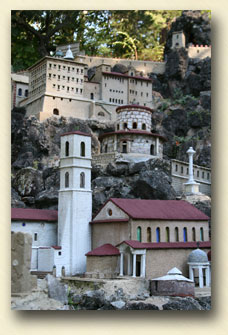
Some years back, when I taught Religion to Catholic teenagers, I was responsible for a group trip to Ave Maria Grotto in Cullman, Alabama. Known throughout the world as “Jerusalem in Miniature,” the Grotto is a beautifully landscaped, four-acre park designed to provide a natural setting for the 125 miniature reproductions of some of the most famous historic buildings and shrines of the world.
The masterpieces of stone and concrete are the lifetime work of Brother Joseph Zoettl, a Benedictine monk of St. Bernard Abbey. Begun as a hobby, with various materials he could find, and infinite patience and a remarkable sense of symmetry and proportion, Brother Joseph re-created some of the greatest edifices of all time.
Before the teens and I visited the Grotto, we took a trip about TRUST through the nearby woods. On that trip the teenagers, another teacher and myself, divided into pairs. One person in each pair took a turn wearing a blindfold while the other person led him or her through the trees, over stones, across a stream. The one in blindfold had to trust completely in the other to give him verbal instructions to keep from bumping into a tree, tripping on a stone, or falling into the winding stream. Then the partners changed places, with the other putting on the blindfold. I will never forget the trust I had to put into the other teacher–because I’m a control freak and to be walking blind was something I didn’t like to do.
But this is what we have to do when we put our Trust in God. We don’t know where we’re going, but we love and trust Him enough to allow Him to lead us there. We even don’t know if we’re actually following His Will when we go through our daily lives in our families, or jobs.
The important thing is that we try to please God in whatever we’re doing. And if we do this, He will be at our side.
The idea from the trip into the woods came from a prayer–one of my favorite prayers–by Thomas Merton, an American Catholic writer, mystic, and Trappist monk of the Abbey of Gethsemani, Kentucky.
Here it is on video. Isn’t it a wonderful prayer for each and every day?
How do we know if–and when–God is talking to us? Does he talk only to Saints? Or does he talk to ME?
Sometimes all we have to is shut our own mouths, and listen. God often speaks in the silence of our thoughts, or if we’re reading something spiritual, like the Bible. When you read God’s Word, you must constantly be saying to yourself, ”It is talking to me, and about me.”” –Soren Kierkegaard
But conversation is a two-way street. If we want God to talk to us, we must talk to him. Ask questions, and expect an answer just as we would from a relationship with a friend.
And this is the point–a relationship. Relationships with friends, co-workers, boyfriend/girlfriend husband/wife, and family are important components of our lives. So, why shouldn’t we be in a relationship with our Creator? The spiritual part of us is equally as important as the physical part of us, yet so many shy away from it. And others negate it altogether.
I think I’m so fortunate to live where I do, in a place that often discusses God, and these are people who even talk about ‘talking’ to God. There’s no ‘hush, hush’ in speaking the name of Jesus Christ, no hesitance to ‘give God the Glory,’—a phrase often used by local Protestants. I don’t mean in church either. I mean in the grocery store, the Mall, or the dentist’s office. If you want to talk about God, or to God, you just do it.
Make no mistake, God is talking to us–to you and to me. It may be through prayer, it maybe through other people, it may be through difficult circumstances–but He is talking. And it is very important in our relationship with God that we respond. Friend to friend. Child to parent. Lover to lover.
Viktor Frankl was an Austrian neurologist and psychiatrist as well as a Holocaust survivor whose concentration camp experiences shaped both his therapeutic approach and philosophical outlook. His life as a concentration camp inmate led him to discover the importance of finding meaning in all forms of existence, even the most sordid ones, and thus, a reason to continue living.
After three years of imprisonment during the Holocaust, he wrote Man’s Search for Meaning
He often said that even within the narrow boundaries of the concentration camps he found only two races of Men to exist: decent men and unprincipled men–and that these were to be found in all classes, ethnicities, and groups. And it stemmed from Attitude.
Here is what he said about Attitude: …Everything can be taken from a man but one thing: the last of the human freedoms — to choose one’s attitude in any given set of circumstances, to choose one’s own way.” ― Viktor E. Frankl
One definition of attitude is that it’s an expression of favor or disfavor toward a person, place, thing, or event (the attitude object). Prominent psychologists describe attitudes as the most distinctive and indispensable concept in contemporary social psychology. But a deeper look at our attitudes will often expose our personal Character.
Character is what we are when we don’t have an audience–and also, at times, when we do have an audience–because it takes Character to stand up with courage if something crucially important needs to be said, or expressed with an action.
Of course, our attitudes reflect what we think is important, and attitudes can change. What’s important to a teenager is not what’s important to an adult. Some believe that a person’s Character is set and cannot be changed. Not so. But what can change it?
The character of Paul, the apostle, changed dramatically when he surrendered to God. Once he’d been a murderer of those who believed in Jesus; but his character was re-formed and he spread the good news of Jesus Christ all over the Gentile world. How did this happen?
In Paul’s words from First Corinthians: By God’s grace I am what I am, and His grace toward me was not ineffective.
Paul’s new life in Christ is Biblical evidence that the grace of God can change character. And give that person’s character a new meaning. Haven’t you seen the character of some people change for the better? Don’t you know of people who have changed the entire meaning of their lives from insignificant to significant? I know I have.
This change may come after surviving a crisis, through a prompt of Grace that brings about a personal re-assessment of our life. Or it may come during great suffering, when we search for meaning. Or it may come because God keeps giving you those divine pushes, and all you have to do is go along.
No matter the circumstance, and however it comes, change is always possible. It’s part of our humanity as children of God, longing to be like Him.
A Streetcar Named Desire, by Tennessee Williams, was made into an award-winning movie many years ago. It is still performed annually as a stage play in New Orleans with many vying for the roles, especially the role of Blanche, an aging, down and out prostitute, still hanging onto her dreams of class and propriety. One of the movie’s most famous lines is the one by Blanche in this video. “I’ve always depended on the kindness of strangers.”
As children we were told, “Don’t talk to strangers,” We are careful, and rightly so, to tell our children the same, because a stranger might do them harm.
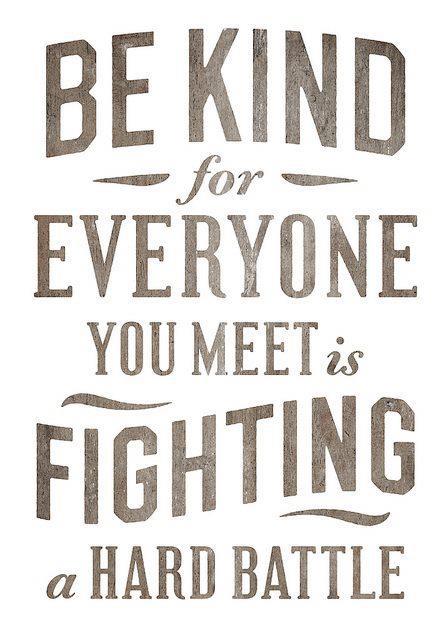
When we’re adults though, it’s a little different. A kind word to someone, even someone we don’t know–even someone like Blanche, can do a lot of good. Sometimes we see a stranger, and our hearts tell us they need encouragement. The compassion within us wants to help, if only with a word, and if only momentarily.
We are a compassionate people. Some work with strangers every day, perhaps as a social worker, an EMT, Emergency room doctors and nurses, Police officers, Priests, Preachers, and Nuns. But it doesn’t have to be our job. Kindness to strangers is actually what God expects of all of us.
What might happen if each of us gave another person more than just smile or a word of encouragement? What if each of us used our God-given talent or trade to really help a person who needs it? Many do. And many bolster their own spirit in the process.
The following video contains portions of another movie called, The Letter Writer. It’s a Christian film, very enjoyable, and makes the point of kindness, even if it does end a bit unrealistically. The movie is about a winning old man who fills his days with writing letters and notes to strangers. He bolsters a distraught teenager’s sagging spirits and helps her learn to help others.
Listen to the words of his letters. Words like these could very well change a life.
Last night, I received this excellent review of my short story collection and wanted to share it. Jeannie Ewing is quite a lovely lady and blogs at http://www.lovealonecreates.com/
Book Review: Birds of a Feather
Kaye Park Hinkley’s new release, a collection of short stories entitled Birds of a Feather, is difficult to categorize and yet birds of a feather is one of the most artistic pieces of literature I have read in quite some time. Hinkley has been compared favorably to Flannery O’Connor, but I confess I have not read O’Connor’s works and therefore am unable to make an honest and adequate comparison between the two.
Hinkley’s writing in Birds of a Feather is as diverse as literature can get, though her voice is steady, unique, clever and grabs the reader with fascinating and thrilling hooks almost immediately. Each story followed a theme of sin and redemption, peppered with deep spiritual underpinnings and rich with colorful Catholic heritage and imagery. Hinkley’s use of language is innovative and powerfully descriptive; her writing is one of the most vivid and raw depictions of human character and emotion I have read from any modern piece of literature.
The tales in Birds of a Feather are ones of humanity, with our commonality of brokenness and longing for healing threaded throughout; I am astounded at Hinkley’s ability to accurately capture myriad settings, eras, and cultures: from late nineteenth century high society to stereotypical hillbillies, from modern psychological thrillers to tender romances, Hinkley wrestles with the very real and raw emotions, struggles, and darknesses that plague humanity throughout history and time. She is honest, mingling grief and love, life and death, in nearly every story. I was often left processing each one for hours after I read it; her narratives aren’t clean with happy endings, but rather they depict the complexity of our interminable striving for the good while battling our vices.
Hinkley writes from the perspective of the main character – sometimes in first person, sometimes in third, immersing her words into their very psyches and souls, which is what strips this collection of any cliched and stereotyped categories of fiction. For at least a few of the tales, she echoes Edgar Allan Poe with disturbing brilliance, which both stunned and fascinated me.
Birds of a Feather is not written for the novice or recreational reader; it is not for the faint of heart. It is written for the reader who is self-aware, who thinks and feels deeply, who recognizes the interrelated existence among all of humanity. It tugs at the core of one’s soul, begs for a tear or two, and challenges one’s intellect while breaking down layers of personal and social barriers related to religion, personality, age, gender, culture, and socioeconomic status.
In essence, everything written in Birds of a Feather reminds the reader that everyone has a story, every life has value and purpose, and it is impossible to speculate about another person’s life journey. This realization necessitates an increase in humility and empathy for the united struggle of humanity, the fact that no one is exempt from sin and suffering in this life. And yet we are all beckoned beyond ourselves into a realm of eternal hope and joy. This is the ultimate message of Birds of a Feather.
I’m polishing up a sequel to my first novel, A Hunger in the Heart. In the first chapter of the sequel, Coleman, the main character, sixteen years old at the book’s beginning, is preparing to leave home for a boy’s school. If you’ve read the first novel, you know the wisdom of the family’s gardener, Fig:
“We got stuff to talk about before you go off on your own, ‘bout the ways of the world.”
Coleman laughed. “What do you know about the ways of the world? You’ve never been anyplace but here.”
“Don’t matter. Here’s got the same worries you gonna find anywhere else. Best to get you prepared.”
The point is the root of all problems follow us anywhere we go, because most of our problems are caused by the weaknesses within us. They are humanity’s weaknesses. Catholics call them the seven deadly sins:
Pride, Greed, Envy, Lust, Anger, Sloth, and Gluttony.
And they are the way of the world. Just look around.
Each of the seven deadly sins is a form of Idolatry-of-Self, and we all know people who may be in danger of destroying their lives in selfish ways through one or more of them.
Except, just as we have capability of sin, human beings also have the capability of virtue. The seven virtues are:
Faith, Hope, Love, Prudence, Temperance, Courage, and Justice.
Are these virtues the way of our world today? Good news; many times they are.
Because whenever there is great evil, virtuous people will fight. Sadly, the reverse is also true. If a person is known to have virtue, there is usually someone to tear him/her down–even to crucify him.
So, like my characters Coleman and Fig, each of us are touched by conflicting ‘ways of the world.’ And the way we choose to take will make an eternal difference, in our own life and in the lives of others.
A hard rain is often cleansing. Roofs of houses, toys left in the yard, pollen-covered driveways and patios are washed by the rain. And then comes the sun.
Think of the first rays of sunlight after a hard rain, when the grass, flowers, crops, and trees are still wet. Recall how the sunlight falls upon the leaves and petals, causing them to glisten, and in the process, dries them.
This is similar to what happens after a tragedy, one we desperately pray will not come, yet it does.
The tragedy may be thrust upon us by another person’s imperfections, or it may have come about from our own transgressions. Either way, it’s often a long, long time afterwards that we’re able to catch our breath and even consider drying our tears, and healing.
But we can trust that God is waiting for us to notice Him. When we turn toward Him and accept His grace, that light will dry our tears, and we can begin to heal.
We often notice grace when we least expect to notice it. It is always there though, because God is always with us. But our worries, busyness, distractions, addictions, sins, and downright refusal to acknowledge God’s mercy; all get in the way–and may even be at the root of our heartbreaks.
But God can bring good out of the ‘not so good.’ It’s possible for heartbreak and tragedy to bring our best self.
For each person on earth, God will show mercy. We only have to ask for it. And if we chose God’s grace, we can come closer and closer to Him, knowing Him better and better, until we’re finally able to say: I am in love with a God who is madly in love with me. So, I am able to trust Him, follow Him, and then surrender my life to Him.
This certainly does not mean we will have become saints. We will still be flawed human beings, sometimes ground in the same old sins. But if we continue to ask, we will be personallyshown what we need to do better.
Psalms 51:10 – Create in me a clean heart, O God; and renew a right spirit within me.
The Fourth of July has passed, but today, I’m feeling even more patriotic than on that day a few weeks ago. In the words of my Daddy, who was awarded the Purple Heart and Bronze Star in WWII— some people in today’s news are “walking on the fightin’ side of me.
…Because I was taught to love America, not to bad-mouth her.
…Because I was taught, and daily declared at school, The Pledge of Allegiance to The United States of America.
…Because I was taught respect for America’s Flag.
…Because I was taught that I was blessed to be an American.
…Because I was taught the history of my country, (in Fourth Grade) and how she courageously fought for her freedom, expressed in the Declaration of Independence, particularly its second sentence: We hold these truths to be self-evident, that all men are created equal, that they are endowed by their Creator with certain unalienable Rights, that among these are Life, Liberty and the pursuit of Happiness.
The key words in the above statements are: I was taught. As were many of you. So what’s happened?
Are today’s children–our children and grandchildren– really taught the correct history of America? Are they being given positive, or negative, impressions of the wonderful country in which they live? Which rights will have been taken away from them by the time they reach adulthood?
No, America isn’t perfect, but if she doesn’t always live up to the principles created for her, then it’s no one’s fault but ours—each one of us. Freedom is everybody’s job. We simply cannot leave it to others to trample on. And this is what is happening today when it comes to :
Religious Freedom (which is being usurped by our own government)
Economic Freedom ( we’ve lost 200 years of ranking as the most prosperous country in the world to not even being the top ten today)
Freedom of Speech (think IRS targeting)
Freedom from tyranny (The Framers of the Constitution created a federal government of limited and enumerated powers – leaving everything else to the states and “the people.”
And on and on.
Check out your rights, and think about what is happening to some of them:
The thing is, we have to KNOW what’s going on. We just can’t get too busy and ignore it, or one day we’ll look up from our busyness and wonder what happened to our America and our rights as Americans.

 For the last week or so, I’ve been watching The Three Little Pigs on Netflix. It’s Disney’s original 1933 version and my grandchildren love it as much as their parents did. You know the story. The first little pig builds his house of flimsy straw, the second pig builds his house of destructible sticks, and the third little pig builds a model house, a house of sturdy bricks. The first and second pigs hurry to get through quickly so they can go to play. The third little pig builds slow and methodically, mortaring between each brick. He doesn’t have time to kick up his heels. And then comes the Big Bad Wolf. He blows down the haphazard houses of the first and second little pigs and threatens to eat them. So they run for safety to their brother’s house of brick.











 Translating a World on the Edge