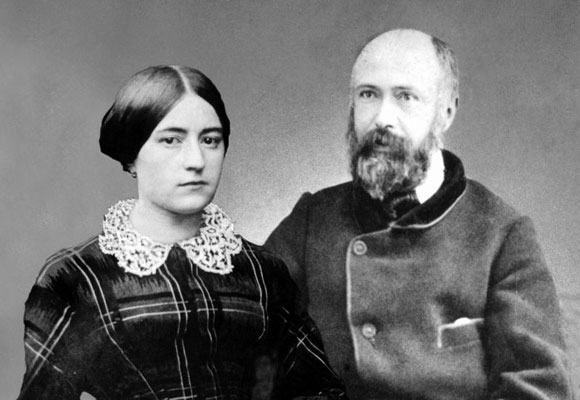
Blessed Louis and Zelie Martin

Blessed Louis and Zelie Martin

Twice now, I’ve addressed The Daughters of Mary at St. Ignatius Church in Mobile, Alabama. This group of beautiful women, founded by my longtime friend, Deborah Madonia, is special.  Their purpose is a renewal of faith and family. Believe me–they do it well!

This post, about the first married couple to be proposed for canonization, is written by Mary Ann McConnell, one of the members of The Daughters of Mary, and was sent out in a newsletter to its members. I think it’s wonderful, very interesting, and I know you will, too. So, here it is. Thank you, Mary Ann!

….     …..     …..     …..     …..

Zelie and Louis Martin: These are the parents of St. Therese of Lisieux or St. Therese of the Little Flower of Jesus. This couple were the first parents of a saint to be beatified and the first married couple to be proposed for canonization. The canonization should take place during the world synod of bishops on the family in October 2015. I was amazed when I heard Father announce this in church a few weeks ago. My thoughts were “They raised a saint and now they are going to be canonized saints too!” What role models for us! Isn’t that what we want to do – raise our children to be holy – but to be saints? Wow! What did they do? I wanted to know.

I researched the web and one article stated, “They were not saintly because they raised a saint; they raised a saint because they were saintly.” What do married saints look or act like?

Both Zelie Guerin and Louis Martin came from prosperous French families. They each were masters of crafts: Zelie was a maker of point d’Alencon lace and started her own business. Louis learned clock making and eventually opened his own watch-making and jewelry business. As each were growing up they were blessed with a strong faith. Each hoped to become a religious and had very close relationships with religious but this was not to be. Zelie and Louis met in Alencon and were married in 1858. Each of their businesses prospered and attained financial stability. Within the next 15 years had nine children – 2 Boys and 7 girls. Zelie wrote; “We lived for them, they were all our happiness.” Within three years the two baby boys, a five year old girl and and a six-and-a half week old infant girl died. Zelie and Louis were numb with sadness but their faith sustained them through these tragedies. Their last daughter was born weak and frail. They feared she too would die but she survived the illness and became strong. This was daughter was Marie Francois Therese later know as St. Therese of the Little Flower.

Zelie died of breast cancer in 1877 at the age of 45, when Therese was only 4 years old and leaving Louis to raise their 5 daughters. The first 3 daughters entered the convent before Louis’ death in 1894 and the other 2 joined after his death. So the question of qualities of saintliness do Zelie and Louis Martin possess? Fr. Antonio Sangalli, vice-postulator of the cause for canonization of the Martins, on the significance of their lives, miracles and canonization states “They give witness that the conjugal and marital experience is not an obstacle to holiness, but rather that two spouses who love each other can become saints….

The example they show us today is: The Martin family have faced all under God’s gaze, placing Jesus Christ in the first place of every situation, both of joy and anguish, always certain of this great embrace of the Lord and with His help they would be able to do anything and overcome any difficulty. Bishop O’Toole stated, “Life came at them unexpectedly, just as it comes at us. Their genius lay in how they accepted what happened to them.” In her autobiography, Therese conveyed the goodness of her parents and the sense of prayerfulness and care for others which was instilled in her home. She wrote God gave me a father and mother more worthy of Heaven than of earth.

Pope Francis has a special devotion to St. Therese. The pope used to keep a photo of her on his library shelf when he was archbishop of Buenos Aires. He has said that when he has a problem, he asks St. Therese “not to solve it, but to take it in her hands and help me accept it.” As a sign that she’s heard his request, he said, “I almost always receive a white rose.”

May God bless you,

Mary Ann McConnell

The following is a video by my friend, Fr. James Kubicki, Apostleship of Prayer

Image  —  Posted: May 26, 2015 in World On The Edge

 By TheBrassGlass, 2014, MorgueFile.com


By TheBrassGlass, 2014, MorgueFile.com

A couple of years ago, I posted a blog about war in the Middle East. Since then, our government may have brought soldiers home, but in the process lost the country/countries that many of our soldiers died to free. A big, short-sighted mistake.

And now, looking at cities in civil unrest like St. Louis, Baltimore, and others, it looks as if we are at war in our own country, with our own countrymen. Americans are killing other Americans.

Are we paying attention??

The danger of not paying attention, or caring about what happens enough to put a stop to it, is HUGE.

We need to see, and remember.

I recently saw a video where a large percentage of Pennsylvania college students couldn’t even answer questions about The Holocaust of World War II. Some didn’t even know who Adolf Hitler was, or what country he led in the War. They’d never even heard of Concentration Camps, and certainly couldn’t name one! Some students in another questionnaire thought George Washington was president during the Civil War. And if you can believe it, another thought the American Revolution was fought against Spain!

What’s happened to once-required American History classes? If they are taught at all, they are sometimes revised to favor the politically correct. These are things that should be remembered, and remembered correctly.

If we don’t study our past, and the generation involved in a particular war dies off, so do the memories and the lessons learned. The past should have been considered in the wars and holocausts that are happening today. Yes, today!

Today, we ought to be considering the courage, of our American soldiers who fought in past wars, as well as the loss and grief of their families. But how many really do that?

However, there is one past war that is, at least, remembered by many Southerners. No matter the side your ancestors may have fought on in the tragic Civil War, Americans actually killed other Americans on their own soil. They suffered the same feelings of fear, and sorrow as soldiers experience today. But the devastation left in the South in order to bring it to its knees was abominable. Think of the burning of Atlanta, and Sherman’s march to the sea, destroying all in his path–including the farms and homes and livestock and possessions of my own relatives. Oh, did they have stories to pass down to us!!

I think this video is a good example of what war really is, an intensely personal tragedy. This goes for past wars, and war in the Middle East today.

 By TheBrassGlass, 2014, MorgueFile.com


By TheBrassGlass, 2014, MorgueFile.com

A couple of years ago, I posted a blog about war in the Middle East. Since then, our government may have brought soldiers home, but in the process lost the country/countries that many of our soldiers died to free. A big, short-sighted mistake.

And now, looking at cities in civil unrest like St. Louis, Baltimore, and others, it looks as if we are at war in our own country, with our own countrymen. Americans are killing other Americans.

Are we paying attention??

The danger of not paying attention, or caring about what happens enough to put a stop to it, is HUGE.

We need to see, and remember.

I recently saw a video where a large percentage of Pennsylvania college students couldn’t even answer questions about The Holocaust of World War II. Some didn’t even know who Adolf Hitler was, or what country he led in the War. They’d never even heard of Concentration Camps, and certainly couldn’t name one! Some students in another questionnaire thought George Washington was president during the Civil War. And if you can believe it, another thought the American Revolution was fought against Spain!

What’s happened to once-required American History classes? If they are taught at all, they are sometimes revised to favor the politically correct. These are things that should be remembered, and remembered correctly.

If we don’t study our past, and the generation involved in a particular war dies off, so do the memories and the lessons learned. The past should have been considered in the wars and holocausts that are happening today. Yes, today!

Today, we ought to be considering the courage, of our American soldiers who fought in past wars, as well as the loss and grief of their families. But how many really do that?

However, there is one past war that is, at least, remembered by many Southerners. No matter the side your ancestors may have fought on in the tragic Civil War, Americans actually killed other Americans on their own soil. They suffered the same feelings of fear, and sorrow as soldiers experience today. But the devastation left in the South in order to bring it to its knees was abominable. Think of the burning of Atlanta, and Sherman’s march to the sea, destroying all in his path–including the farms and homes and livestock and possessions of my own relatives. Oh, did they have stories to pass down to us!!

I think this video is a good example of what war really is, an intensely personal tragedy. This goes for past wars, and war in the Middle East today.

Image  —  Posted: May 25, 2015 in World On The Edge

By Pippalou, 2015, MorgueFile.ocm

By Pippalou, 2015, MorgueFile.ocm

I am going to a funeral today, a Mass of Christian Burial. I am going to celebrate a life lived in a marriage that lasted over seven decades.

I am going to share in the rhythm of Mass, its recitation of prayers and rituals that echo back through the years to a little white church made of bricks, much smaller, much closer than today.

I am going with memories sliding through my thoughts like the moon passing behind the branches of pines.

I am going to a burial ground that is sacred, a spot where those who have gone before us, marked with the sign of faith, await resurrection.

I am going to a hill where I’ll step near my own parents, grandparents, other relatives and friends.

I am going to the inevitable closing of life on earth to the opening of life everlasting.

I am going to a funeral today.

Be at rest once more, O my soul,

for the LORD has been good to you.

— Psalm 116:7

Image  —  Posted: May 22, 2015 in World On The Edge

by Juditu, 2005, MorgueFile.com

by Juditu, 2005, MorgueFile.com

Sometimes I’m a whiner. I complain about a negative situation, even find comfort in my complaints; yet I don’t want to give it my all and do what it takes to fix the problem. I’d like to be a champion, but I don’t want to suffer through what it takes to win.

That’s when I remember the Crow.

There was a Crow, half-dead with thirst, who came upon a Pitcher which had once been full of water; but when the Crow put its beak into the mouth of the Pitcher he found that only very little water was left in it, and that he could not reach far enough down to get at it. He tried, and he tried, but at last gave up in despair and went off whining, “I need some water, but nothing good ever happens for me!”

But he became thirstier and thirstier.

Then a thought came to him. Except it was a thought that required a lot of effort on his part and he didn’t know if he wanted to exert himself that much.

Still, he was getting thirstier and thirstier.

“Oh, all right,” he said to himself. “Maybe I’ll try my idea.” So he found a little pebble and dropped it into the Pitcher. Then he took another pebble and dropped it into the pitcher. Then he started complaining again, doubting himself, and he was just about to quit when something started to happen inside the pitcher. He went for another pebble and dropped that into the Pitcher. Another pebble, and on and on.

At last, he saw the water rising up near the reach of his beak, and after casting in a few more pebbles he was able to quench his thirst, and save his life.

Little by little, the crow won because he did the work and didn’t give up.

Complaining and whining does us no good. But a well-thought-out, positive action, and a lot of sweat can literally change our life, and  one day, maybe even save it.

Video  —  Posted: May 21, 2015 in World On The Edge

By Ken Baughman, 2015

Photo By Ken Baughman, 2015

The Soul

The body does not hold the soul;

The soul holds the body.

It is not within, but without.

It is present, past, and future.

It is always.

It has no need of space or time.

It is Spirit.

The body decays,

But the soul displays

The meaning of life.

And its echo resounds in a risen people.

 Hear this, and pass it on.

                                                                         Copyright 2015, Kaye Park Hinckley

Video  —  Posted: May 20, 2015 in World On The Edge

By pedroiperez, 2013, MorgueFile.com

By pedroiperez, 2013, MorgueFile.com

At some time or another, each of us will lose our focus and be mean to another person. And often it’s intentional. Why do we do this?

Are we mean to people because our own needs have not been met and so we lash out, “getting back at the world” for having treated us badly?

This is silly, because the world gives back to us the same as we put out. Meanness will always rebound on us.

I think one of the reasons we are sometimes mean is because we see something in the other person that reminds us of what we don’t like in ourselves. If we find ourselves bullying someone else, or insulting them, or plotting against them, we need to take a good look inside our own hearts. What is bothering us? And then, try to be honest enough with ourselves to change it.

Another reason for meanness is jealously of another person. We may feel the world has treated them better than us, given them more friends, or provided them with a better lifestyle.

To get over it, we should first think about exactly what it is that they have that we want. Secondly, will that thing make us happy? if we believe that it will, then we can actually learn from the person we are jealous of. We can compliment them to their face on an accomplishment, rather than spitefully tearing them down behind their backs. And then in the nicest way we can, simply ask them how they developed in themselves the thing that we want.

Meanness can also come from fear–maybe even the fear of abandonment by someone we love. To guard against it we put that person down as often as we can. We denigrate them in an attempt to devalue them in the off-balanced thinking that this will keep them dependent on us…i.e. “Who else would have you anyway?”

When meanness gets this out of hand, we need spiritual help, because we’re destroying our selves as well as the one we pretend to love.

We should remember that meanness cannot make us happy, only more unhappy.

Malice drinks one half of its own poison.
—-Seneca

By Taliespin, MorgueFile.com

By Taliespin, MorgueFile.com

In the life of each of us, there are a few people we can count on. For some of us it’s our spouse, or children. For others it’s a good friend.

What is it that causes us to set those people apart from others?

Is it that we are certain they have our best interests at heart? That at a given time, they put us ahead of their own self-interests?

Some people are users; they like us because they need something from us. Mostly, we’re able to see that, but sometimes, not. Sometimes, we’re fooled—and often disappointed.

Turn it around. Do we hang around some people only because we need/want something from them?

This is a test of character. Character that is, or isn’t, LOVE in action. Because we all know that LOVE means action, not words. There are people who can “tickle our ears” with what they think we want to hear; but they are not people who will stand by us, regardless. Let the first wind come–a wind that requires them to step forward and actually stand up for us–and they are nowhere to be seen.

Who will stand up for you?

Video pics by Stawberrypatch1

Image  —  Posted: May 18, 2015 in World On The Edge

By kconnors, 2013, MorgueFile.com

By kconnors, 2013, MorgueFile.com

I’ve been working on a new novel for months, and now, I’m finishing up the final draft.  It’s working title is “Something in the Water.” It’s a mystery, in the deepest sense.

The main characters are farmers, tillers of the soil. Boring characters, you say? Well I say, Think again.  Put a flashlight on the life of a farmer and his family and you’ll see some mind-blowing action. Ups and downs that would keep Superman on his toes.

I’ve had to research quite a bit for this novel because I don’t live on a farm and didn’t grow up on one, though farming was, and is, a huge part of where I live. I’ve had to research digging wells, irrigation systems, and peanuts; Hydraulic fracturing and Williston North Dakota, the Chattahoochee River and Creek Indian lore, Birmingham, Alabama and steel, the actual sale of human beings and babies–and more. Let me say with humility though, after all the research, I am loving my characters!

I love the older farmer, the steel man, who would stoop as low as he has to, to get what he wants–and does just that when his land and family are threatened,

I love his handsome son, the high-minded man, who marries a woman for convenience and finds he’s not as high as he thinks he is.

I love the handsome man’s boy, who discovers a skull by the nearly-dry river, tucked in the roots of a dying tree—a skull that propels both the steel man and his high-minded son to come to grips with particulars in their flawed natures. I love that skull, too! And that it actually has a voice through other characters.

I love the boy’s new mother, who he hates; and his unusually intuitive younger sister, who he loves.

I love that the characters are so…well, human. I love that they often fail, that they fall hard, and some get back up. That they are wise, and misguided; lovable, and hateful, compassionate, and downright cruel.

What I’ve learned so far in writing this book, is that everyone’s life necessitates Faith, especially a farmer’s.

Faith in the Nature of the Earth, knowing it can put him on the verge of personal destruction through events like floods and droughts–as well as feeding his family and producing food for the world.

Faith in his own Nature as man, realizing he is flawed and can fail–but that he is also strong and resilient.

Faith in God, that He will overshadow with grace and mercy any destruction caused by floods and droughts, human flaws, or failures.

I’ll let you know when it’s completely finished. Until then, here’s a little dirt from around the Chattahoochee.

by DuBoix, 2012, MorgueFile.com

by DuBoix, 2012, MorgueFile.com

This is our time. Yours and Mine.

We might have been born some years in the past, or in the future.  But we were not born then.

We are here now. Today, in this particular world.

Our life is NOW.

This is Our Time to make a difference.  And we will, one way or another. It may be a good difference or a bad difference, depending on whether we base our time here on Truth, or Lies.

But it counts.

We may make a difference in a very personal and singular way, with only one person. But if we give our loyalty, kindness, and  love to that one person; he may give the same loyalty, kindness and love to another person, or to many people. And in turn, they may pass it on, too. A real domino effect.

And it counts!

We may not be someone who likes to work up close with others, but we work anonymously on the sidelines, taking no credit, no facebook publicity, no bows, at all.

It counts.

We may be people who pray for others, those we know and those we don’t.

It counts.

We may raise our children to love God, to love themselves as creations of God, and to treat others with respect.

It counts.

OR

We may not give, but only take. We may not work for anyone except ourselves. We may allow our children to lie and bully others. We may never give the problems of anyone else a passing thought.

All that counts, too, but in the opposite way.

Let’s make a difference in our time, in our world, that will not hinder, but benefit ourselves and others. So that when we leave our time in this world, we’ll have left it better, not worse.

Video  —  Posted: May 14, 2015 in World On The Edge