Behind all your stories is always your mother’s story, because hers is where yours begins.
― Mitch Albom, For One More Day
Happy Mother’s Day to all mothers. You are experiencing a rare kind of love.
The love for your child is special because it has the capability of being a truly holy love, a love that sometimes calls for intense sacrifice, a love that puts your child ahead of yourself and your own desires. A love that mimics the love of Mary for Jesus.
A mother–every mother–is forever bound to her child. And at one time or another, she will experience sorrow.
Sorrow. Maybe because of what her child does.
Sorrow. Maybe because of what is done to her child.
Often what is done is betrayal. And sometimes betrayal by one’s own country when that betrayal is performed by leaders who are supposed to protect. We saw that in the debacle of the US defeat and chaotic retreat in Afghanistan.
And I still remember the 2016 tragedy of Benghazi when on the first day of the Republican Convention in Ohio, revelations by the mother of Sean Smith, one of four Americans killed in Benghazi, brought me to tears. American Ambassador Chris Stevens, Sean Smith, Tyrone Woods, and Glen Doherty pled for help from the U.S. government to no avail. “All security had been pulled from the embassy, Patricia Smith said. “Nobody seemed to listen, nobody seemed to care. . . .The last time I talked to Sean, the night before the terrorist attack, he told me, ‘Mom, I am going to die.’ ”
What a tragic betrayal! A current story, one of many, where the life of a child is snatched from his/her mother; and yet, the mother courageously goes on to make sure that her child did not live in vain.
My heart aches for all mothers who have lost beloved sons and daughters, precious gifts from God.
What can a mother do with her sorrow? What good can come from suffering?
We might remind ourselves that it was the betrayal and sufferings of Jesus Christ on the Cross that opened for us the gates of Heaven.
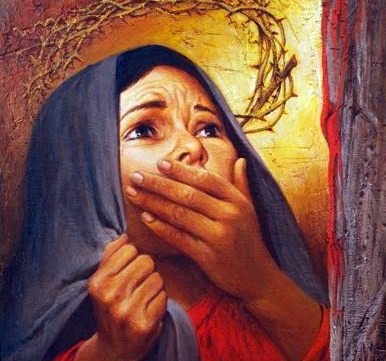
We might picture Mary there, at the scourging at the pillow, at the crowning of thrones, and remember how she followed her son as he carried his cross. How did she feel as she knelt beneath the cross, watching the unbearable crucifixion and death of her beautiful son?
Her mother’s love, her sacrificial love, was a perfect love.
THE SORROWFUL MYSTERIES OF THE ROSARY
1.The Agony in the Garden. Fruit of the Mystery: Sorrow for Sin, Uniformity with the will of God
2.The Scourging at the Pillar. Fruit of the Mystery: Mortification, Purity
3.The Crowning with Thorns. Fruit of the Mystery: Contempt of the world, Courage
4.The Carrying of the Cross. Fruit of the Mystery: Patience
5.The Crucifixion and Death of our Lord. Fruit of the Mystery: Salvation, Forgiveness
When The Ghosts of Faithful won First-Runner-up for Poets & Writers Magazine’s Maureen Egen Award, it was a novel in progress. Here’s what Victor La Valle, author, Professor at Columbia, and Judge of the contest had to say about it:
Faithful suggests a broad canvas–a well-rendered local; a promising war of equals in the characters, a clear desire to address/tackle the issues larger than the back and forth, and a clear understanding on the author’s part about pacing and clarity. Also, I thought the father’s chapter was really funny!
IN 2019, THE GHOSTS OF FAITHFUL was Runner-Up for the American Fiction Award, and also won the Independent Press Award for Religion Fiction. ‘Ghosts’ was the second novel of mine to win this prestigious award. The first, The Wind That Shakes the Corn: Memoirs of a Scots Irish Woman, won the same Independent Press Award in 2018.
My novels are labeled Religion Fiction, but they are really about everyday people, flawed people just like you and I. Flawed people who are presented within the context of being very valuable. Why? Because they are human beings created by God, and no matter what they are doing or have done, their actions are known by God who loves them. Do the characters change their ways? Some of them do, and some don’t. That’s life.
I WRITE FICTION AS I DO BECAUSE OF MY CATHOLIC FAITH.
WHAT’S DIFFERENT ABOUT THAT?
I.
First of all, the soul of Catholic Fiction is that God exists and works in the lives of sinful, fallen in people who have totally rejected Him–and that He does this out of love, regardless of how forcefully a character tries try to shut Him out. And we need to know that.
2.
Secondly, because Catholic Fiction points to our true identity as human beings, which is that we are not just happenstance entities placed on Earth. We are God’s children, created by Him and made in His image and likeness, and that we have a greater purpose here. And hopefully, Catholic Fiction does this through stories in which we can see ourselves, and with language and imagery that points to the divine in each one of us.
3.
And then, thirdly, Catholic Fiction attracts us to what we lack on Earth, something larger and more beautiful than what this material world can give. And honestly I think in their hearts most people know this. It may not be the underpinning of a lot of fiction as much as other subjects are, but the yearning is definitely in every person, though they may have crusted it over with ‘stuff’ that our culture says we ought to have. And this is an innate yearning that only the divine can satisfy. People are seeking the beauty of God, whether they classify it as such or not.
WHAT IS THE KEY CHARACTERISTIC OF CATHOLIC FICTION?
The Sacramental aspect of the Catholic Church. We are bound by the Sacraments of the church and believe that they are instruments of grace. Think of our definition of grace—an outward sign instituted by God to give grace. Then go to this Flannery O’Connor quote:
From the Sign to the thing Signified From the Visible to the Invisible From the Sacrament to the Mystery
The Catholic sacramental view of life is one that sustains, and supports at every turn, the vision that the storyteller must have if he is going to write fiction of any depth.
ABOUT THE GHOSTS OF FAITHFUL
Izzy Collier runs the Food Bank in a town called Faithful, on the banks of the Suwannee River. She is the least amicable of two daughters in a frustrating family; all, keeping secrets of betrayal. Her parents are at odds with both daughters, and with each other. Her sister, always Izzy’s competition, is an unstable former beauty queen, the wife of a philanderer, and the mother of four. Now, their ninety-four year-old grandmother sees her dead husband’s ghost, accompanied by a strange little girl. At the same time, Izzy’s husband, a defense lawyer, is being forced by his boss to effect the acquittal of a teenager accused of the rape and murder of a child. When Izzy starts to see her deceased grandfather and the little girl, too, she questions her sanity. What if the little girl ghost is the murdered child? But then, why would she be with Izzy’s grandfather? Are the ghosts after revenge, justice, or something greater?
Given the recent heartbreaking violence in America, produced by intense hatred and the lack of consequences attitude of the current administration, I offer a book I worked on intermittently for nearly twenty-five years, a book with a theme of vengeance that leads up to the First American Revolution after which Americans began to build a country above all others.
THE WIND THAT SHAKES THE CORN: Memoirs of a Scots Irish Woman
A Brief Background
Throughout the ages, human history has been dominated by the selfish desire to control and subjugate. Whatever the reason for the conflict–territorial, economic, political, or religious—nations, races, and individuals, have resorted to violence and warfare to resolve disputes, rather than compromise. Whether the reasons are just or unjust, the conflict drastically diminishes, and even snuffs out, the lives of both guilty and innocent human beings. We certainly see this today in high-crime cities where there are no consequences for even the most heinous acts.
Most nations and individuals espouse convictions that call for charity toward neighbor, but avarice and malice can overwhelm those convictions and lead to violence. When violence is perpetrated, it regularly breeds vengeance. Vengeance leads to more conflict and the whole circumstance becomes an endlessly spinning wheel. Numerous powerful nations have activated such a wheel. Is twenty-first century America on its way to doing so as well?
In the eighteenth century, England was one of its greatest executors, and the people of Ireland, its casualty.
England feared the old faith, Catholicism, which the nation as a whole had cherished for over a thousand years, and sought to annihilate it. The Crown enacted the Penal Code, the price an Irish Catholic had to pay for refusal to conform to the new religion of the Church of England. From 1558 until 1769, the English Protestant government imposed the Penal Code on a country that was 97 percent Catholic. Naturally, feelings of vengeance abounded in those Catholics. And later, when the Penal Code was extended to Presbyterians, vengeance and hatred for the Crown intensified.
The Wind That Shakes the Corn is a story of those long-held hatreds. It is also a love story, about one woman’s difficult journey toward letting go of past grievances–the only way to allow for genuine love.
The Wind That Shakes the Corn, a memoir of fact and fiction, is based on the life of Eleanor Dugan Parke, my eighth great-grandmother who for ninety-nine years lived through it all. Nell Dugan has a history that has given her a fanatic heart–capable of great love, but also great hatred. Her story has been passed down in my Scots Irish family. Of course, much of this novel is imagined, though England’s cruel control of Ireland’s people, the American Revolution, and some of the real players are factually told.
The Story
In 1723 Ireland, Nell, an unruly Catholic girl, falls in love with the grandson of a Protestant Scottish lord. On their wedding night she is snatched from his arms. As he lies bloodied on the ground, she is thrown on a British ship headed for a sugar plantation in the West Indies, where she is sold into slavery. But Nell is a person of learned strategies, never to be underestimated. Beautiful and cunning, she seduces the plantation owner’s infatuated son who sneaks her away to pre-revolutionary Philadelphia. There she agrees to marry him, eventually falling in love with him, but keeping her first marriage secret as she becomes a loyal wife and mother–and a tireless rebel against the English rule.
Tensions rise between the Patriots and Loyalists. Nell sees opportunities to pay back the English–blood for blood with no remorse–not only for her own kidnapping but also for her Irish mother’s hanging two decades earlier. When her first husband shows up in Philadelphia, very much alive and married, too, emotions between them run high, but Nell’s Scot remains stoic and the two families actually bond in their desire to leave the turmoil around them and take advantage of land offers in the Carolinas. Except the American Revolution follows in full flow to Carolinas. Nell experiences a tragic crescendo for her family after the Battle of Kings Mountain that only increases her desire for vengeance.
And then, a child is born. The dangerous circumstances of his birth cause a final migration into the wilderness of the Mississippi Territory to a cave of miracles, where Nell’s eyes are opened at last to what it will take to truly love.
The Wind That Shakes the Corn is not only Nell’s story, it is the saga of the feisty Scots Irish immigrants in a burgeoning America, and their heart-held faith and courage that led the struggle toward freedom. The novel spotlights both Catholic and Protestants immigrants to America who brought with them age-old grudges against the English Crown.
Love and hate, life and death, trust, betrayal, and the ‘always hovering’ choice to forgive, are prominent themes in this novel. In fact, they are themes that every person on earth struggles with, aren’t they?
And yet, in the end Nell confesses: “I am struck by the craving common in every man–white, red, or black–for more than he has, for more than his share; that prideful warring to complete himself, and only himself, despite consequences to another. I have come to this conclusion: genuine completion is not meant to be found on this earth, at all.” — Eleanor Dugan Parke, c.1799
The Wind That Shakes The Corn won the Religion Fiction category in the 2018 Independent Press Awards. It was also Runner-up for the Josiah Bancroft Award for Novel sponsored by Florida First Coast Writers, and a Finalist in the New Orleans Pirate’s Alley Society William Faulkner/William Wisdom Writing Competition.
Several years back, I held a Stories of Faith workshop in my parish. The purpose was to consider a particular time that God had been present in the participant’s life, and for him or her to write about it.
At the beginning of the workshop, each person was to write down a single word that might express his or her own faith experience. There were 18 participants, and there were 17 different words expressed. Only two people picked the same word!
I was amazed at how varied the responses were. But aren’t we all so different? God touches us very uniquely in our particular situations. How vast, how great, how infinite He must be!
Some of the words were: relief, patience, love, thankful, surrender, acceptance, frustration, tears, lost, joy, and many others that escape me at the moment. But there was one word expressed that really touched me because I have felt it personally. That word was Fear.
I happen to know that the lady at workshop who chose the word, Fear, had transported herself and her family to Dothan after surviving the terror of Hurricane Katrina that practically wiped out her small town. I cannot imagine what she lost. I can, however, imagine her fear. For most of my life, I’ve had to work to overcome this emotion–in small things, as well as in larger ones.
At the workshop, this lady didn’t read aloud what she’d written as some others did. So I can’t speak for her, only myself.
As I’ve said before on this blog: God loves us madly, even though we are sinners. If we don’t accept that God loves us, we will be fearful. If we don’t accept that His mercy has redeemed us, we will be fearful. If we don’t trust Him to always be with us, we will be fearful.
But when we accept that God loves us, that love of His often calls us to do what is uncomfortable. It calls us to actions that may well strike fear in us. It may be something as seemingly simple as reaching out to a person we don’t like very much. Or it may be as complicated as giving up something, or someone, we’ve become excessively attached to.
So is this the cat biting its tail? We look to God to keep us from fear and what does He do? He allows fearful people and situations in our lives? He gives us a task, a calling, that frightens us to death?
The difference is that He is beside us in this task, whatever it might be.
I am certain that God is in every person’s life whether the person acknowledges Him or not, believes in Him or not. From the moment of conception, God is in everyone’s life, almost like a divine flashlight we carry with us that brings darkness into light. Even if our life is a disaster. Even if it is destroyed by vices, drugs or anything else—God is the life of every person. Even in a life full of thorns and weeds, God can shine out a space in which a good seed can grow, prosper, and ultimately change us.
This is exactly why we don’t have to fear. We only have to accept that God is present and with us in everything. We are never alone.
This is, of course, key in Catholic fiction—it’s what we authors strive to infuse into our novels and short stories– God’s divine presence like a flashlight within us.
Again Jesus spoke to them, saying, “I am the light of the world. Whoever follows me will not walk in darkness, but will have the light of life. John 8 :12
“From the earliest days of Christianity, no Mass has been celebrated on Good Friday; instead, the Church celebrates a special liturgy in which the account of the Passion according to the Gospel of John is read, a series of intercessory prayers (prayers for special intentions) are offered, and the faithful venerate the Cross by coming forward and kissing it. The Good Friday liturgy concludes with the distribution of Holy Communion. Since there is no Mass, Hosts that were reserved from the Mass of the Lord’s Supper on Holy Thursday are distributed instead.
The service is particularly solemn; the organ is not played, and all vestments are red or (in the Traditional Latin Mass) black.
Since the date of Good Friday is dependent on the date of Easter, it changes from year to year.
Fasting and Abstinence:
Good Friday is a day of strict fasting and abstinence. Catholics over the age of 18 and under the age of 60 are required to fast, which means that they can eat only one complete meal and two smaller ones during the day, with no food in between. Catholics who are over the age of 14 are required to refrain from eating any meat, or any food made with meat, on Good Friday.” –Catholicism, About.com
When we think about what God allowed to happen to his son, we have to think about Mary, Jesus’s mother.
Her entire life was a journey of faith in her son from birth to death. A life of surrender and total unwavering commitment. But this did not mean her sorrows were slight. On the contrary, they were profound. As mothers, we know the agony we feel when our children are hurt or in danger. Mary was a mother. Her agony was real. And yet, in faith, she never turned from it. She was there.
On my kitchen counter is a stone bowl on a stem–a fruit and vegetable compote that once belonged to my mother, and her mother before her. In it, I keep bananas and tomatoes, same as my mother did.
Some of the tomatoes are still green when I put them in the bowl, but that’s okay because the bananas have a way of ripening them. My mother likened it to friendship and love. “One ripens first and then helps the other along.”
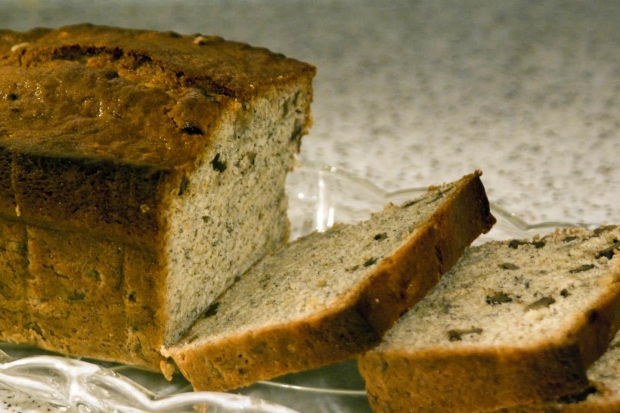
And like her, I cannot waste the uneaten bananas. I simply cannot bring myself to discard a banana only because it’s past its prime for peeling and eating. I have to make something else out of it. Banana nut bread, muffins, cake—something!
Naturally, my children always liked this family quirk, when an aging fruit they might have discarded is changed into something fresh, new–and edible.
A couple of days ago, I noticed three spotted bananas snuggled against my home-grown, reddening tomatoes. I took the bananas and mashed them. I added flour, sugar, milk, egg, baking powder and pecans.
When I took the loaf from the oven, I set it beside the stone compote where the bananas had once influenced the green tomatoes to turn red. It smelled so good. It looked so good. And in half an hour, it would probably be eaten and gone.
There is nothing that’s useless, or past its prime. There is no experience, no matter how painful that we cannot learn from. There is no seemingly spoiled situation that cannot be benefitted from or perhaps even changed. Everything holds the potential of something new and fresh within it. Something we can pass on to those we love.
When she died, my mother’s closets and drawers were filled with “stuff.” ‘Stuff” she saw value in. Value in an old, torn school picture. Value in a hand-drawn birthday card, or a baby shoe, or a high school scrap book. Value in a postcard, and a menu from the old Dixie Sherman Hotel in Panama City, FL where she and my father spent their wedding night before he left for the Pacific in WWII. All those seemingly unimportant things held memory and a story that went with it
But how does all that “stuff” get transformed into something new?
All those timeworn things are now in my closets and drawers, in my trunks and cabinets, even shoved under my beds. Those old keepsakes now pass memory to me. They create something new in me, not about a past reality, but a fresh way of seeing reality in the present and the future. And so, as a mother and grandmother, I pass it down — in stories, in a touch or a hug, in a word of confidence.
This is in the essence of every human being: that he is capable of passing down intelligence, imagination, and emotion to other human beings. A reminder though—the passing can be for better, or worse.
Often, we’re unaware of this, but we should give it attention because it’s how we can spur the better parts of our culture and beliefs to our children and their children, and not the worst ones. Hopefully, “the something new” we pass onto them is bound up in love.
Everyone wants to be Irish on Saint Patrick’s Day. But did you know Saint Patrick was a slave? Here’s the story from the Catholic Encyclopedia.
Patrick was born around 385 in Scotland, probably Kilpatrick. His parents were Calpurnius and Conchessa, who were Romans living in Britian in charge of the colonies.
As a boy of fourteen or so, he was captured during a raiding party and taken to Ireland as a slave to herd and tend sheep. Ireland at this time was a land of Druids and pagans. He learned the language and practices of the people who held him.
During his captivity, he turned to God in prayer. He wrote
“The love of God and his fear grew in me more and more, as did the faith, and my soul was rosed, so that, in a single day, I have said as many as a hundred prayers and in the night, nearly the same.” “I prayed in the woods and on the mountain, even before dawn. I felt no hurt from the snow or ice or rain.”
Patrick’s captivity lasted until he was twenty, when he escaped after having a dream from God in which he was told to leave Ireland by going to the coast. There he found some sailors who took him back to Britian, where he reunited with his family.
He had another dream in which the people of Ireland were calling out to him “We beg you, holy youth, to come and walk among us once more.”
He began his studies for the priesthood. He was ordained by St. Germanus, the Bishop of Auxerre, whom he had studied under for years.
Later, Patrick was ordained a bishop, and was sent to take the Gospel to Ireland. He arrived in Ireland March 25, 433, at Slane. One legend says that he met a chieftain of one of the tribes, who tried to kill Patrick. Patrick converted Dichu (the chieftain) after he was unable to move his arm until he became friendly to Patrick.
Patrick began preaching the Gospel throughout Ireland, converting many. He and his disciples preached and converted thousands and began building churches all over the country. Kings, their families, and entire kingdoms converted to Christianity when hearing Patrick’s message.
Patrick by now had many disciples, among them Beningnus, Auxilius, Iserninus, and Fiaac, (all later canonized as well).
Patrick preached and converted all of Ireland for 40 years. He worked many miracles and wrote of his love for God in Confessions. After years of living in poverty, traveling and enduring much suffering he died March 17, 461.
He died at Saul, where he had built the first church.
Why a shamrock on Saint Patrick’s day?
Patrick used the three leaves of the shamrock to explain the Trinity, and has been associated with him and the Irish since that time.
Patrick was a humble, pious, gentle man, whose love and total devotion to and trust in God can be a shining example to each of us. He feared nothing, not even death, so complete was his trust in God, and of the importance of his mission.
HAPPY SAINT PATRICK’S DAY!!!
“Danny Boy” is a ballad set to an ancient Irish melody. The words were written over a hundred years ago by English songwriter Frederic Weatherly and usually set to the Irish tune of the “Londonderry Air.” It was published in 1913, a year before millions of people were finding themselves having to say goodbye to people who they hoped against hope that they might one day see again due to World War I.
The theme of longing also struck a chord with many Irish emigrants who headed to America to escape the famine back home. Through the decades, the song became woven into the cultural fabric of the U.S. and beyond, often as a final farewell.
Elvis said he thought “Danny Boy” was written by angels and asked for it to be played at his funeral. At Princess Diana’s church service, the words were different, but the haunting melody of “The Londonderry Aire,” the same.
And after the tragic events of Sept. 11, 2001, the strains of “Danny Boy” rose from the memorial services of so many Irish-American police and firefighters who were among the victims.–CBS news, 2013
In good Catholic fiction, characters live in a broken world, like ours today, and they are fallible people, as we are. What’s key though is that real Truths shine through the fictional story–Truths about the beauty and mystery of God and His presence. God is now, and always will be, present to characters in Catholic Fiction, just as He is for us in real life even when we sin.
There are plenty of sinners in my novels, plenty of broken people. One of my favorites is Sarah Neal Bridgeman , a main character in A Hunger in the Heart. I’d like to talk about her today, and to point out that God never leaves this character alone, even in her sinfulness—just as he never leaves you and I alone.
Sarah Neal Bridgeman is an alcoholic, a vindictive mother and wife. This is a woman who’s lost a lot. And because she’s prideful and somewhat narcissistic, she can’t handle that loss. She’d like to, but she just can’t let go of her own self-importance and prejudices. Yet, she doesn’t let God go either.
Her greatest loss is in the deficiency of the perfect husband she used to have before he was wounded and left with PTSD from World War II. Sarah Neal wants her husband to be like he was. She prays for it. She surrounds herself with symbols of God. She wears a crucifix around her neck and hangs one in every room of her house. But Sarah Neal is a person, like many of us, who want to blame someone else for her sorrows.
Surprisingly, she doesn’t blame God. She never says, “Why did God do this to me!” Instead, she blames the soldier her husband saved in the war. She even blames her alcoholism on this soldier.
And her drinking affects everyone around her, especially her son, Coleman. Her sin changes her, just as sin changes us. God still loves her, but she can’t love him as she ought to because whiskey has become her primary love. Addictions do that. They take over our lives.
God’s grace is available to Sarah Neal, as it is for all of us. He waits for us to take it. The problem is, until we lose our pride and see ourselves as the sinner—-until we notice we’re the only one in the room responsible for our sins—-we can’t recognize that Grace so we don’t reach for it. And just like Sarah Neal, if we don’t recognize and reach for grace, how can we use it in our lives?
In real life, if we take a truthful look at ourselves, we will see our sins and how they affect others. That truthful look at ourselves can cause us to change our behaviors and return to the God who loves us. The God who waits for us with open arms may use the most common places to get our attention. He may speak to us through people we love or even those we’d never expect to care. He is, after all, a God of surprises.
Belief: a feeling of being sure that someone or something exists or that something is true.
Where do your personal beliefs come from? Can you really trust the source?
I grew up in a small town where neighbors knew neighbors, children were taught manners and held to them, and families went to church. There were role models in my town, people we trusted and loved, not people made up for some sort of performance. Real people.
Many of today’s role models are those who’ve made names for themselves in sports, movies, television, social media, and politics. They live lives that we envy–money, notoriety, control of others. Somehow the idea pervades our society that these sorts of people are better than most, better than we are because they are so important.
Well, this is sonot true. The importance of a person lies in his heart, not in a newspaper headline.
I think of a seemingly unimportant woman who spends her entire life unknown by any but a few close friends, a woman devoted to her children and husband, a woman who cares for others when they are sick or depressed or in trouble. I think of a person whose only claim to fame is that she loves. A woman who believes that loving is her mission, and has a will strong enough to commit to it. A woman who can overcome anything because she believes this world is not all there is.
I think of a seemingly unimportant man who works for his family, provides for his children, is honest in his job. A man who prays. A man who does not let go of his convictions for something less important. I think of a person whose only claim to fame is that he loves. A man who believes that loving is his mission, and has a will strong enough to commit to it. A man who can overcome anything because he believes this world is not all there is.
I think of a seemingly unimportant priest committed to his parish, or his order; a man whose vocation has been demeaned by some, yet he continues in the holiness of it. A priest for others no matter their often gross imperfections. I think of a priest whose only claim to fame is that he loves. A priest who believes that loving is his mission, and has a will strong enough to commit to it. A priest who can overcome anything because he believes this world is not all there is.
And here is something else I think. When we stand at Heaven’s Gate, we will have no notoriety except the love we’ve shown others. Because God does not read headlines. God reads hearts.









 Translating a World on the Edge