Archive for the ‘World On The Edge’ Category

jesus-and-the-devilMost people believe in angels, and that God created them, but many don’t believe in  the devil. Yet the devil was created by God before God created Man.

Frankly,  especially today, I don’t see how it’s  possible not to believe in  the devil, who is evil itself.  We don’t have to go to the Middle East to find Satan in action—because he’s certainly here, too—-but what is happening there surely points a finger at personified evil  Consider the beheadings of Americans, the crucifixion of Christian children and the burning out of their eyes, the raping of women,  burying people alive,  destroying their homes, stealing, torturing, defaming, and on and on!

The devil hates goodness, and goodness is all about God.

So, what is the nature of  Satan’s game?

The devil attacks us in our complacencies, where we are, through what we love. And sometimes the devil has a very attractive face–one that’s hard to resist.  He lures us by our addictions, the things we think most about, the things we’ve tied ourselves to. He yanks on the chain of those addictions, leading us further and further away from what is good, to what is evil–until we become his devoted ‘pet.’ Then he’s got us just where he wants us.

No, we don’t want to hear this.  We say, “Look, I am who I am, and who I am is okay.”

Well, that depends. Because we weren’t given life on earth in order to fulfill ourselves. Believe it or not, each of us has a greater mission than our own existence. There is a reason for our having been born.    God knows our mission even if we haven’t yet discovered it. And it has nothing to do with evil, and everything to do with good.

To determine what is good for us requires an informed conscience—an objective conscience, based on what we know to be true. We have to be able to stand outside of ourselves and look into the mirror of what we are becoming. And then, we have to courage enough to admit it.

The Devil is a liar,  who will use any means to get to us–flattery is one of them. That misguided axiom we hold to–“I’m okay, you’re okay no matter what I do, or what you do” is one of his tools. We see it growing day by day in our present society.

The word Satan comes from the Hebrew verb satan meaning to oppose, to harass someone. The word devil is derived from the Greek diabolos meaning an accuser, a slanderer. The Bible says  that in the beginning, God created Satan as a good angel, as a beautiful cherub called Lucifer. Lucifer had a superabundance of spiritual gifts, he was also endowed, as we are, with the gift of free will. God left him free to choose good over evil, and, as we know, he chose evil, rebelling against God and taking one third of the angels (now referred to as demons) with him into rebellion.

And war broke out in heaven: Michael and his angels fought with the dragon; and the dragon and his angels fought,  but they did not prevail, nor was a place found for them in heaven any longer.  So the great dragon was cast out, that serpent of old, called the Devil and Satan, who deceives the whole world; he was cast to the earth, and his angels were cast out with him. —Revelation 12:7-9

These angels irrevocably chose through their free will to rebel against God and not to serve Him.  When we do the same in our lives, Satan would be the tempter, the one to bring out the fallen nature in ourselves, the one to assist us in tripping and falling, the one to turn us from God.

How can we say he’s not real?  And how can we honestly say that we haven’t personally learned a thing or two from him?


One Part of The Whole?

Posted: September 4, 2014 in World On The Edge

OLYMPUS DIGITAL CAMERAMy husband and I once stopped at an overlook on The Blue Ridge Parkway. It was Fall, so the mountains beyond us were blazing with color; every shade of red, orange, and yellow. To the side of the overlook, we noticed a little-worn path that led into the woods below. We took it.

Step by step we went down into an odd, emerald-colored shade, almost as if we had descended into a different season. There, we found a stream running between fat tree trunks and meandering down and around small rises in the earth. For a time, we sat in silence on a large rock beside the stream, listening to the trickling sounds and the quiet rustle of a breeze.

At the time, one of my grandsons was a lover of rocks; the more unique they were, the more he liked them. So I began to look for some.

All around were smaller rocks that had obviously come from a ragged indent in one side of the large rock on which we were sitting. Perhaps time had made the indentation, or maybe another boulder had fallen upon it. But one thing was certain, the smaller rocks surrounding it had the fiery color of the large rock’s interior, and if any one of them were tested, it would have the same interior composition of elements, too.

Individually though, the parts of the big rock were very different in appearance. Some had ended up in the stream and were round and smooth. Others were angular and roughly formed through weathering and erosion. Yet each was born from the same large rock.

I think our human lives are like those rocks. We all come from the same origin. Many of us may have personally broken away from that entity, or we may have been severed from it by happenstance. Nevertheless, despite our differing appearances through facial features, skin color, or personality traits, we possess the characteristics of our origin. We come from a ‘whole,’ and we all are related to it. This is the fact that makes us brothers and sisters.

Of course, the ‘whole’ I’m speaking of is God, our Creator. The amazing thing is that although we are no longer physically attached to God, as the smaller rocks are no longer physically attached to their origin, we still carry His likeness within us.

Many today, refuse to accept that we carry God within us, or that God exists at all. But if you’ve ever truly loved anyone, how do you come to that refusal? Love is not a physical attachment, not really. Love is something that can’t be touched or seen except through a person’s actions. Our love in action, the way we relate to our brothers and sisters, is the unifying characteristic that likens us to God, and it is the characteristic that distinguishes a human being from the rest of creation.

Reconsider the rocks; the whole and its parts. It is the law of physical nature that the broken pieces of rock will never again be ‘one’ with the boulder they came from. Their natural destiny is to remain divided from it. But human beings have a supernatural destiny. All religions believe that someday we will individually re-unite with God. We will return to the whole.

In the words of Mother Theresa of Calcutta, “I am not sure exactly what heaven will be like, but I know that when we die and it comes time for God to judge us, he will not ask, ‘How many good things have you done in your life?’ rather he will ask, ‘How much love did you put into what you did?'”

In other words, God will ask: How much of Me did you show to the world?

God is Not a Sugar Daddy

Posted: September 3, 2014 in World On The Edge

Candy-Sugar-Daddy-Wrapper-Small

Sometimes as Christians we get a little smug, especially when we’ve been blessed with some good fortune.

We may think we are favored more than others by God.

We may even think that those who suffer from something caused by their own choices are not as good  or as righteous as we,  because WE have followed the will of God, and THEY haven’t.

That kind of thinking is prideful, and judgmental.  It puts others below us—and those others, no matter what they have done, or didn’t do, are equally loved by God.

Sometimes, we have the idea that God is some kind of  Sugar Daddy.  that God is saying “You do this for me, and I’ll do that for you.” In other w0rds, if we’re good, He’ll give us what we ask for, and if not He’ll pay us back with suffering.

If we think this way, we’re deceiving ourselves.

God does not always give us what we ask for, but what we need.  And what we need may be hard to take. We may even have to suffer because of it.

We have in our heads that God is a good God. Of course, He is. But He is also a wise God who sees us as we truly are–after all He created us and He knows us intimately.

What we think is good for us is often the opposite of what we need. Remember our goal is eternal life. Only God knows what it will take for each of us personally to achieve it.

So how do we come to grips with the fact that God has allowed suffering in our lives–not because we are less than good,  but because we are meant to be more than we are?

The only way is through Trust. A total surrender to God, knowing He loves us as a parent, as our Creator, and not as our personal Sugar Daddy.


Have Integrity?

Posted: September 2, 2014 in World On The Edge

living-our-values-dailyGood values create virtues, which are the content of our character, and the essence of our  human spirit.  I’ve listed the virtues before–according to the ancient Greeks like Plato who came up with four:  Courage, Temperance, Prudence, and Justice.  To these, Christianity added Faith, Hope and Love. And so we have seven cardinal virtues .

Truly great men and women are virtuous men and women.   Don’t we want our children to be the same?

Except in today’s society academic achievement and performance are often put ahead of character building . We often appear more engrossed in  grades, sports, and other extracurricular activities,  rather than imbuing positive values in our children, which will build their character, enabling them to make the right choices in their future lives.

So how do we instill values and virtues in our children?

An obvious answer–because children mostly follow their parents– is to be examples of virtue ourselves. Children don’t learn the values that make up good character simply by being told about them. They learn instead through observing and then emulating what other people are doing and acting out around them.  Parental modeling is the best way.

According to most experts, a child’s character must begin at a very young  age. In preschool age,  children can be shaped and guided to learn about what is right and what is wrong, and to learn to live a value-filled life. They can easily absorb and emulate what they see and hear from the adults in their surroundings.

Every day offers countless opportunities for children to emulate what their parents say and do in upholding the values they are teaching their children.How parents do and accomplish daily routines can show children every value in this life. They can set examples of courteous acts to children like respecting people with different cultures, religions and races, valuing honesty and showing compassion and care when others are grieving.

A note of caution, however, needs a mention here. Consistency in upholding values as demonstrated in what parents say and do every day is important and shouldn’t be overlooked. Parents may teach the importance of valuing honesty, yet never keep their word when they promised children something, like having a picnic on a weekend. They may tell children the value of fairness, yet treat other family members unequally.

If parents do this, their children are likely to emulate and eventually develop these attitudes as well. Reinforcing positive values can also be done through something that captures a child’s interest. Fiction and nonfiction books, folk tales, poems, plays and television shows are some resources that may draw a child’s attention.

These resources can exert a considerable influence in building kids’ character both negatively and positively. However, with parental guidance and a careful selection of children’s literature and TV programs, parents can direct their children to be critical in discerning what is good and what is bad for them.” — Evaries Rosita, Contributor, Jakarta Post


Just Look What He Did to Me!

Posted: September 1, 2014 in World On The Edge

grudges2Some of the happiest people, I think, are those who accept  life as it is. They look at the good things around them with appreciation.  They let go of the less than ‘good’ things with the idea that they learned something from them.   They do not walk backward toward past hurts.  Of course,  this is hard to do. We have a thing called–the grudge.  And sometimes couples carry it around all day long.

Many of us are disposed to holding grudges about what he or she did to me.  We can’t let it go. We have to have some recompense–to balance things, we say. We let the ghost of yesterday take over today. And some of us allow that vindictive ghost to run our lives.

This will not bring harmony to family life.

Pope Francis questioned pilgrims about the harmony of their home lives at the Sunday Mass held on October 27, 2013,  during the “Day for the Family” in Rome. “I would like to ask a question today. Everyone – how will you carry joy home in your heart? How’s the joy in your home? How’s the joy in your family?”

What is our answer to his question?  Harmony denotes peace. Holding a grudge is hardly peaceful. Real joy comes when we accept that not every one has our best interests at heart, but that some do. And shouldn’t we focus on the ones who do, rather than the ones who didn’t?

What he or she did to me is in the past. No one can change the past. We have only the Present. And  we can  most assuredly make our Present, and possibly our Future,  worse when we concentrate on a grudge. We may even destroy what is good in the here and now by our vindictiveness.

So let’s turn our backs on those ghosts. Let’s get out of the rut of the grudge.  Let’s look around to those family and friends who bring us real joy, and concentrate on them for awhile. Then, I think we’ll be able to see ourselves in the Present and not the past.  And that might very well bring us to forgiveness and a brand new harmony with those who’ve hurt us.

Preparing to Fail?

Posted: August 29, 2014 in World On The Edge

images28CR8SER

Would you build a new house without a blueprint? Would you take a trip without knowing where you’re going?  The blueprint and the knowledge are important preparations to success.

“By failing to prepare, you are preparing to fail.” –Benjamin Franklin

These words from a great American leader reinforce the need to prepare.

But wait. Have  today’s American leaders neglected to realize that  our enemies are preparing, too—against us?

Remember the Emperor Nero who ‘fiddled’ while Rome burned?   In other words, he was so full of himself, he  did not prepare for the hard times to come.

Perfect example: The Ant and the Grasshopper

It was summer, hot and sunny, and, instead of working and preparing for winter, a Grasshopper preferred to dance, sing and play his violin at his leisure, not minding that these wonderful days will soon be over, that cold and rainy days will soon be near.

On seeing a hardworking Ant passing by him, preparing for the hard winter that was to come one day, he invited him to join him and share his fun.
“Unfortunately, I don’t have time for this”, the Ant answered, “I must work hard, so that winter won’t find me without shelter and food.”
“Stop worrying so much, there is still plenty of time to prepare for winter. Let’s sing and dance together, let’s laugh and enjoy life”.
But Ant was very wise and wouldn’t pay attention to the Grasshopper’s words and continued to work hard and store food for the long winter that was to come.
The winter came sooner than expected, and the Grasshopper found himself without home and without food. He went to the Ant’s house and begged him for food and shelter.
“I’m sorry, but I can’t help you”, the Ant said. “I only have room and food for me and my family, so go find help somewhere else.”

Moral:  Prepare for the hard days to come.

Once again: “By failing to prepare, you are preparing to fail.”

We must prepare. Because—right under our noses– there are those who, for years, have been preparing for terrible evil against us. Sadly, we either ignored it, or some of us were too busy playing King. And now, like the grasshopper’s, our survival may be in great danger

Hard to Figure the Reasons?

Posted: August 28, 2014 in World On The Edge

tough-loveWhen raising your children, have you ever practiced what is called Tough Love?

This might come about if they want something badly, but you know it isn’t good for them and so refuse their request. Of course, a child may pitch a fit, cry, stomp, scream that you are being unreasonable. He or she might even say you don’t love them–because if you did, you’d give them what they want.

But there are situations when we know what a child does not know. We are experienced enough to see that a certain thing or situation will harm them. And it’s precisely because we Do love them that we refuse–even when we know that our refusal will cause them pain.

As Christians who pray, we adults do not always receive what we pray for. How do we handle it? Do we pitch a fit, cry, stomp, scream that God is being unreasonable. Do we lose faith that He loves us? Sometimes we do.

Maybe we’ve lost someone dear to us, or are fired from a job. or maybe a huge tragedy out of our control comes upon us as a people–hurricanes, earthquakes, floods, and war? It would seem, then, that  God is forcing us to our knees.

Can we believe that all this comes from a God who loves us as a parent?

The answer is difficult.  Just as a child questions her parent’s reasoning, we question God’s reasoning. OR at the very least, we wonder about God’s intent.  A wonderful priest I know wouldn’t venture an answer as to why awful things happen to people. “If you want to know why human beings suffer, don’t ask me–ask God,” he said.

So the question goes unanswered because for a human being to know the reasoning of God  can be compared to a grasshopper attempting to know the reasoning of a human being. It cannot be done. Yet what we often see happening  is that  uncontrollable tragedies, like those mentioned above,  have an ability to pull people together. People stand together, and pray together,  in the face of great disasters.

So, in situations of suffering when it seems God has brought us to our knees, what should we do?  I think we  trust that God loves us as a parent, and that because of that great love, He will give us what we need to get through, to get up, and even  to become better people.

confidence-farzana-featured

There are times when we’re young that we are also confident. Someone will ask, “What do you want to be when you grow up?” And we can give a quick answer. But as we grow, things are not so clear as when we were children. Life gets complicated because we have more and more responsibility–for our own lives, and the lives of those in our care.

We may feel lost. We may not be sure where we’re going anymore. We may not  even have a direction in mind. We look around and think we see everyone else in a situation we’d like to be in, too; but we’re just not there–and don’t know if we’ll ever be.

We can feel pretty depressed in times like these. We can feel very alone and unimportant.

Then something happens.

No, we don’t win the lottery.

The something that happens may not seem profitable at the time. It may not be fun.  In fact, we may want to avoid suffering through it.

But we do suffer through it. And afterwards, it’s possible that we find some good in it. We may find our true self in it, too.

When this something happens, we are changed by it. We may be so changed that we begin to live for someone else. And in the process we find our own self–the person we were meant to be.

txt-pray6mary-uscca

The mother of Jesus is our partner in prayer. We do not pray to her, we ask her to pray to Jesus for us. The latest, publicized example of this is James Foley, beheaded last week by a fellow human who made evil his personal choice.

James Foley beseeched Mary’s prayers in his hour of greatest need.

Here are the stirring words of Elizabeth Argue, Catholic Vote.com

“He knelt in the sand with a shaved head, in the garb of a prisoner. The image is heartbreaking and maddening, a cruel act of hatred……

James Foley lived and died as an American Catholic man and he ought to be esteemed as such. He did not call out, but clenched his jaw and courageously faced death. Although we cannot know what he thought in that moment, he wrote that he recited the rosary in captivity, slowly tracing prayers over each knuckle of his hands.

He wrote that it brought him an interior freedom, which his captors could never take away.

James Foley’s life and death are a testament to his character and to all who raised him: to his country, his religion, his family, his teachers, his friends.

Life as an American Catholic is one of relative ease, but it places upon our shoulders a burden of responsibility. While we work and play, we must remember to pray, to read and write, to discuss real issues, to care for one another, to lift up all humanity through our lives. We have opportunities to speak freely and to proclaim the truth – not just that of faith, but also of the beauty and suffering of humanity.

Each day, we must face with courage the little battles – cultural, political, social, moral, personal – in order to be strong if ever a great challenge arises. Each day, we must stand with those who suffer persecution. Each day, we must raise our eyes above our very small trials to see the hope that freedom and faith bring. We are privileged to be both Catholic and American.

Let James Foley be an example to us all of one who lived, suffered, and died with the courage derived from a life of dedication to the truth. Although we will never know what he thought as he knelt in the sand, we take comfort knowing he had often prayed these words:

Holy Mary, Mother of God, pray for us sinners, now and at the hour of our death.

Surely these prayers, uttered as his only hope in the darkness of a prison, were answered. The Blessed Mother was with him at the hour of his death and nothing, not even the taunts of his murderers, can take away that freedom.

May James Foley rest in peace, may he be freed from death.”—Elizabeth Argue

Ready For The Boys of Fall?

Posted: August 25, 2014 in World On The Edge

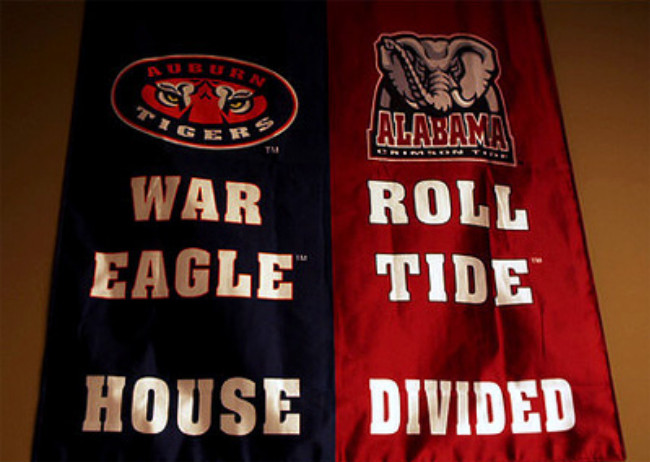
Auburn-AlabamaRoll Tide! and War Eagle!

Are you ready for Football?

Are you ready for the uniforms, the helmets,  the cleats, the shoulder pads, and the PRIDE?

Are you ready for the tackles, the blocks, and the scores?

Are you ready to watch COURAGE get back up when its down? Are you ready for TEAMWORK?

This week it begins!

Many have said the game of life is a lot like football.

Paul “Bear” Bryant:
 In life, you’ll have your back up against the wall many times. You might as well get used to it.

James Ralph “Shug” Jordan:
Wisdom is knowing what to do next, skill is knowing how to do it, and virtue is doing it.

Vince Lombardi:
Football is like life – it requires perseverance, self-denial, hard work, sacrifice, dedication and respect for authority.”

Football really is like life. In the game, you and I are its  receivers, and God is the passer. And what He passes to us is goodness, the light that shines in the darkness. We may refuse to catch what has been passed to us. Or we may be so bogged down we may not even recognize it.

But those who  do catch it and recognize it are meant to pass it on. We are literally asked by God to be the hands of Jesus Christ on Earth in our lifetimes.

That’s a huge request.

But  let’s do it. Let’s stand in the huddle and listen to the call. Then let’s go virile with it.

Let’s run with the ball. Don’t fumble it. Don’t drop it. And when the right time comes to pass it, let’s make that play great enough for a touchdown.