When you prepare for an action, how do you gear yourself up? We could learn a lot about preparing from Bumble Bees.
At rest a bumblebee’s body temperature will fall to that of its surroundings. If it wants to fly the temperature of its flight muscles must be raised high enough to enable it. What does the bumblebee do? It shivers. Sort of like we do when we are cold. This shivering can easily be seen in a grounded bee when her abdomen pumps to ventilate the flight muscles. And then she’s up!
If we want to succeed in something, we need to prepare ourselves. If we are involved in sports, we train hard. If we want a good job, we educate ourselves. If we want to go on a great vacation, we plan it. If we want to be successful parents, we learn patience. And if we want to play a musical instrument, we have to practice. (Can’t wait for you to see the video below!)
But above all the training, education, planning, patience, and practice, there is an even greater preparation, and that is the sincere trust that God will lead us in our endeavors, all of our endeavors no matter how big, or small. We can achieve this through prayer.
We don’t have to be on our knees to pray. We can pray anytime, anywhere, and in any circumstance. Our prayer does not have to be rote, or long, or complicated. A sincere “Jesus help me,” or “Lord lead me,” or any heartfelt words that link us to God, is enough. So when you want to do something beyond yourself, and are shivering like the Bumblebee, PRAY.
I simply couldn’t do anything without prayer–I mean that literally. I know many of you feel that way. But for those who haven’t tried it, I have one word. DO. And keep doing it. Why? Because prayer is a conversation that opens, and then continues, our relationship with a God who loves us and wants us to love him back.
For me prayer is a surge of the heart, it is a simple look towards Heaven, it is a cry of recognition and of love, embracing both trial and joy. – Saint Therese of Lisieux
The Latin word sacramentum means “a sign of the sacred.” In the Catholic Church, the seven sacraments are ceremonies that point to what is sacred, significant and important for Christians. They are special occasions for experiencing God’s saving presence. That’s what theologians mean when they say that sacraments are at the same time signs and instruments of God’s grace.
There are seven sacraments in the Church: Baptism, Confirmation, Eucharist, Penance, Anointing of the Sick, Matrimony, and Holy Orders. The purpose of each one is to make people holy, to build up the body of Christ, and finally, to give worship to God; but being signs, they also have a teaching function. They not only presuppose faith, but by words and object, they also nourish, strengthen, and express it. That is why they are called sacraments of faith.–Catholic.org
This blog is about one of the sacraments, the Sacrament of Marriage, and how it can lead us toward holiness.
Marriage is meant to be a lifelong union with the purpose of creating holiness in a man and a woman. In marriage each spouse gives up some rights over his or her life in exchange for rights over the life of the other spouse.
As Fr. John Hardon explains in his Pocket Catholic Dictionary, there are four elements common to natural marriage throughout history:
1. It is a union of opposite sexes. 2. It is a lifelong union, ending only with the death of one spouse. 3. It excludes a union with any other person so long as the marriage exists. 4. Its lifelong nature and exclusiveness are guaranteed by contract.
So, even at a natural level, divorce, adultery, and “homosexual marriage” are not compatible with marriage, and a lack of commitment means that no marriage has taken place.
It is important to remember, however, that the opposite occurrence of any of these points does not keep God from loving that person as if he/she were the only person in the world–He does. Neither does it keep God from continuing His offer of grace to all.
As a sacrament, Marriage is truly a vocation. But there will be ups and downs. Sometimes those ups and downs will be terribly exhausting, and seemingly unsolvable. But then, out of commitment, comes divine grace.
Marriage is a vehicle for God’s grace, his sanctifying grace which helps each spouse to help the other advance in holiness, as well as helping them together to cooperate in God’s plan of redemption by raising up children in the Faith.
In this way, sacramental marriage is more than a union of a man and a woman; it is, in fact, a type and symbol of the divine union between Christ, the Bridegroom, and His Church, the Bride. As married Christians, open to the creation of new life and committed to our mutual salvation, we participate not only in God’s creative act but in the redemptive act of Christ.–Aboutreligion.com
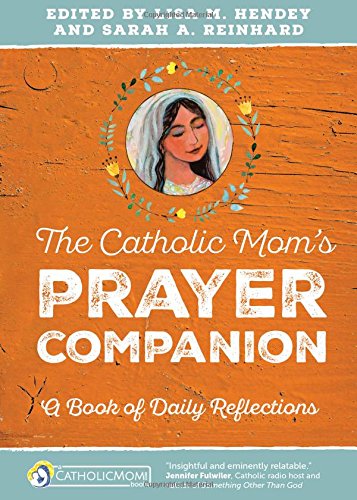
Until a few months ago, when I began polishing up a novel I’m working on, I was a weekly contributor at www.catholicmom.com You can still find my articles in the archives, but before I took off, many of the columnists and I contributed to this prayer book.
If you are busy with life, but also, someone who daily links to God, i.e. YOU PRAY, then you will benefit from this prayer companion. One brief prayer pondering for each day of the year, beginning with a brief quotation from scripture, saints, recent popes, or important spiritual writers; and then, a personal reflection written by contributors.
Contributors include Catholic writers, Mary Amore, Sherry Antonetti, Danielle Bean, Donna-Marie Cooper O’Boyle, SP Corbitt, Erin Cupp, Sarah Damm, Patrice Fagnant MacArthur, Jen Fitz, Allison Gingras, Pat Gohn, Lisa Hendey, Kaye Hinckley, Ellen Gable Hrkach, Judy Klein, Colleen Connell Mitchell, Lisa Mladinich, Rhonda Ortiz, Cassandra Clifton Poppe, Margaret Rose Realy Oblate, Karee Santos, Barb Grady Szyszkiewicz, Charisse Tierney, Leticia Velasquez, Kelly Wahlquist, and Nancy Ward.
Here’s one of my reflections: (Only because I already had the copy. 🙂
April 15—The Super Glue of Renewal
Monthly theme: Renewal
Core focus: Forgiveness works both ways
Forgiveness says you are given another chance to make a new beginning.
–Desmond Tutu
Renew: To make new or as if new again. To restore. I know a woman who could renew or restore anything. She was my grandmother. In her pocket was a tube of Super Glue, just in case she found anything broken in her house; a china cup with a broken handle, the bead off a piece of jewelry, or the crack in the frame of a picture. But she was a fixer of people, too, as well as things. She was a healer of hearts. How did she do it? Well, this time, it wasn’t with Super Glue. It was with forgiveness.
Each of us, as human beings, has something to forgive–because people hurt us, even those who profess to love us. We must let go of our hurts whether it be an act of infidelity against us, prejudice, the loss of a job, or the ‘just plain meanness’ of another toward us. But again, as human beings, we also have something to be forgiven for. So we must first look at ourselves, at the ways we have hurt others, too. Until this is done, our renewal is not really possible. Forgiveness works both ways.
Jesus, help me to see that I must forgive others before I can expect to receive forgiveness myself.
Question to Ponder: Will I commit to forgive someone who’s hurt me in order to bring about my own new beginning, and renewal?
At times we feel like a fragile leaf taken up by the wind, with no control over where we’re going. And we worry, we obsess. We may shake, or sweat, crying out, “What will happen to me?”
Maybe we’re suffering from some disease. Maybe we’re despondent over the loss of a loved one. Or we may have deliberately hurt someone else, and while we regret it, what we’ve done eats away at us.
We may have committed an offense we don’t think we can be forgiven for. Or we may be afraid of the punishment we’ll receive from that offense. All these happenings can alter us until we barely respond to others in kind ways, because there’s too much darkness around us to recgonize any sort of joy.
But life itself is good. Life can be affirming even in our sorrow, pain, or distress.
The idea that Life is good doesn’t come to us from something outside of us. It comes from inside us, if we allow it to. It comes from creating in our hearts an attitude of Trust–no matter who has hurt us, or who we’ve lost, no matter how terrible we think we’ve been, and no matter how weak our bodies have become.
Trust means a lack of worry about tomorrow. Trust means loving the moment we are living in. Trust means that even if the moment we love doesn’t last, our Trust, our Faith, our Hope will last.
Can we do this alone? Can we stoke the fire inside us and carry it forward without someone else? Don’t we need a hand to hold, the hand of someone who truly loves us?
Oh, you are alone? And nobody loves you?
Don’t fall for that.
We are never alone–not alone on the top of a mountain of happiness and good fortune, and not alone at the bottom of a sea of sorrow and despair.
The One who created us never leaves us.
Trust that the hand of God is always extended to you.
ONE day a countryman going to the nest of his Goose found there an egg all yellow and glittering. When he took it up it was as heavy as lead and he was going to throw it away, because he thought a trick had been played upon him. But he took it home on second thoughts, and soon found to his delight that it was an egg of pure gold. Every morning the same thing occurred, and he soon became rich by selling his eggs. As he grew rich he grew greedy; and thinking to get at once all the gold the Goose could give, he killed it and opened it only to find,—nothing.
“To kill the Goose That Laid the Golden Eggs” is often used to express the idea of an unprofitable action motivated by greed.
So why do we want more and more of everything when we don’t really need it?
I have many pairs of shoes. But my friend has a new pair that I like better than any of mine. I don’t need any more shoes, still, I hurry to the store to get a pair like hers.
I don’t need everything, especially not the ‘everything’ everybody else has. I just need enough to live a good life.
Some tyrants have enough land, but they want more. Some politicians have enough power, but they want more. Some of us have a spouse who loves us, but we look elsewhere for someone we perceive as better. Some of us have children who for some reason in our own minds, don’t measure up to our expectations, so we berate them constantly. Some of us steal what others have worked for. Some of us lie to make ourselves look better. Some of us want to live in a world that asks nothing from us, so we stick needles in our arms, or swallow pills, or smoke marijuana or cocaine. And some of us will do anything at all for money.
What good comes from all that? I’ll answer the question: Nothing good comes from it.
We’re looking for satisfaction in the wrong places. We’re letting ourselves be drawn into a world of greed. For years, we’ve been enticed by television, movies, and the internet, to want more. By now, we’re nearly programmed to believe we actually need more.
We overlook the lovely, little spoonfuls of life because we no longer see them as enough. In fact, we’ve already come close to destroying things we see as small. Even face to face interaction with a loved one or a friend is seen as too small when we can ‘hit’ many more through Facebook, iPhones, etc. As a result, our society is becoming very saturated with ‘stuff,’ but very impersonal when it comes to people.
Like the countryman in the story above, we’re killing the golden goose of a joyous life—our life, which is a gift, after all. Soon we’ll have nothing left but our greed. And that will be the death of us.
One of my sons once told me that he did not want to be a spectator in life, he wanted to be a participator.
What does being a participator mean? To take part, to be or become actively involved. So, the way I heard it was that he did not want to ‘sit-out’ his life on the sideline. He wanted to dance!
Thank goodness and Hallelujah!! Because that is what I’ve wanted for all my children, and grandchildren, and I haven’t been disappointed.
Today, it’s hard for children to participate as they once did; the world has become so dangerous. But here’s a trip down memory lane.
My family lived nearly ten years in Scottsboro, Alabama, a small, mountainous, and beautiful town off the Tennessee River. I wonder if neighborhoods like the one I experienced in Scottsboro are able to exist anymore; it’s so important, now, to keep your children close at hand. But then, our children were free to go most anywhere; roaming the woods, riding miles on bicycles, paddling around Roseberry Creek which led to the river near the neighborhood dock. There, we had cook-outs, and lots of boating, skiing and swimming (while watching out for cotton mouth moccasins, of course.) The children never sat down. They took part, actively involved with others; family and neighbors. My cousin and her family lived steps away from us, and so did the finest neighbors anywhere.
We were blessed to be there at the time we were, with those people, in that place of beauty. It wasn’t necessarily what we did, but who we were doing it with that made us happiest.
My oldest son–always doing, never sitting–was about nine years old, when he came to me one night after we’d gotten home from a gathering at the dock. “Mama, this was a good day,” he said. “In fact, it was the best day of my life.”
What would make him say that? He was a child, for one thing. He lived in the present moment. He did not look back and grieve over something that happened yesterday, and he wasn’t troubled about the future. What affected him most was a day he actively did all the things he loved to do. In other words, he danced.
As adults, do we appreciate a good day? What about when a bad day happens? Can we learn from it? Because it’s often the worst day of our life that starts us on a path of hope, and active striving that ultimately achieves our best day. When we realize that tomorrow can produce a better day, we are experiencing a divine virtue we receive through the grace of God, called hope.
And hope insists on participation, not sitting on the sideline and whining.
Hope is what keeps us going. Hope is the possibility of change. If we participate with God in the virtue of hope He has given us, then even the worst days have power enough to become the best days of our life.
At one time or another in each of their lives, I had my five children listen to the song that follows. I told them and I say to them now, If you have a choice to sit it out or dance–I hope you DANCE.
Life is never without its problems. Things happen.
The beauty of the human spirit is that we are able to live through them. We are able to carry on.
How do we do this?
How do parents who’ve lost a child carry on? Or the person who’s lost a job, a livelihood his family depends upon? How do we get through injustice, lying stealing, cheating, killing?
Our world is full of these things–yet most of us carry on.
We carry on because we have Hope. Despite all of the above, and more, we believe there is goodness in the world, too. Goodness in our lives.
Oddly, the things that happen to us, often bring out our goodness, more than they bring out our hatred, or vengeance, or lack of forgiveness.
This is what Hope accomplishes–a conquering of self-pity. It stirs courage within us to go on with our lives and make the best we can out of them.
And where does it come from? We are born with it. We are created in its image. We will be guided from within, if only we let ourselves be.
So whenever the holes in our lives appear, remember the Hope we have inside to fill them. Stir that hope, and keep stirring it, through prayer, through positive people, through continuing to love others. Stir it until courage comes, to begin again.
Moses Receives the Tablets of the Law (painting by João Zeferino da Costa, 1868)
God created each one of us as a person meant to be responsible for his or her own eternal fate. He gave us that responsibility when He gave us the commandments, along with our free will with which we alone choose whether or not to carry out those commandments. No one else can assume this innate responsibility for us, no one else can carry out God’s commands for us. The buck stops at our door.
We show this responsibility in how we carry out our daily tasks, through the virtues we personally exhibit and the vices that we personally fight. But many of us have a somebody do it for me attitude. Or maybe our attitude is a political one: I don’t like the commandment so I don’t have to follow it.
If we have those attitudes, we ought to take heed. God also promises consequences for our disobedience. We will be held accountable for our personal actions on Earth.
But when he (John the Baptist) saw many of the Pharisees and Sadducees coming to where he was baptizing, he said to them: “You brood of vipers! Who warned you to flee from the coming wrath? Produce fruit in keeping with repentance. And do not think you can say to yourselves, ‘We have Abraham as our father.’ I tell you that out of these stones God can raise up children for Abraham. The ax is already at the root of the trees, and every tree that does not produce good fruit will be cut down and thrown into the fire.
I baptize you with water for repentance. But after me comes one who is more powerful than I, whose sandals I am not worthy to carry. He will baptize you with the Holy Spirit and fire. His winnowing fork is in his hand, and he will clear his threshing floor, gathering his wheat into the barn and burning up the chaff with unquenchable fire.–Matthew 3: 7-12
Chaff is the dry, scaly protective casings of the seeds of cereal grain, or similar fine, dry, scaly plant material such as scaly parts of flowers, or finely chopped straw. It is a waste material ploughed into the soil or burnt. Chaff is indigestible by humans, just as sin is indigestible by our perfect God.
The truth is we should not waste our lives here on what is abhorrent to God.
Well, you say God is merciful, and He most definitely is! But we should remember that God is also just. It’s been said before: The Ten Commandments are not ten suggestions. They are the roadmap given to us by our Creator so that we can live a joyful and happy life here on Earth, and ultimately an unbelievably beautiful, eternal life with Him.
Our personal demons never really leave us. They hover very close to the things we desire, waiting to turn us in harmful directions. So often, and in various ways–through people, or events– we are warned to beware of them, but just as often, we set the warnings aside. And we can do that, why? Because each of us has Free Will. And this is central to the books I write.
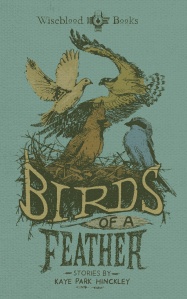
My short story collection, Birds of a Feather, published by Wiseblood Books, is now on Kindle. (click on the book cover to go there) I’d love for you to read it if you haven’t already. Each story is about a character with personal dragons who utilizes his or her free will in keeping or dismissing them.
Lucy Adams, Lake Oconee Living Magazine journalist and reviewer, says the collection is propelled by curiosity about human nature. And she is correct. I am.
Here’s Lucy Adam’s entire review:
“No one lives without despair and hope, grief and joy, tears and laughter, selfishness and gratitude, jealousy and empathy, self-loathing and self-love, destructiveness and creativity. Though we focus on differences, attempt to elevate our worth above others, justify our righteousness by comparing deeds, we essentially are all the same. As Kaye Park Hinckley’s collection of short stories is titled, we are Birds of a Feather.
The theme of all the stories is sin and salvation,” says Hinckley, “the sinfulness of everyone and the opportunity for everyone to take advantage of God’s mercy.” Raised in the Catholic Church in the deep South, Hinckley crafts each story in Birds of a Feather out of her Southern heritage and her Catholic faith. “What I want people to take away from this book,” says Hinckley, “is that we are all created in the divine image of God.” Intertwining religion with regional culture, the collection is classic Southern literature in the same vein as short stories by the likes of Flannery O’Connor, whose work strongly influences that of Hinckley.
Hinckley writes characters who are shocking, flamboyant, disturbed, unkind. She writes characters who are merciful, gracious, empathic, loving. She writes characters who demonstrate the dualities of human nature. Edmund, in “Shooting at Heaven’s Gate,” allows himself to be used by evil. Rather than condemn his actions, Hinckley pushes her reader to acknowledge the frailties of the human heart. “We all are capable of doing great evil,” explains Hinckley. “Why does a person do this? I like to know reasons.” Curiosity about human nature propels her plots.
Don’t seek clearly defined protagonists and antagonists here, however. Hinckley’s characters are complicated. They’ve done horrible things, witnessed horrible things, been the victims of horrible things, yet they continue rising each morning and putting one foot in front of the other. They fulfill their obligations to each other while these horrible things gnaw at them from the inside out. Hinckley deftly presents the repulsiveness of her character’s actions, while also revealing her characters’ drive toward love.
In the story “Dragon,” Liz harbors guilt and secrets about a vengeful act that she believes revealed her true nature, which she pours out to a roadside café waitress as if making a confession. Her confessor comforts her, saying, “Listen Shugah, we all got to pass by the dragon . . . Don’t give him nothing else to eat.” The power of sinfulness is juxtaposed against the power of God’s mercy. The capability to do great evil lies next to the ability to advance great good.
In the midst of turmoil and wrestling with truth, Hinckley injects humor so familiar, it causes the reader to recognize himself. “Red Bird” poignantly traces the ocean of dementia into which the main character, Jude, drifts without fighting the tide. His wife, conflicted in her anger over his past wrongs and her duty to care for him in his illness, addresses him with irritation, asking, “Don’t you know who I am, Jude?” He doesn’t, so he grins and replies, “Don’t you know who you are?”
Birds of a Feather contains ten short stories that hearken to Hinckley’s Alabama childhood, Georgia roots (on her mother’s side), and Catholic faith. She masterfully manipulates the English language and the vernacular to generate fully developed plots and well-rounded characters. Drawing on the influences of Flannery O’Connor, William Faulkner, and others, she infuses her writing with a bounty of symbolism. Most of all, she is fair, always fair to her characters and her reader. She allows them to make their own choices and to draw their own conclusions. Because, at the very core of the human condition, of us all, of Birds of a Feather, is free will.–From Lake Oconee Living Magazine
A Weed: an undesirable plant growing wild, especially one growing on cultivated ground to the disadvantage of a crop, lawn, or flower bed.
Gospel Mt 13:24-30
Jesus proposed a parable to the crowds.
“The Kingdom of heaven may be likened to a man
who sowed good seed in his field.
While everyone was asleep his enemy came
and sowed weeds all through the wheat, and then went off.
When the crop grew and bore fruit, the weeds appeared as well.
The slaves of the householder came to him and said,
‘Master, did you not sow good seed in your field?
Where have the weeds come from?’
He answered, ‘An enemy has done this.’
His slaves said to him, ‘Do you want us to go and pull them up?’
He replied, ‘No, if you pull up the weeds
you might uproot the wheat along with them.
Let them grow together until harvest;
then at harvest time I will say to the harvesters,
“First collect the weeds and tie them in bundles for burning;
but gather the wheat into my barn.”
– – –






 One of my sons once told me that he did not want to be a spectator in life, he wanted to be a participator.




 Translating a World on the Edge