


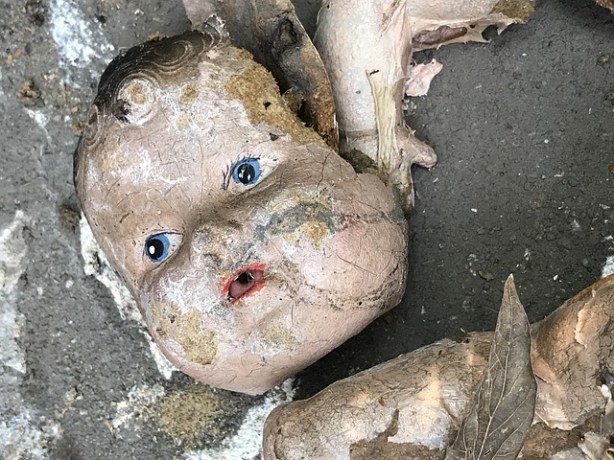
Water covers an enormous portion of our planet, and is needed for all life, human and otherwise. Without the presence of water, there would be no life at all. Water is our lifeline. But there are times when it presents trouble for us: hurricanes, floods, accidental drownings. A lot can be lost in these situations, and that loss affects us very personally, even to our core.
Families are also a mainstay of our planet, the core of human life, the domestic church. But the family is in troubled waters today. The family has been hit by the hurricane of misguided thinking, flooded with misinformation. And there are too many drownings because of it.
There are forces who hate what is right. There are forces who want to destroy the God-created family: Mother, Father, Children. There are forces who would dishonor the virtuous love meant to bind them all together, and replace it with a less than virtuous copy: a falsity of marriage, family, and even gender. And some of those forces rise high up in our government, and in our churches, as well.
How is this being accomplished?
By making something much less than good SEEM like good. Social media is filled with propaganda like this:
That men and women are no different—that a person can even choose which to be.
That a baby in the family does not need to be welcomed, and can even be destroyed.
That boys and men are solely responsible for all that is wrong with girls and women.
That people can no longer judge what is right and what is wrong—even using the standards of God’s own laws. A bastardized meaning of LOVE will be used instead.
The family, the mainstay of our planet, is being snapped like trees in a hurricane. Family members are swallowing, and then, drowning in the contaminated flood water, without admitting there is a storm. Or if we do admit it, we lack the courage to speak out.
We don’t speak out with courage because we want to be broad-minded; we don’t want to be labeled–you know: Love vs. Hate, and all that. We have swallowed the propaganda as truth. Well, it is NOT truth. And we must cross the bridge of courage and say so, or drown as the people of God.
Broadmindedness, when it means indifference to right and wrong, eventually ends in a hatred of what is right.–Bishop Fulton J. Sheen.
We must put ourselves in the presence of God and pray for courage. Then we must put ourselves out there, and lay ourselves down in defense of Truth.
So do not fear, for I am with you; do not be dismayed, for I am your God. I will strengthen you and help you; I will uphold you with my righteous right hand.–Isaiah 41:10
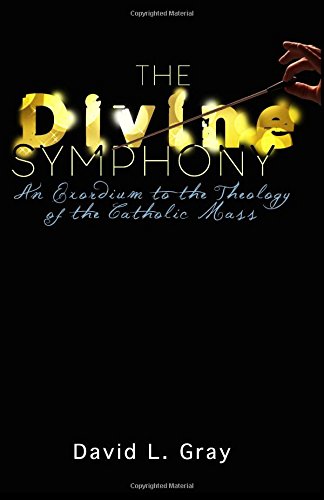
The Catholic Mass: The Composition of Christianity. A masterpiece, the embodiment of what we believe. The Mass makes God present to His people by telling His story, and is the daily echo of our Catholic faith.
As a cradle Catholic, I have a lifetime of love for the Mass. Yet, never before have I perceived it as a symphony; The Divine Symphony, as does David L. Gray in this remarkable book.
I read the book slowly, taking in the very familiar parts of the Ite Missa Est, but seeing them in a new light–not as the Mass I’ve become used to, standing kneeling, responding, without much thought as to why we do all that–but as the particular movements of a symphonic journey revealing the Incarnation, and Christianity itself. David Gray reclaims our theology in this book, and reframes what we believe and why we believe it. He takes us through the essential life-giving act of God given to us in the Old Testament, and found in the memorial Passover sacrifice instituted before the exodus, then subsequently played out in the Crucifixion in the New Testament, and now, offered daily in Masses all over the world.
For those lifetime Catholics like me, this is a book for you. For those who are not Catholic and have wondered just what the Catholic Mass is–this book will reveal it. With examples from the Latin Rite, the Novus Ordo, Melkite, Orthodox—all—because, as David Gray says, “As God is one, so is there only one Mass that is expressed through various liturgical traditions that are rooted in a Divinely inspired cross-pollination with each other, especially for the first seven centuries of the Church.”
Backed up by biblical history, both Old and New Testament, along with the earliest church writers, David Gray has set his very keen eye on our beautiful Mass and laid before us an impeccable encapsulation of our faith.
I wrote this book to contribute to that idea of recapturing our theology and framing it around the central truth of our faith. My hope is that this book inspires you, with the prose of theological song and theory, to know, love, and reverently pray the Mass. For when you know the Mass, you truly know that Jesus the Christ loves you and that He is there for you. Be entirely dependent on Him for everything!
—David L. Gray, MA degree in Theology, Ohio Dominican University. President and publisher of Saint Dominic’s Media, Inc.
In one sentence, The Divine Symphony is one of the most valuable books about the Catholic faith that I have read. Thank you, David, for offering it to me.

When I was young and expressing my own creative ideas to my father, he smiled, gave me a hug, and told me that I might be a “nutcase.” I took this as a compliment because he meant it as one. My father and I were very much alike–both dreamers, both able to turn a bad situation into something better with our dreams. We were very often not realists, and while that might pose a problem in some situations, because of it, we were rarely depressed. And if we did get down, were able to put things back together with HOPE.
I knew, and still know others, who are what one of my sons calls, “Debbie Downers.” These people, wonderful though they may be, cannot sluff things off, cannot dream, cannot be nutcases; they are too practical, and afraid to try new things. Instead of ideas, excuses for ‘why they can’t’ come into play: I won’t measure up. I don’t have enough talent. I am too old.
Well, you are never too old to set another goal or to dream a new dream, according to C.S. Lewis.
According to Shakespeare, We are such stuff as dreams are made on.
And in Alice in Wonderland, the Mad Hatter asks: Have I gone mad? Alice responds: I’m afraid so. You’re entirely bonkers. But I’ll tell you a secret. All the best people are.
If you’re looking around for someone to lift your spirits, you may find a nutcase in the spontaneous.
You may find a dreamer in the cheerful.
You may even find the lunatic you need to light up your ‘Debbie Downer’ life.
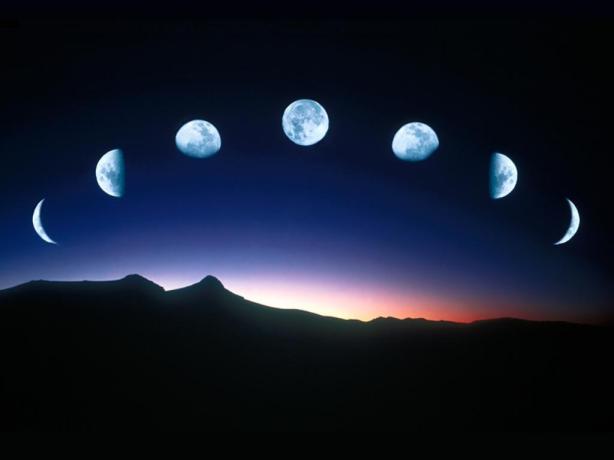
A new moon is born every 27 days. During that period the moon progresses through certain stages or phases. Each phase has its on set of unique viewing characteristics, so that we on Earth see each phase as being different from another. We have phases in our lives too–most obvious is from youth to old age. But there are other phases we go through, and may even be going through now. From revenge to reconciliation. From hopelessness to hope. From loneliness to friendship. From greediness to generosity. And from loathing to loving.
“Moon Dance: A Love Story,” is the eighth story in my collection, Birds of a Feather. It has won several awards and is reprinted in two anthologies.

The piece is both a present day and an historical story about lasting love and the necessity of forgiveness.
Here are the first paragraphs:
Every night, when she makes her rounds, she finds us watching the Georgia moon. We lay together in a single bed to catch the first inkling of its light and nightly mark its swell from miniscule to magnificent. We tell her of its essence, that it is something much bigger and brighter than itself. She gives us a condescending, “Uh huh, Shugah;” then leans over to tuck the white sheet around our thighs, and brush a dark hand across our foreheads. She smells of honey.
In the darkness, we point out to her the way the moon takes center stage to a sparkle of dancing stars, how it soon becomes distorted, fades and passes, leaving only a promise of return. We tell her that return is certain—our covenant between nothing and everything, between life and death. But she only wrinkles her sweet, black face and smiles, a tall silhouette against the silver light from the window.
“Night, night, Miz Anna,” she says.
I expect her to give us a kiss goodnight, but instead she gives us a pill for pain. On her way out, she does not close the window. She does not shut our door. We do not allow her to do that, because we will not be fastened here forever.
The artificial light from the hall draws a triangular shape on the linoleum, pierces the soft splash of moonlight that spreads downward from the foot of our bed. The illumination of the hall is soon extinguished by a human hand, but we lie in a radiance the human hand does not control. In the night, we speak of the covenant, the promise in death. I see its purpose. Death is passage. Death is close.
One hundred and six years old, both of us, we’ve held many who passed before us, held them in our arms as they took a last breath—parents, children, grandchildren, others we loved. I tell Will, my beloved husband, that God’s desires are greater than our own. He accepts the truth in that. Then we speak of our daughter, our first child.

Many of you have read my short story collection, Birds of a Feather, was published by Wiseblood Books. For those who have not read it, the stories are about those personal demons which never really leave us. They hover very close to the things we desire, waiting to turn us in harmful directions. So often, and in various ways–through people, or events– we are warned to beware of them, but just as often, we set the warnings aside. And we can do that, why? Because each of us has God-given Free Will. And this is central to the books I write.
BUT also central to my books is HOPE in the chance for restoration. Hope is set into us by God, as are Faith and Love. Every human being is created to exemplify these virtues and literally has the ability to do so. The fact that we often choose not to exemplify them doesn’t mean we can’t. The personal demons we allow in our lives are indeed conquerable.
Like some of the characters in these stories, we are all mistaken sometimes; sometimes we do wrong things, things that have bad consequences. But it doesn’t mean we are evil, or that we can’t be trusted ever again. Our demons often feed on our frequent leanings toward hopelessness which does not take into consideration the grace of God. But if we want to change, if we truly HOPE to change, then change is surely possible.
….. In the past few years Kaye Park Hinckley has emerged as a major talent in what Paul Elie calls “the literature of belief.” Hinckley translates grace in a world on edge, sees a double beginning and ending in everything, literally everything, including the unspeakably awful. Like her novel A Hunger in the Heart, the stories in Birds of a Feather—several of which have won substantive awards—take us to the heart of the matter.– Publisher, Wiseblood Books.
Praise for Birds of a Feather:
The first story in this collection sits a reader bolt upright. Two stories in, you marvel at this storyteller, who sends us flying over new country, a landscape of modern parables where faith runs river-deep. Kaye Park Hinckley seems to overflow with beautiful, heartbreaking love and lessons. A world with broken wings can surely make use of such stories.
—Charles McNair, author of Pickett’s Charge and Land O’Goshen
“With masterful control and skillful writing, Kaye Park Hinckley boldly explores a wide range of wounded souls in this amazing collection of stories, ultimately finding love in the unloveable, and grace in the sufferings of a complex world.”
—Cassandra King, author of The Sunday Wife
Print Reviews:
“The short stories in Birds of a Feather are richly imagined tales full of finely drawn characters who demonstrate how people estranged from faith can bumble through life so distracted by worldly horrors and delights, so full of themselves, that they don’t even notice faint nudges of grace that stir in their souls or recognize subtle emanations of the holy that abound in the world around them.” –The Catholic World Report
Voted one of the Six Best Fiction Books from the First Half of 2014.
“Kaye Park Hinckley’s stories give a fuller picture of the Christian faith. Like a bird-watcher, the thoughtful reader can even learn to spot the flutter of redemption in these stories.” –Englewood Book Reviewer Magazine
“Hinckley’s characters are complicated. They’ve done horrible things, witnessed horrible things, been the victims of horrible things, yet they continue rising each morning and putting one foot in front of the other. They fulfill their obligations to each other while these horrible things gnaw at them from the inside out. Hinckley deftly presents the repulsiveness of her character’s actions, while also revealing her characters’ drive toward love. ..fully developed plots and well-rounded characters.” –Lake Oconee Living Magazine, Lucy Adams
“The birds in Kaye Park Hinckley’s short story collection, Birds of a Feather, all find themselves from flocks of Catholics. Their family members, or at least a shining few, believe in forgiveness, hope and redemption. But it’s the sinners with whom we most sympathize. How can we not? Hinckley’s expert literary craft is matched by the drama of Judeo-Christian values confronting American relativism and egoism. “– ANGELUS, The Tidings Online, Jennifer Ann Jones
Thank you, Sue Vincent!
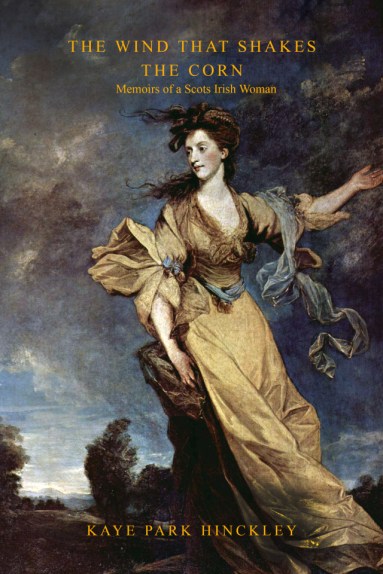
THE WIND THAT SHAKES THE CORN:
MEMOIRS OF A SCOTS IRISH WOMAN
Kaye Park Hinckley
Love and hate, life and death, trust, betrayal, and the ‘always hovering’ choice to forgive, are prominent themes in this novel–themes that every person on earth struggles with.
As is evident in today’s world and in its history, nations and individuals espouse convictions that call for charity toward neighbor, but avarice and malice can overwhelm those convictions and lead to violence. When violence is perpetrated, it regularly breeds vengeance. Vengeance leads to more conflict and the whole circumstance becomes an endlessly spinning wheel. Numerous powerful nations have activated such a wheel. In the eighteenth century, England was one of its greatest executors, and the people of Ireland, its casualty.
England feared the old faith, Catholicism, which the nation as a whole had cherished for over…
View original post 1,411 more words


 Translating a World on the Edge